
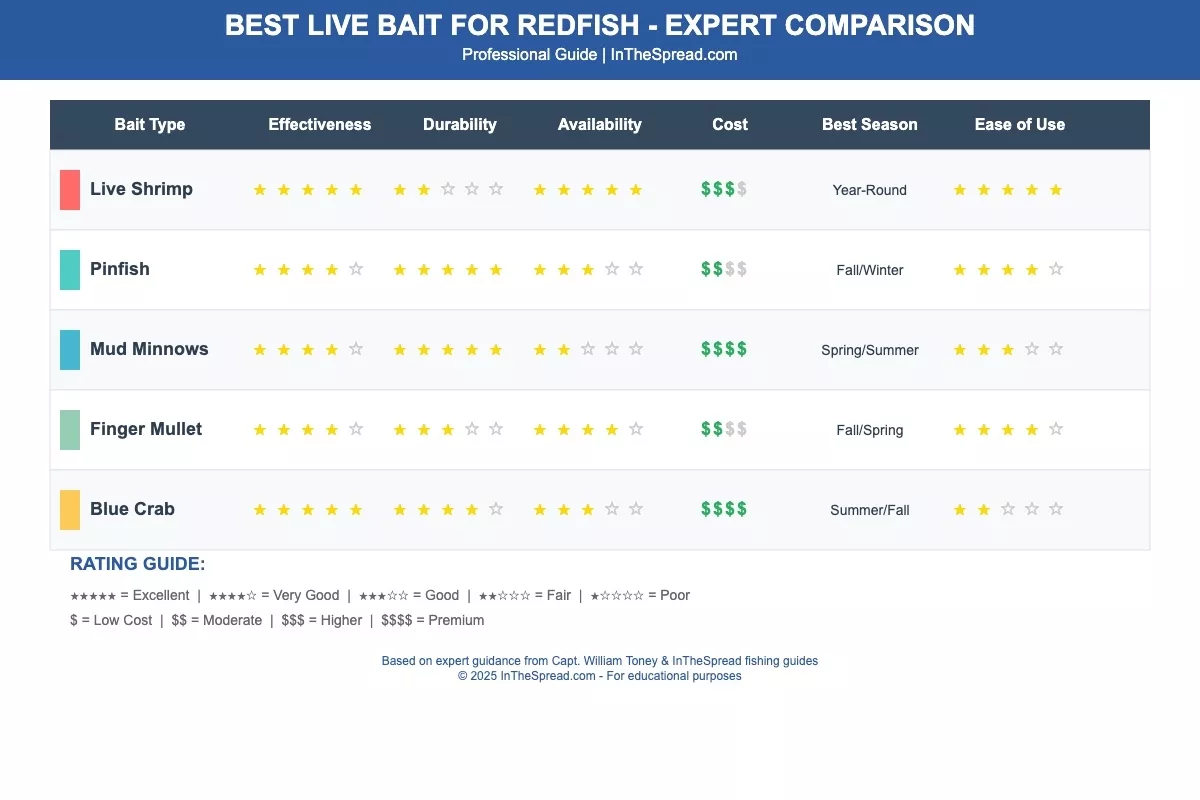
There is no single best bait for redfish. There is the right bait for the water temperature, the salinity, the size of fish you are hunting, and whatever is already swimming around the boat. Five baits, when each one works, and when it will cost you the day.
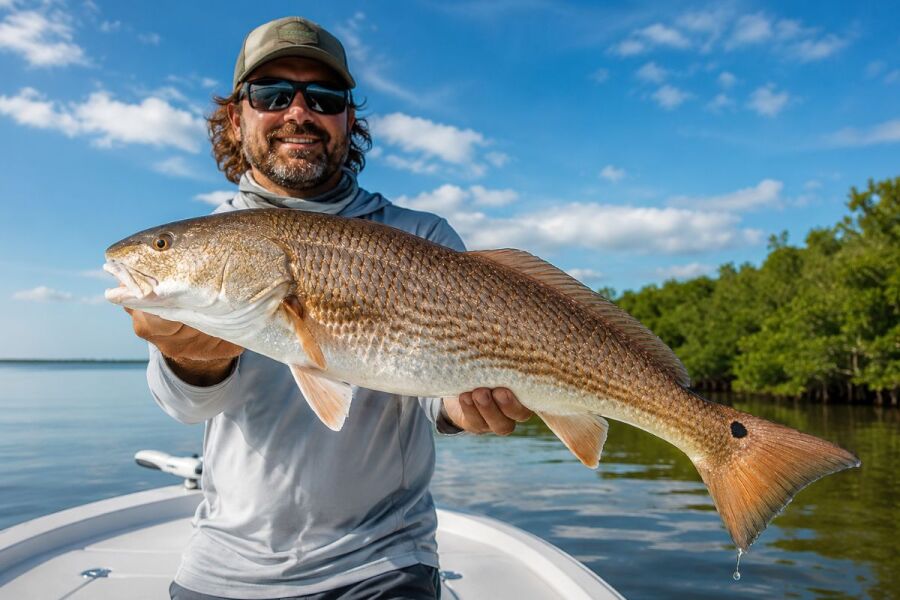
Choosing the Best Live Bait for Redfish
Ask ten anglers what the best live bait for redfish is and you will get ten answers, most of them correct and most of them useless. The honest answer is that it depends on the month, the water temperature, the salinity, the stage of the tide, the size of the fish you are after, and what is naturally living in the water you are standing in. A jumbo shrimp that produces in February will get destroyed by pinfish in July before a redfish ever finds it.
I have filmed Captain William Toney fishing bait out of Homosassa across every season, and the thing that separates his approach from most people's is that he is not loyal to a bait. He is loyal to a read. He looks at the water, the time of year, and what is swimming around the boat, and then he picks. Some days that is a pinfish. Some days it is a chunk of cut ladyfish sitting on the bottom next to an oyster bar.
This covers the five baits that consistently produce for redfish, when each one is the right call, when it is the wrong one, and how to rig it. If you want the broader tactical picture of finding fish before you feed them, start with catching redfish on flats, shorelines, and structure.
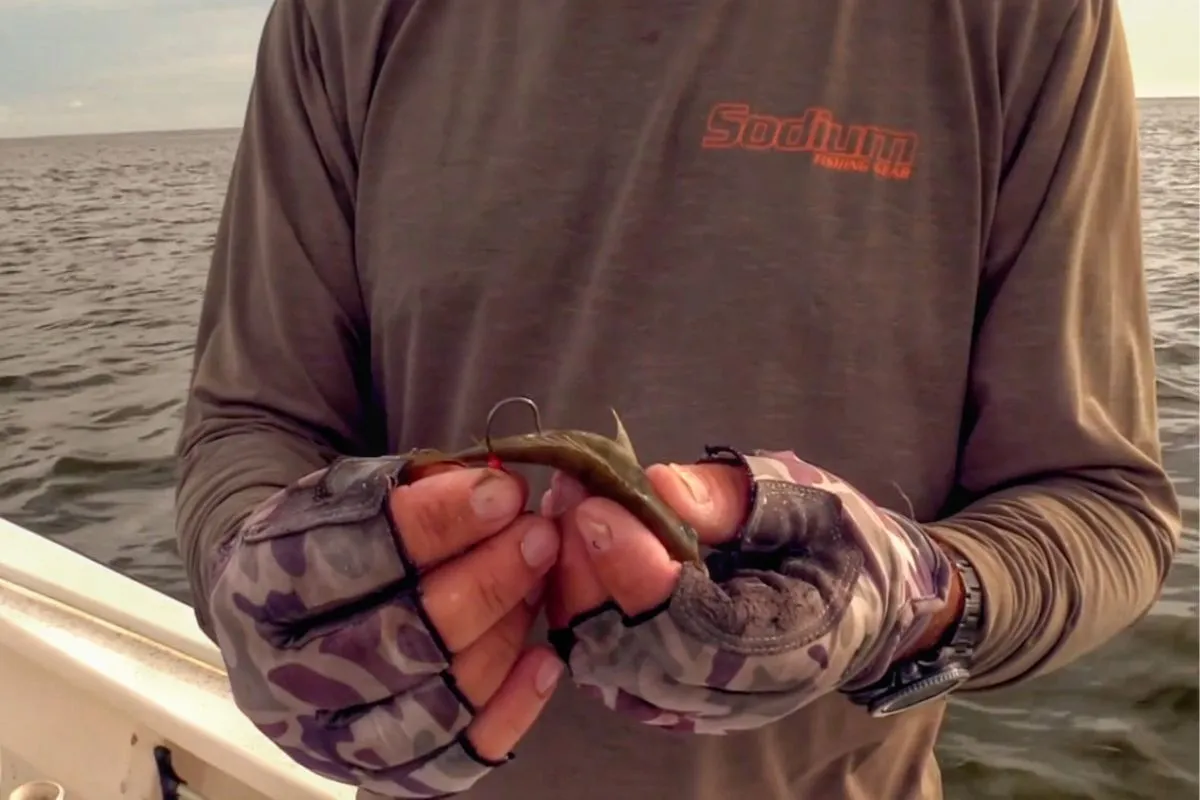
What Redfish Eat and How They Find It
Everything about bait selection follows from two facts about the animal.
The first is diet. Redfish are opportunistic, and redfish diet leans heavily on crustaceans in most estuary systems, though the mix shifts with size, season, and location. Blue crab, mud crabs, and shrimp make up the bulk of it in most places, with baitfish like mullet, menhaden, and pinfish moving up and down seasonally with availability. That is why crustaceans are a reliable baseline across most redfish water, and why finfish baits shine when that forage is locally concentrated rather than year round.
The second is how the fish hunts. A redfish has a mouth that sits low on the head and points down, built for taking food off the bottom. It finds that food using its lateral line to detect vibration and water displacement, its eyes when water clarity allows, and chemoreception to follow scent. Worth being clear about one thing, because it gets repeated constantly and it is wrong: redfish have no chin barbels. Black drum do. That is one of the fastest ways to tell the two apart. A redfish is reading pressure and chemistry off the bottom without any whiskers involved.
The practical consequence is that a bait sitting on or near the bottom is a bait presented the way the fish is built to eat, and a bait putting out scent is a bait the fish can find in water you cannot see six inches into. The full breakdown of feeding behavior and life stage is in understanding redfish biology, diet, and life cycle.
One more thing worth saying before we get into specific baits. Bait you catch yourself, in the water you are about to fish, outperforms bait you bought. It is fresher, it is more active, and it is exactly what those fish have been eating. On pressured water that difference is not marginal. Fish that see a dozen shop-bought shrimp a week will eat a pinfish that came out of the same grass they are sitting in.
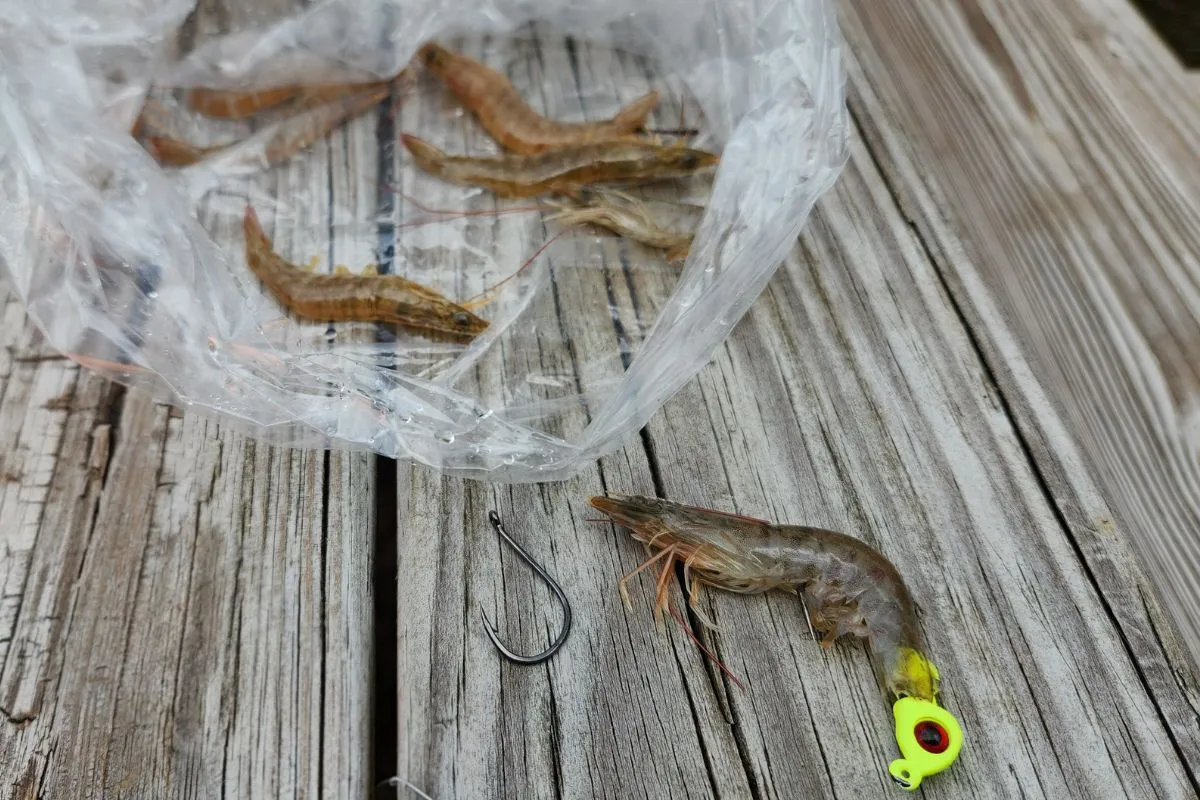
Live Shrimp and When It Is the Wrong Choice
Live shrimp is the most universally available and most universally effective redfish bait, which is exactly why it gets overused.
It works because shrimp are a dietary staple, they put out scent, and they stay active on a hook longer than most baits when handled properly. Select for translucent, hard-shelled shrimp that kick when you pick them up. Three to four inches is the working range. Small shrimp feed everything in the bay except the fish you want. Oversized shrimp get picked at rather than eaten.
Hook it through the horn, forward of the dark spot behind the eyes, which holds the organs. Go through the horn and the shrimp swims naturally and lives a long time. Go through the dark spot and you have a dead bait in ten minutes. Nose hooking is the other common option and it works better in stronger current, where you want the bait tracking straight rather than spinning.
Here is when shrimp is the wrong choice. In summer, when water is warm and the flats are thick with pinfish, a live shrimp is a pinfish magnet. You will re-bait every four casts and never get a shrimp in front of a redfish. Toney switches off shrimp in the hot months for exactly this reason. The same problem shows up anywhere pinfish, small mangrove snapper, or juvenile grunts are dense.
Shrimp is at its best in cooler water, when the bait stealers slow down and redfish want something small and easy that does not require a chase. It is the winter bait for the same reason it fails in July.
Pinfish for Bigger Redfish
Pinfish is Toney's primary bait out of Homosassa, and it is the most underrated live bait in inshore fishing.
The reasoning is straightforward. Pinfish live in exactly the same grass flats, rocky bottoms, and structure where mature redfish hunt. In most Florida and Gulf grass systems they are familiar forage that redfish encounter constantly, which makes them a bait that draws very little suspicion. They are also tough. A pinfish stays alive and swimming under a cork far longer than a shrimp, which means fewer bait changes and more time with something in the water.
Size selection actually matters here, more than most anglers account for:
- Two to three inches for slot fish in shallow water, where a big bait looks out of place
- Three to four inches as the all-around size for most situations
- Four to five inches when you are specifically hunting oversized fish and are willing to wait
Fish them free lined near structure on light wire, or under a popping cork over grass where you want the bait held above the bottom and want the noise to pull fish in. Free lining is best when fish are shallow and settled. A cork or a light bottom rig is the answer when you need to control depth in current or over grass that will swallow the bait. The cork does two jobs: it keeps the pinfish from burying, and the pop imitates feeding activity.
Catching your own is straightforward and worth the hour. A small hook baited with shrimp scraps, a pinfish trap set near structure, or a sabiki will fill a well fast. The method and the gear are covered in catching pinfish for bait.
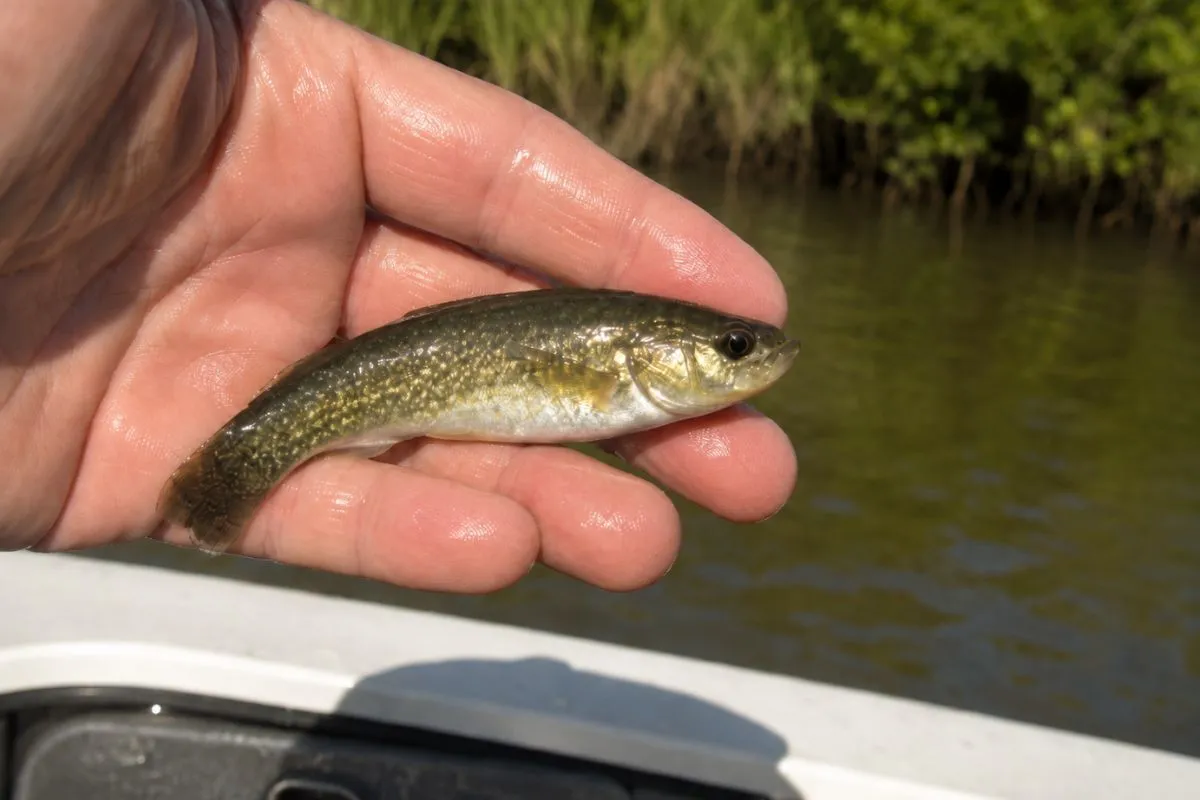
Mud Minnows for Durability
Mud minnows, or killifish, are the bait to reach for when conditions are hard on everything else.
They tolerate temperature swings, low oxygen, and rough handling better than any other common inshore bait. In a livewell that is running warm, or on a long day when you cannot re-supply, mud minnows will still be kicking when shrimp have gone belly up. That resilience is the entire argument for them.
They also live where redfish live. Tidal creeks, marsh edges, and the shallow backs of bays hold them in numbers, which makes them a familiar food item rather than a novelty. Their elongated profile and steady swimming action read as a small baitfish rather than a crustacean, which gives you a different look when fish have refused shrimp.
Hook through the lips for maximum swimming action, or through the back just behind the dorsal when you are fishing current or structure and need the bait to stay on. They are best in stained water and in the cooler months, and they are a marsh system bait above all else. Along the Louisiana and Carolina marsh they occur in enormous numbers and are often the better choice than pinfish, which dominate in Florida and much of the eastern Gulf.
The catch is availability. Most bait shops do not carry them. A small seine or a minnow trap set in a tidal creek solves that, and again, bait from the water you are fishing is worth the effort.
Finger Mullet and the Fall Run
Finger mullet is a seasonal bait, and when the run is on it is one of the best in the water.
Redfish key hard on juvenile mullet when they are moving, which on the Gulf Coast means late summer building into fall. When schools of finger mullet are pouring through inshore water, the fish are already looking for that exact profile, and putting anything else in front of them is working against the grain. This is one of the few times of year that a baitfish clearly outperforms a crustacean.
Cast net is the way to get them. Early morning and late evening along shorelines and around docks, when mullet are up and active in shallow water. Keep them in a round well if you can, because mullet bruise themselves in square corners and die fast.
Fish them free lined in open water when fish are actively hunting, or on a light bottom rig when current or depth requires it. Hook through the lips for free lining, through the back for weighted presentations.
Cut mullet is the other half of this. As water warms or when fish are sluggish, a redfish that will not chase a swimming bait will still follow a scent trail to something lying on the bottom. Cut mullet, cut ladyfish, and cut pinfish all work. Ladyfish in particular is overlooked, and the flesh is oily enough that the scent carries well.
Blue Crab for Bull Reds
Blue crab is the specialist's bait and one of the best available for oversized redfish.
Big redfish have specialized equipment for eating crabs. They have pharyngeal grinding plates in the back of the throat that let them crush shell, and a mature fish will pass up a lot of other food for a crab. If you are fishing passes, beaches, or deeper structure specifically hunting fish above the slot, crab is the call.
Rigging matters more with crab than with anything else:
- Whole crab hooked through the rear corner of the shell, which keeps the crab alive and oriented
- Half crab cut through the middle, which sacrifices the live action for a much stronger scent trail
- Claws removed, because a crab with claws will grab structure and anchor itself out of the strike zone
- Minimum weight, enough to hold position and no more
How much you trim varies with the size of the crab and how you are presenting it, and a few states regulate crab used as bait. Check with your state fish and wildlife agency if you are unsure.
Soft-shell and recently molted crabs outproduce hard shells by a wide margin, because the fish does not have to work for it. Silver dollar size up through palm size covers most situations.
The drawback is availability and cost. Crab traps and hand nets work if you have time. Otherwise you are buying them, and they are not cheap. This is a bait to deploy deliberately when you are hunting a specific fish, not one to burn through on a general outing.
Rigging, Hooks, and Leader for Live Bait
The rig should do one thing: put the bait where the fish is feeding while letting it behave naturally.
Circle hooks should be the default across every live bait presentation. A redfish takes a bait and turns, which is precisely the motion a circle hook is designed for. Hookup percentages go up, and corner hookups release cleanly, which matters on oversized fish that have to go back.
Match hook size to the bait, not to the fish:
- 1/0 to 2/0 for live shrimp and mud minnows
- 3/0 to 4/0 for pinfish and finger mullet
- 5/0 to 6/0 for blue crab and large baitfish
An oversized hook kills the bait's action, and that action is the entire reason you are fishing live bait instead of a lure. Wire gauge matters alongside size. A heavy gauge hook that is technically the right number will still drown a small shrimp, and a light wire hook that holds a pinfish beautifully will straighten on an oversized fish against structure.
For weight, use the least you can get away with. Split shot gives you precise adjustment with minimal impact on how the bait swims, and it is right for shallow water. An egg sinker on a fish finder rig is better in current or depth, because it lets a fish pick the bait up and move without feeling resistance.
Leader is where most people overdo it. Twenty pound fluorocarbon at two to three feet handles clear shallow water. Move to thirty around heavy oyster, dock pilings, or jetty rock, where abrasion rather than visibility is the threat. In very clear water on fish that have been worked over, dropping to fifteen is often what turns follows into eats.
Toney's full bait program, including how he handles and presents each one, is in Best Live Bait for Redfish with William Toney.
Keeping Bait Alive and Why It Decides Your Day
A sluggish bait is close to worthless, and this is the part of live bait fishing people skip.
The reason live bait outfishes lures is movement and scent. A pinfish barely swimming produces neither. If your bait is not kicking hard when you pull it out of the well, change it. That single discipline will do more for your catch rate than any refinement of hook size or leader.
What actually keeps bait alive is oxygen and temperature stability, in that order. Run a recirculating pump and keep the water turning over. Do not overcrowd, because a well packed too tight goes hypoxic fast and everything in it dies at once. Never use ice made from chlorinated tap water to cool a well, because the chlorine will kill your bait faster than the heat would have.
In summer the well needs attention every hour. In winter it mostly takes care of itself. Handle bait with wet hands, keep it out of the sun, and accept that the twenty minutes you spend managing the well is worth more than the twenty minutes you would have spent fishing.
Matching Bait to Season
Bait selection tracks water temperature more closely than it tracks the calendar, so read the thermometer rather than the month.
Redfish feed most strongly from the low 70s into the upper 80s. Above that they compress feeding into shorter windows and want either something easy or something with a strong scent trail. Below the mid 50s their metabolism slows, they concentrate in deeper and darker water, and they want small, slow, and close.
Spring favors live shrimp as water warms and fish move shallow to feed aggressively. Mud minnows are a strong second, particularly on unstable weather when temperatures swing.
Summer is when shrimp often becomes a liability and pinfish takes over, though that depends on how thick the bait stealers are where you fish. In some systems redfish keep eating shrimp and crab through the heat. Cut bait earns its keep as temperatures climb, and blue crab produces on the bigger fish holding deeper.
Fall belongs to finger mullet, for as long as the run lasts. Pinfish are also at their annual peak size and abundance.
Winter shifts back toward smaller baits fished slow and close to the bottom. Live shrimp and mud minnows are both productive depending on local forage and water clarity, and it is worth remembering that cold water redfish often key on small crabs and bottom invertebrates rather than shrimp specifically, so a small profile worked slowly matters more than the exact bait. The full cold water approach is in winter redfish fishing cold water tactics.
Regional Differences from Texas to the Carolinas
The five baits above work coast wide, but the mix shifts with geography.
Louisiana marsh systems produce mud minnows in extraordinary numbers along with year round shrimp availability, and the sheer volume of tidal creek habitat means bait is rarely the limiting factor. Texas bay systems are known for blue crab, which supports some of the best oversized redfish fishing anywhere. Florida's Gulf Coast, particularly the Nature Coast around Homosassa and Crystal River, has exceptional pinfish populations and water clear enough that bait presentation and approach matter as much as bait choice.
On the Atlantic side, the Carolinas and Georgia see strong finger mullet runs in fall that concentrate fish predictably, and the greater tidal range means bait placement relative to moving water becomes the dominant variable. For a wider look at inshore habitat across the northern Gulf, see fishing Gulf of Mexico inshore waters.
Wherever you are, the rule holds: find out what the local forage actually is in that month, and fish that.
Redfish Fishing Courses
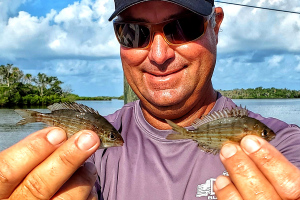

Common Questions About Live Bait for Redfish
What is the best live bait for redfish?
Live shrimp is the most universally effective and most widely available, but pinfish outproduces it in warm months when shrimp get destroyed by bait stealers. Blue crab is the best choice for oversized fish. The correct answer depends on water temperature, target fish size, and what forage is naturally present.
What size hook should you use for live bait?
Match the hook to the bait rather than the fish. Circle hooks in 1/0 to 2/0 suit live shrimp and mud minnows, 3/0 to 4/0 suit pinfish and finger mullet, and 5/0 to 6/0 suit blue crab and large baitfish. An oversized hook kills the bait's action.
Do redfish have barbels like black drum?
No. Redfish have no chin barbels. Black drum do, and that is one of the quickest ways to tell the two species apart. Redfish locate food using the lateral line, vision, and chemoreception rather than whiskers.
Why do pinfish work so well as redfish bait?
Pinfish live in the same grass flats and structure where redfish hunt, so redfish encounter them constantly and show no wariness. They are also far tougher than shrimp, staying alive and active on a hook long enough to fish properly, which means fewer bait changes through the day.
Can you use cut bait instead of live bait for redfish?
Yes, and in warm water or on sluggish fish it often works better. A redfish that will not chase a swimming bait will still follow a scent trail to something lying on the bottom. Cut mullet, ladyfish, and pinfish all produce, with ladyfish putting out particularly strong scent.
What water temperature changes which bait you should use?
Feeding is strongest from the low 70s into the upper 80s. Above that, shift toward durable baits and cut bait with strong scent, since shrimp will be stolen before a redfish finds them. Below the mid 50s, go back to live shrimp fished small, slow, and near the bottom.
How do you keep live bait alive all day?
Oxygen and stable temperature. Run a recirculating pump, avoid overcrowding the well, handle bait with wet hands, and keep it out of direct sun. Never cool a well with ice made from chlorinated tap water, which kills bait quickly.
Reading the Water Before You Pick the Bait
The mistake most anglers make is deciding what bait they are fishing before they leave the dock.
The better sequence runs the other way. Look at the water temperature. Look at what is swimming around the boat. Consider whether you are hunting a slot fish for dinner or an oversized fish for a photograph. Then pick. In February that reasoning lands you on a live shrimp fished slowly on the bottom. In August it lands you on a pinfish under a cork, or a chunk of cut ladyfish against an oyster bar. In October, if the mullet are running, it lands you on a finger mullet and it is not a close call.
None of these five baits is the best one. Each of them is the best one under conditions you can learn to recognize, and recognizing those conditions is the actual skill. Catch your own bait when you can, keep it alive once you have it, rig it so it can behave naturally, and put it where the fish is already looking.
For how this plays out through the hottest months on the Gulf Coast, see catching summer redfish on Florida's Gulf Coast, and browse the full redfish video library to watch these baits rigged and fished on real water.
Login
to leave a review.
User Reviews
There are no reviews yet.
Complete Dredge Pulley Setup Guide
Saltwater
12.28.2020
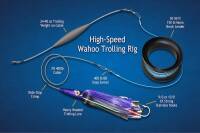
High Speed Wahoo Trolling Rig
Saltwater
09.08.2018
Fishing Light Tackle for Yellowfin Tuna
Saltwater
09.08.2018

Fishing Gulf of Mexico Inshore Waters
Saltwater
11.28.2023
0