
Tuna, marlin, wahoo, and swordfish rarely scatter at random. They relate to a temperature break you cannot see from the deck, and where it sits decides their depth and their mood. Here is how the thermocline forms offshore, how it moves with the season, and how to fish it on purpose.
Featured
Fishing the Thermocline: How It Moves Fish and Bait
There is water out there you will never see from the bridge that matters more than anything on the surface. On a slick, sunny day a layer of warm water settles on top of the ocean, and a little way down the temperature drops off a ledge. Bait piles up against that edge. The fish you are after sit on it, under it, or right in it, and most of the time their depth has a lot less to do with the bottom than with that one invisible line.
That line is the thermocline, and reading it is about as close to a cheat code as offshore fishing gives you. The thermocline is the layer where water temperature falls off sharply with depth, splitting the warm, mixed surface from the cold water underneath. Where it sits tells you how deep the tuna, billfish, wahoo, and swordfish are holding, and whether they will bother coming up for a bait. If you already watch what is happening up top, this pairs with our breakdown of reading offshore water temperature charts, because the surface and the subsurface are two halves of the same story.
What Is the Thermocline in Simple Terms?
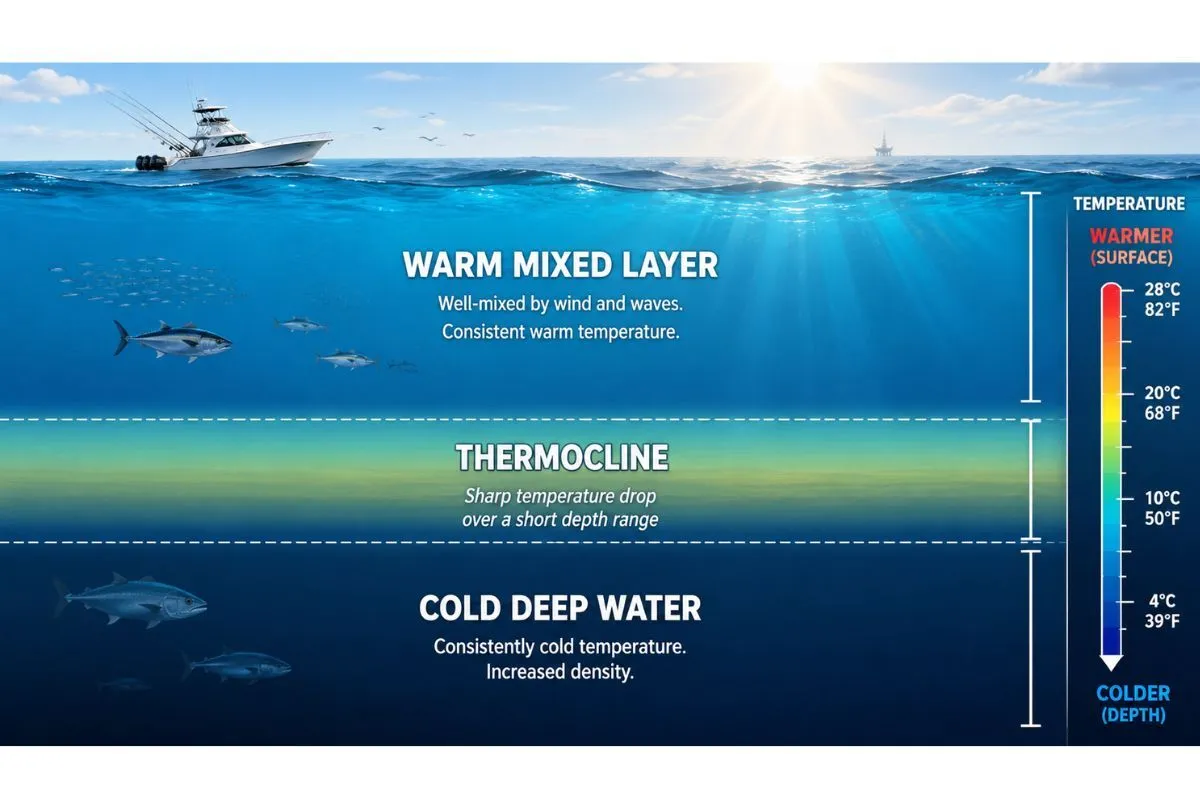
The thermocline is the zone where water temperature drops fast over a short stretch of depth. Warm, oxygen rich, wind stirred water sits on top. Cold, heavy, sluggish water sits below. The thermocline is the wall between them.
Why Does the Thermocline Form Offshore?
The thermocline forms because the sun only heats the top of the ocean while the depths stay cold, and warm water will not mix down into cold water on its own.
What is the mixed layer and why does it matter offshore?
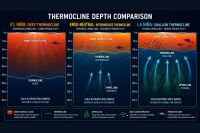
The mixed layer is that band of warm, even temperature water at the surface, and how thick it is, the mixed layer depth, is the offshore way of asking how deep the thermocline is. Thin mixed layer means a shallow break and fish stacked up high. Thick mixed layer means they can spread out deep. A few flat, sunny days build a thin, sharp cap. A good blow churns it down and smears the break out. Simple as that.
How Deep Is the Thermocline Offshore and What Changes It?
There is no magic number offshore, because the break rides with the mixed layer, and that moves with weather, season, and which water mass you are sitting in. The seasonal break can sit a few feet down or a couple hundred feet down, and it will slide on you from one day to the next.
- Seasonal thermocline: builds through spring and summer as the surface warms, then washes out in fall and winter when cooling and storms stir the column.
- Permanent thermocline: the deeper, year round break in tropical and subtropical water, sitting well under the seasonal one.
- Diurnal thermocline: a shallow, short lived break that can form on a calm, sunny afternoon and disappear overnight.
Why Do Pelagic Fish Relate to the Thermocline?
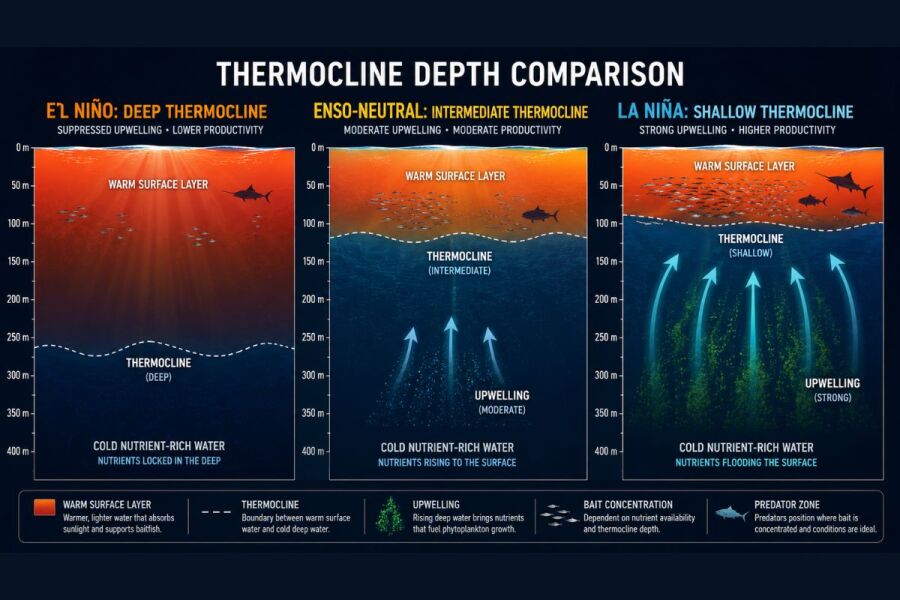
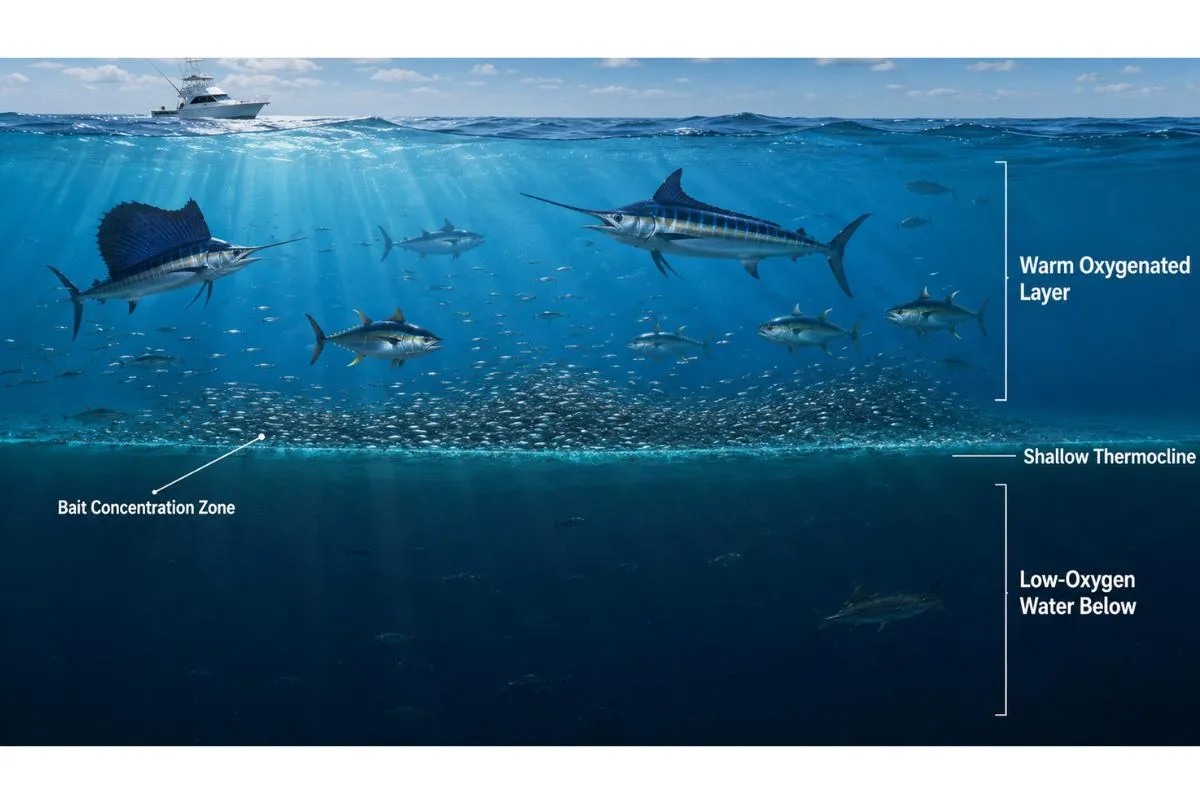
Pelagic fish stack on the thermocline because it does three things at once: it piles up bait, it sets a comfortable temperature edge, and in some parts of the ocean it caps off the water they can actually breathe.
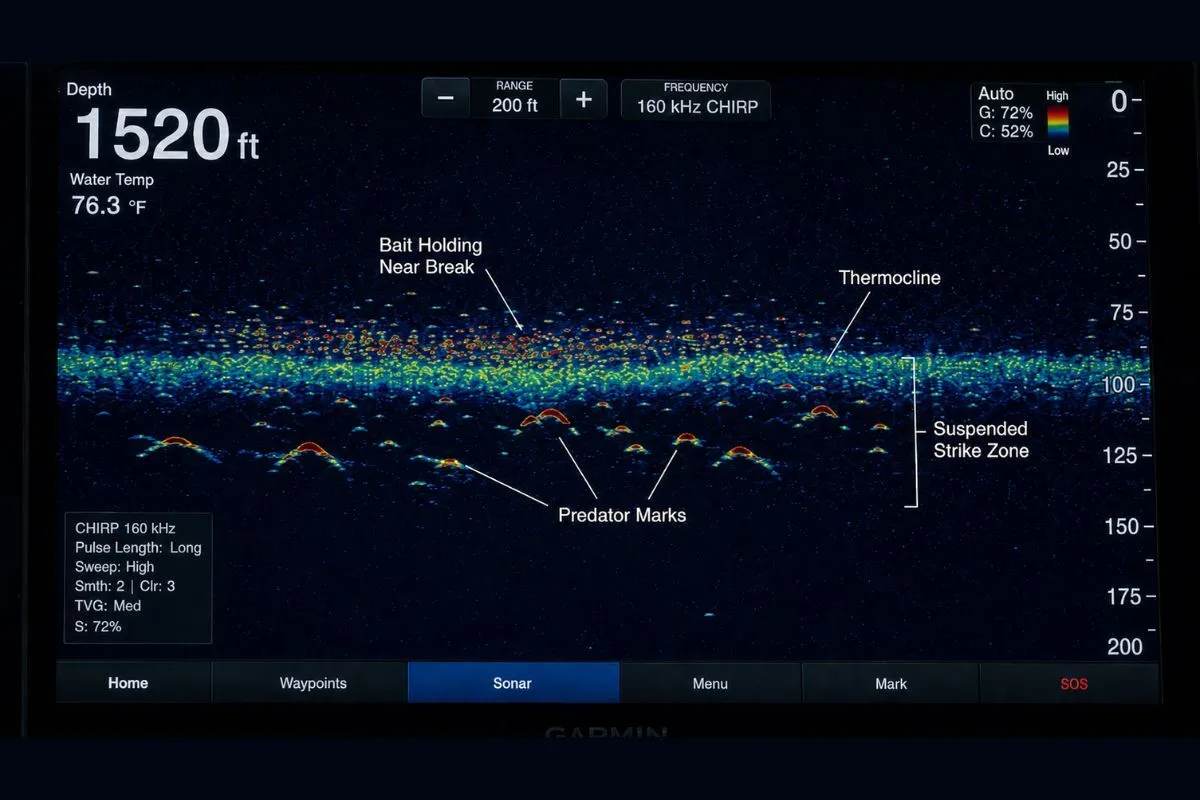
Start with bait, because that is what you are really chasing. Plankton and baitfish concentrate along the break, and predators line up to feed on them. Those suspended fish you mark that look like they are sitting over nothing are almost always relating to that edge. A tight band of marks at the same depth across open water is the thermocline doing your scouting for you.
How Does the Thermocline Change Through the Seasons Offshore?
Offshore it is mostly a warm season deal in temperate water and a year round fixture in the tropics, and knowing which one you have got tells you when depth control is worth the trouble.
Up in temperate zones, the seasonal break builds through late spring and summer as the surface warms, often getting sharper and shallower as things heat up. Come fall and winter, the surface cools, storms beat the water up, the mixed layer drops down deep, and that seasonal break fades out or vanishes. When it goes, the fish spread through the column and quit keying on one temperature edge. They go back to relating to structure, current, and bait.
How Do You Find the Thermocline Offshore?
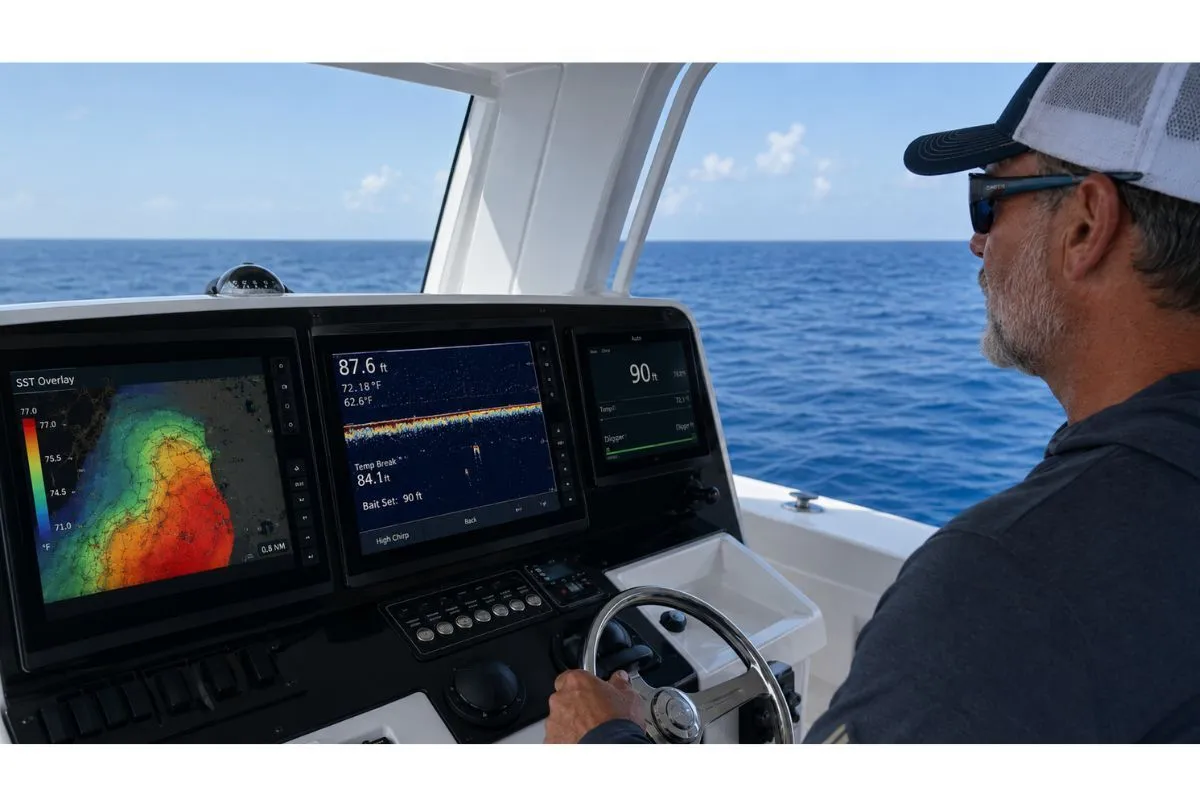
Fastest way to find it is to crank the gain on your sounder until a faint band shows up across the screen. That fuzz is the density change at the break, and you will usually see bait or arches sitting close to it.
- Crank up the sonar gain. Turning sensitivity up reveals a hazy line where the water density changes. On some CHIRP units it paints as a shaded color band, so do not go mistaking it for hard bottom.
- Drop a temperature probe or run a downrigger sensor. Your hull transducer only reads surface temperature, so the one way to get an actual temperature at depth is to send a probe or an expendable bathythermograph down through the column.
- Read the top to find the bottom. Sea surface temperature charts and altimetry show you where water masses collide and where the mixed layer is thin, which flags a shallow, productive break.
How Does the Thermocline Change Offshore Tactics?
The thermocline decides how deep your fish are and whether they will come up, so it ought to be driving how you set your spread. When the surface layer is warm and the break is sharp, behavior changes in ways you can flat out use.
In strongly stratified water, bluefin will dive through the break to feed but pop back up to the top a lot, which makes them players on trolled and surface baits. In weakly stratified water they tend to sit deep longer and barely show up top. The frustrating part is that when they are feeding down below the break, they will watch a bait drag across the surface all day and not move, then eat that same bait the second it is set at their level.
- Downriggers put trolled baits right on the temperature wall where tuna, wahoo, and mahi cruise.
- Vertical jigs and deep set baits get down to fish stacked below the break.
- Deep drop rigs reach the species living well under the surface layer, down near the breaks and current edges where the food gathers.
Light is in the mix too. Swordfish spend the daylight hundreds to over a thousand feet down near the break, then ride the squid and bait up shallower after dark, which is the whole foundation of deep drop swordfish tactics. Tuna and wahoo run a smaller version of the same move, sliding up at first and last light and dropping back to the comfort of the break through the bright middle of the day. Here is the tell that proves it: when the surface trolling dies even though you are sitting in warm blue water, the fish have usually dropped below the thermocline to eat deep. Quit dragging the top and get baits down at and under the break.
How Do Conditions Change Your Thermocline Strategy?
The thermocline hands you a starting depth, not a promise, and the good crews never stop adjusting to what the day is actually doing. Knowing when it will lie to you is the difference between a steady boat and a lucky one.
Current is the big one out here. The water just under the surface can be running a whole different speed and temperature than the top, and fish love riding those edges, so the money is usually where moving water shoves up against a piece of structure or a color change, not out over flat bottom. Light moves them up and down, so match your depth to the clock and work dawn and dusk hard. Pressure plays in too. A falling glass ahead of a front will often light a bite, and a bluebird high behind the front pushes fish tight to the most comfortable band they can find.
A Quick Offshore Thermocline Routine
When you get to the grounds, run a quick check instead of guessing. Here is the routine before you commit to a depth:
- Look at the recent wind and weather for anything that mixed the column or moved the break.
- Scan with the sounder, crank the gain, and mark where the bait and arches stack up.
- Confirm the actual temperature break once with a probe or downrigger sensor.
- Set one bait on the break, one a little above, and one below, then let the fish tell you which they want.
- Recheck after any big wind shift, current change, or temperature swing.
Five minutes of that and you are fishing a plan instead of fishing your hopes.
Frequently Asked Questions About the Thermocline
At what depth does the thermocline form offshore?
There is no fixed depth offshore. The break rides with the mixed layer, which shifts with wind, sun, season, and water mass. It can sit anywhere from a few feet down to a couple hundred feet down and move day to day, so you confirm it on the water instead of assuming.
Do pelagic fish live below the thermocline?
It depends on the oxygen. Where there is a shallow oxygen minimum zone, like the eastern tropical Pacific and Atlantic, marlin, sailfish, and tuna get squeezed into the oxygenated layer above the break. In the Gulf Stream and western North Atlantic, where that low oxygen layer is deep or absent, the same fish range far deeper.
How do I see the thermocline on my fish finder?
Turn your sonar gain up by hand until a faint band shows across the screen at the density change. On CHIRP units it can paint as a shaded color band, so do not confuse it with hard bottom, and remember your transducer only reads surface temperature.
Why did the bite die when the surface water looks perfect?
Because the fish dropped below the thermocline to feed deep, and they will ignore baits dragged across warm surface water when they are down there. Put baits at and below the break with downriggers, vertical jigs, or deep set rigs instead of grinding away on top.
Does the thermocline matter year round?
In the tropics and subtropics a permanent thermocline holds all year, so depth patterns stay consistent. In temperate water the seasonal break is mostly a warm weather thing that fades through fall and winter as storms and cooling drop the mixed layer deeper.
Final Thoughts on Fishing the Thermocline
The thermocline is one of the few edges offshore that is both invisible and dependable. When the water stratifies, it stacks bait, sets a comfortable temperature line, and in a lot of the ocean it pins predators into a thin band over water they cannot breathe. Find it on your electronics, confirm it with a temperature read, and pay attention to how current, light, and pressure shove it around. Do that and you stop burning fuel and bait on empty water.
The part that takes time to learn is matching your effort to the conditions. Lean on depth control when the water is hard stratified. When wind and cooling churn it all together, forget the break and go back to structure, current, and bait. Fish it that way for a few seasons and a feature most boats never think about turns into something you count on.
Login
to leave a review.
User Reviews
There are no reviews yet.
Setting Up a Dredge Pulley for Billfish
Saltwater
12.28.2020
High Speed Wahoo Trolling Rig
Saltwater
09.08.2018
Fishing Light Tackle for Yellowfin Tuna
Saltwater
09.08.2018
0