
When yellowfin refuse chunks and lures, a healthy bait swimming on its own is the answer. Bait selection, livewell discipline, hook placement by depth and drift, free-lining versus weighted, and the live chumming that manufactures a feed.
Fishing Live Bait for Yellowfin Tuna
There is a moment that repeats itself in every yellowfin fishery I have fished. The fish are up, the slick is working, and they are eating everything in the water except what you are throwing at them. Chunks go back and disappear. Lures get followed and refused. Then somebody drops a lively blue runner over the side on a hook they can barely see, and the water opens up.
Live bait is the highest-percentage answer to a selective yellowfin, and it is the closest you can come to putting the real thing in front of a fish that hunts by sight and rejects anything false. A healthy baitfish swimming naturally does not need to fool anyone. It is what the tuna are already eating. Your job is to keep it alive, rig it so it can swim, and put it where the fish are, and if you do those three things well, live bait will out-fish everything else in the box on the days that matter. For the full picture of how these fish are found and caught, the pillar on catching yellowfin tuna offshore sets the context. This article is about the bait.
When does live bait beat dead bait and lures?
Live bait is not always the right call, and knowing when to reach for it is the first skill. It wins decisively in a few specific situations, and understanding why tells you when to switch.
It wins when the fish are selective. Yellowfin that have inspected and refused chunks and lures are telling you your presentation has a flaw in it, and a live bait removes most of the ways to be wrong. It wins in clean, clear water, where their eyesight is at its most punishing and a bait that swims on its own gives them the least to read. It wins on pressured fish that have seen a fleet work them over and have gotten shy of everything with a leader attached. And it wins when the tuna are keyed on a specific forage that you can actually match with the real thing, because nothing imitates a blue runner like a blue runner.
What are the best live baits for yellowfin tuna?
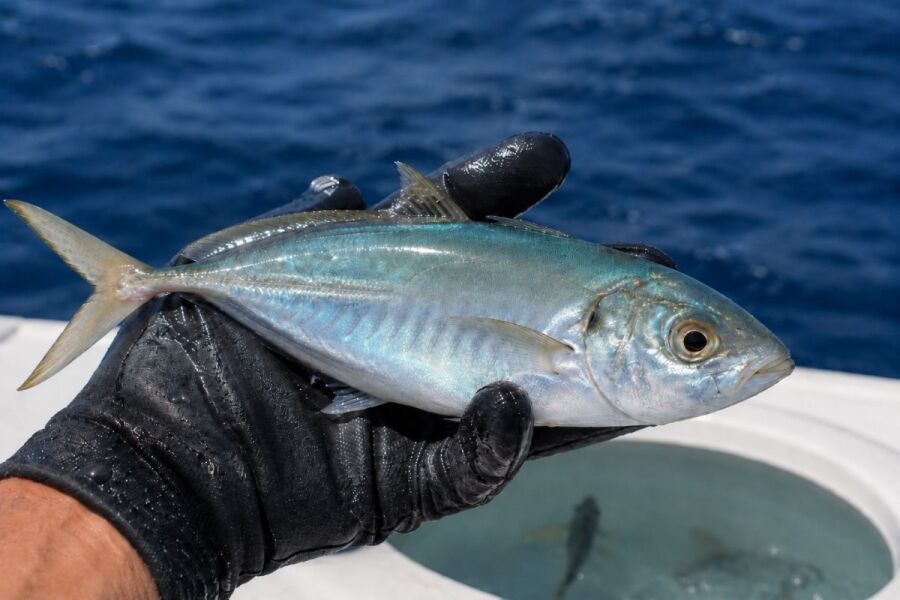
Bait choice comes down to what swims in your water and what stays alive under pressure. Blue runners, known as hardtails through much of the Gulf and the Southeast, are the workhorse for a reason. They are tough, they take a hook well, and they keep swimming hard long after a softer bait has quit, which matters enormously when a bait may sit in the water for twenty minutes waiting on the right fish.
- Goggle eyes, or scad, prized for hook life and a strong natural swimming action that draws fish from a distance
- Speedos, small bonito that yellowfin key on hard in many fisheries and that swim with real urgency
- Pilchards in the four to six inch range, excellent when the tuna are on smaller forage and refusing anything larger
- Live mackerel, which trigger aggressive eats but bruise easily and need careful handling
- Threadfin and finger mullet, situational but deadly where they are the dominant local bait
What you throw depends heavily on where you fish. The names above are the Gulf and Southeast roster, and goggle eyes are bigeye scad while speedos are the small bonito and mackerel tuna that tuna key on hard in that region. Elsewhere the cast changes. Pacific crews live and die on sardines and anchovies, Carolina and Northeast boats lean on menhaden, Spanish sardines, and herring, and the principle travels even when the species do not. Fish what the tuna in your water are already eating.
How do you catch and keep bait alive?
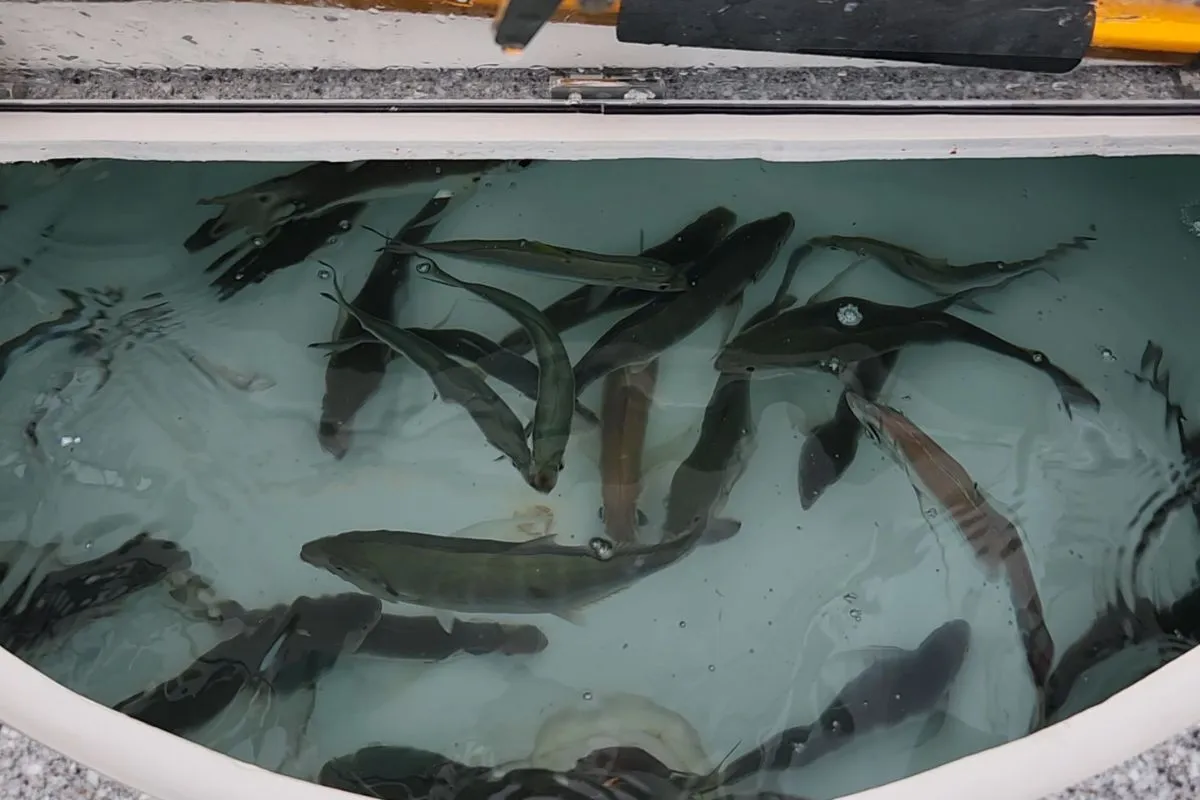
Nothing in live baiting matters more than the condition of your bait, and this is where most days are won or lost before you ever raise a fish. A yellowfin can tell the difference between a vigorous bait and a stressed, half-dead one from a remarkable distance, and it will take the healthy one every time. A tired bait hanging listlessly under the boat is not live bait. It is dead bait with extra steps.
Getting bait is its own morning's work. Sabiki rigs on nearshore structure, wrecks, buoys, and rigs produce runners, goggle eyes, and scad, and a cast net over a school of pilchards or threadfin fills a well fast when you find them. Plan to spend real time on it, because a boat that runs offshore with a thin, beat-up livewell has already limited its day. Many Gulf crews catch bait at night on lights around the rigs and trawlers, where scad and runners stack up under the glow and a sabiki fills a well fast. Bait capture is regulated in a lot of places, with rules on cast net use, species, and quantities, so check the current rules with your state fish and wildlife agency or NOAA Fisheries before you fill a livewell.
How do you hook a live bait for yellowfin?
Hook placement is not a detail. It decides how the bait swims, where it goes in the water column, and how long it lives, and each placement is a tool for a specific job.
Nose hooking, through the cartilage between the nostrils or the upper lip, lets a bait swim forward naturally and is the right choice on a slow drift or when you want the bait tracking ahead of the boat. Take the cartilage rather than soft tissue and the bait lives far longer. Shoulder hooking, just behind the head and above the lateral line, holds up better to a faster drift or a bait you need to cast, and it keeps the bait swimming level. Hooking near the anal fin, behind the vent, makes a bait swim down and away from the boat, which is exactly what you want when the fish are holding deeper and you want the bait to take itself into the zone.
Choose based on drift speed and where in the column you want the bait. That is the whole logic. On a slow drift with fish up high, nose hook and let it swim. On a fast drift or when you need depth, shift back on the bait and let its own panic carry it down.
Free-lining, weighted baits, and working the column
Once the bait is rigged, the presentation is a question of depth. Free-lining a bait with no weight at all is the purest version of live baiting and the most effective when fish are up. The bait swims where it wants, the line does nothing to restrain it, and there is almost nothing for the fish to read as wrong. Feed line freely as the bait pulls away from the boat, and resist the urge to hold it in place, because a bait swimming against a tethered line looks unnatural immediately. Feed it under control rather than dumping coils on the water, keeping just enough drag to prevent a backlash while letting the bait take line whenever it wants.
When the fish are down, you have to get the bait to them. A split shot or rubber-core sinker adds just enough weight to take a bait into the mid-column without killing its action, and heavier weight, or a breakaway sinker that drops off, punches a bait down to fish holding deep. A float or a kite suspends a bait at a set depth and keeps it up in the strike zone while you cover water, which is a proven approach where crews have the setup for it, and a simple balloon does much of the same job for a fraction of the cost, which is why you see so many of them around Gulf rigs and trawlers. Anal-fin hooking, as above, achieves some of the same thing without adding any hardware at all, which is why experienced crews reach for it first.
How do you chum with live bait to trigger a feed?
This is where live baiting stops being a presentation and becomes a strategy. You are not just putting one bait in the water. You are using live bait to create a feeding event and then feeding a hooked bait into the middle of it.
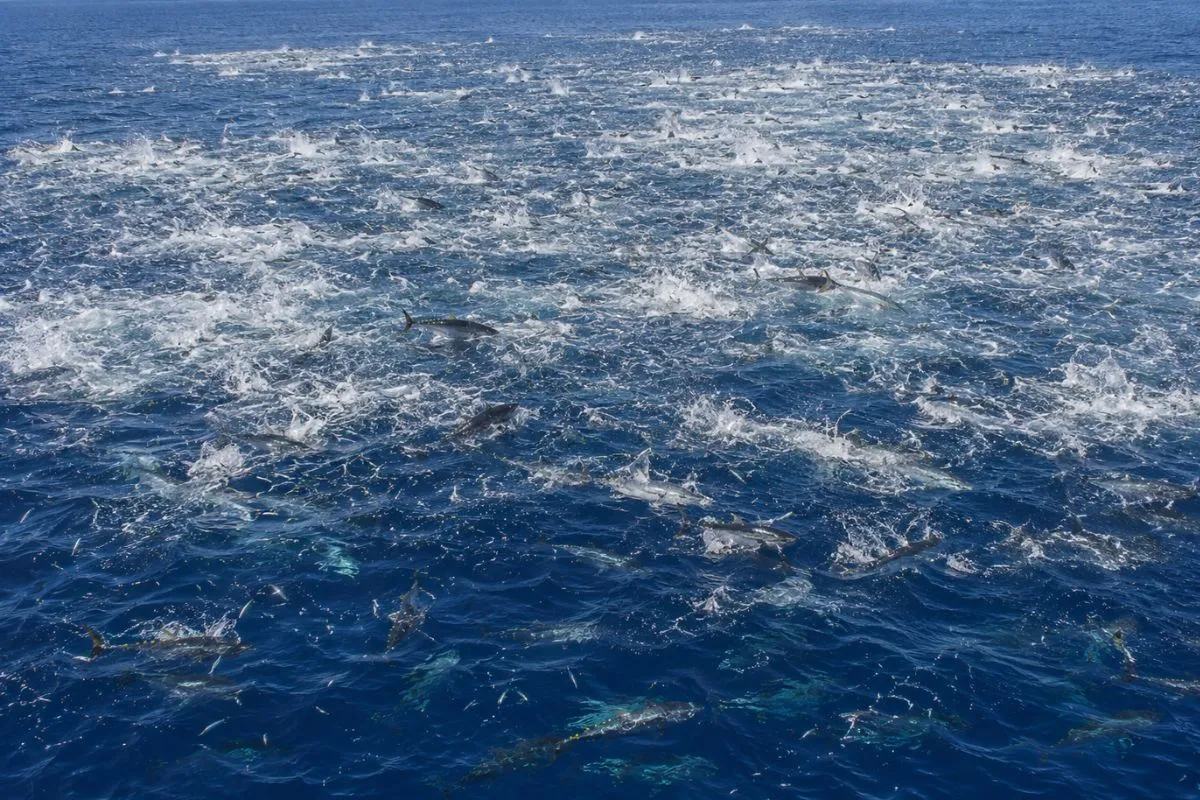
The method is straightforward and brutally effective. You throw a scoop of live baits, fifteen or twenty of them, over the side in a concentrated area. Frightened baitfish scattering on the surface is a visual and acoustic signal that yellowfin cannot ignore, and fish that were cruising indifferently will come up and start circling within minutes. As they commit and begin crushing the free baits, you pitch your hooked bait into the chaos, and it goes back looking exactly like every other bait in the water, because it is.
There is a refinement to this that Gulf crews use to devastating effect. As the tuna commit to the surface, put the boat in gear briefly and create a burst of white water off the props. Fleeing baitfish instinctively run toward that turbulence and hold there, treating the prop wash as cover, which packs your free baits and your hooked bait together in one tight, agitated knot. When the white water dissipates, that whole knot of bait is suddenly exposed in open water with tuna underneath it, and the eats are violent. Timing is everything. You are manufacturing the moment of vulnerability that triggers a competitive feed.
Combining live bait with a dead bait slick
The two approaches are not rivals, and the best crews run them together. A dead bait slick reaches out and pulls fish in from a distance, because dissolved oils and scent travel far further underwater than the visual signal of a few live baits ever will. Live bait converts the fish once they arrive.
How do you keep the school with you?
Drawing tuna is one problem. Holding them is another, and live bait gives you real leverage here. Once fish are eating your baits, you have become the most reliable food source in the area, and they will stay with you as long as the food keeps appearing. That is how crews pull a school off a trawler or a rig and keep it behind their own boat, which is the entire game in structure fisheries.
The discipline is in the rate. Feed enough live bait to hold their interest and keep competition alive, but not so much that you fill them, because a satisfied tuna drifts off and a hungry one keeps hunting. Keep a bait going out even while you are fighting a fish, because a slick that goes quiet during a twenty minute battle is a school that leaves. Assign someone to that job and do not let it lapse.
Frequently asked questions about live baiting yellowfin tuna
What is the best live bait for yellowfin tuna?
Blue runners, also called hardtails, are the most reliable choice because they are durable and keep swimming hard under pressure. Goggle eyes, speedos, pilchards, and live mackerel all produce as well. The best bait is the one that matches what the tuna are already eating and stays lively on the hook.
How do you hook a live bait for tuna?
Nose hooking suits a slow drift and lets the bait swim forward naturally. Shoulder hooking holds up to a faster drift and keeps the bait level. Hooking near the anal fin makes the bait swim down and away, which gets it deeper without adding weight. Choose based on drift speed and the depth you want.
How many live baits do you need for a day of tuna fishing?
Plan on a couple hundred for a serious live-bait day, because a hot bite consumes bait fast and chumming with live baits uses them quickly. Running short in the middle of a feed ends the day early, so carry more than you think you need.
Should you use weight with live bait for yellowfin?
Use as little as you can. A free-lined bait with no weight swims most naturally and is best when fish are up high. Add a split shot or rubber-core sinker to reach the mid-column, and heavier weight only when fish are holding deep and the bait cannot get to them on its own.
What tackle do you use for live-bait yellowfin?
Most crews run 50 to 80 pound class conventional outfits or heavy spinning gear, with 65 to 100 pound braid and fluorocarbon leader scaled to the situation, roughly 40 to 80 pound in clean open water and 80 to 130 pound around structure or true giants. Circle hooks sized to the bait complete the rig.
Is live bait better than chunking for yellowfin tuna?
They do different jobs. Chunking builds a scent trail that draws fish from a distance, while live bait converts selective fish once they arrive. The strongest approach on many days is both, using a dead bait slick to gather the school and live baits to get the eats.
Yellowfin Tuna Video Courses
Venice, Louisiana is known for its abundant yellowfin tuna fishing, with captains and crews using advanced tactics and techniques. Capt. Josh Howard utilizes trawl boat by-catch to create a healthy chum slick, while In The Spread fishing video teaches ideal baits, chumming, and chunking. Fishing in the Gulf of Mexico relies on working fixed or mobile fish aggregators, making trowl boats an excellent fishing opportunity.
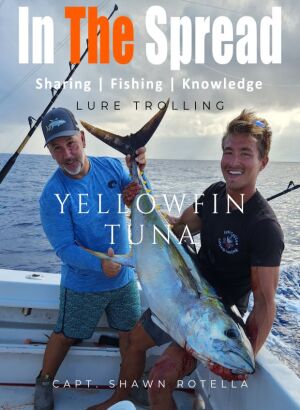
Yellowfin tuna trolling tactics shift dramatically when skipjack schools appear, demanding lure adjustments most anglers miss. Captain Shawn Rotella's Kona expertise reveals how predatory patterns, tide influences, and habitat structures determine which lure colors and trolling speeds trigger strikes from Thunnus albacares, plus post-catch gilling and cooling techniques preserving quality for premium table fare.
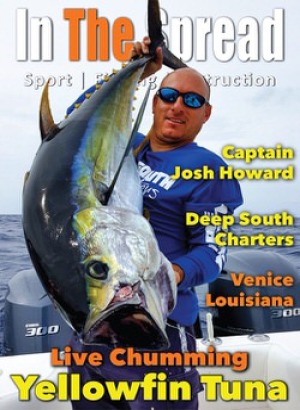
Yellowfin tuna around Venice trawlers feed competitively on bycatch discharge, creating brief windows where aggressive strikes can overwhelm standard tackle and technique. Captain Josh Howard explains how live bait selection matches trawler discharge, why hook and drag specifications prevent lost fish around moving vessels, and when these mobile feeding situations produce versus platform fishing.
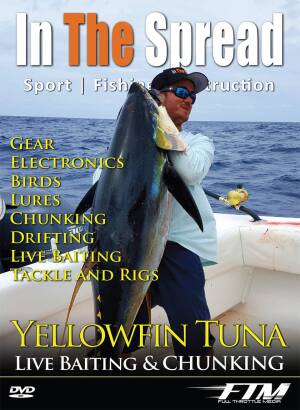
Yellowfin tuna reject more baits than they strike when chunking and drifting. RJ Boyle explains how chum distribution rate, bait matching, and drift positioning determine whether competitive feeding behavior triggers or fish simply feed selectively on free chunks without committing to hooked offerings.
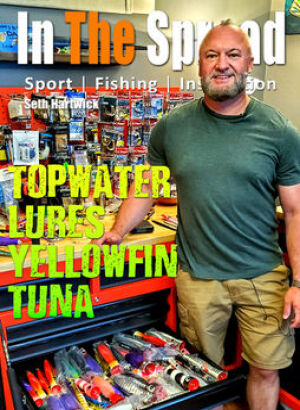
Topwater yellowfin tuna fishing evolved into refined styles where popper and stickbait quality, build, and price vary dramatically. Seth Hartwick's extensive lure testing reveals which designs justify investment, how sea conditions affect lure selection and placement, and what tackle components including hooks, split rings, swivels, and leaders create reliable setups withstanding violent tuna strikes.
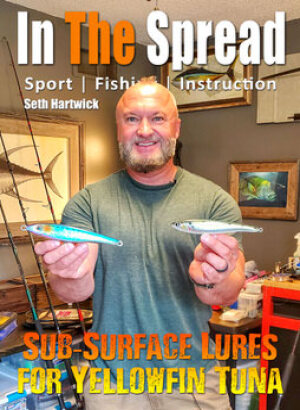
Yellowfin tuna feed in the top three to five meters using the surface as an edge to trap baitfish, making sub-surface lures more effective than topwater presentations. Sinking stickbaits reach these feeding zones while avoiding bird interference that dominates surface activity, requiring proper terminal tackle pairing with hooks and split rings maintaining lure action during violent strikes.
Putting a live bait in front of a tuna
Live baiting yellowfin is not complicated, but it is unforgiving of shortcuts. The bait has to be healthy, which means real effort spent catching it and real discipline in the livewell. It has to be hooked so it swims the way you need it to swim, in the direction and at the depth the fish are holding. And it has to be presented on terminal tackle light enough and clean enough that a fish built to detect flaws cannot find one. Get those right and you will catch fish on days when the boats around you are watching tuna refuse everything they own.
The rest is reading the situation, knowing when to build a slick, when to throw a scoop of baits and manufacture a frenzy, when to free-line and when to sink one down, and when live bait is simply not the tool the day calls for. The fastest way to build that judgment is to watch it done by people who live it, and our full library of yellowfin tuna video courses puts you on the boat with captains doing exactly this in real conditions. Learn to keep bait alive, learn to rig it so it swims, and the hardest fish in the ocean gets a good deal easier to fool.
Seth Horne
Founder and CEO
Login
to leave a review.
User Reviews
There are no reviews yet.
Setting Up a Dredge Pulley for Billfish
Saltwater
12.28.2020
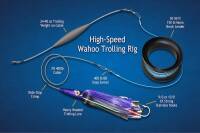
High Speed Wahoo Trolling Rig
Saltwater
09.08.2018
Fishing Light Tackle for Yellowfin Tuna
Saltwater
09.08.2018

0