
Why does a ledge hold scamp while flat rock holds red porgy? Survey data and In The Spread captains explain how bottom structure sorts reef fish through relief, hole size, current and edges, and how to pick the depth, bottom type and spot for your target species.
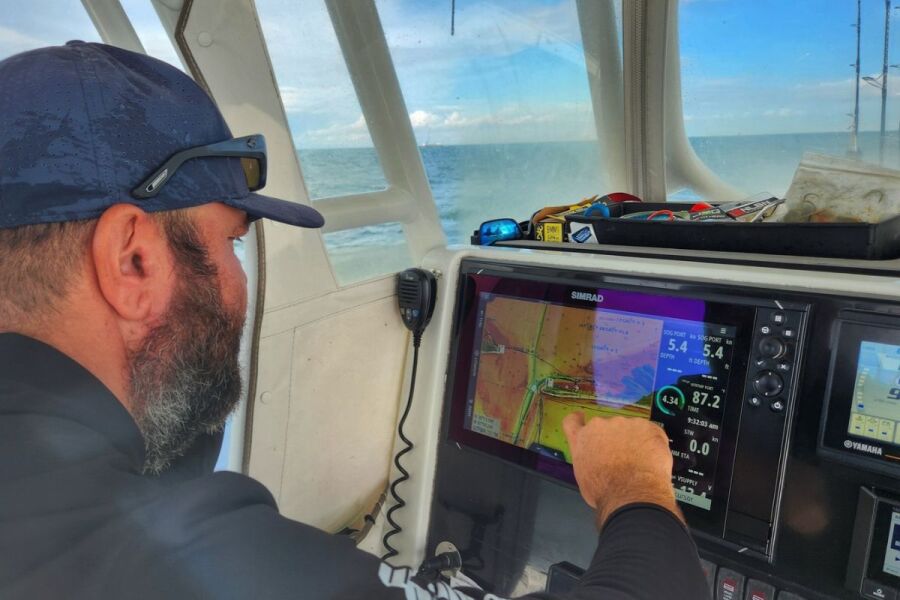
Reading Bottom Structure to Predict Where Species Hold
Bottom structure decides which species hold on a piece of hard bottom by controlling four things: how big the hiding spots are, how tall the structure stands off the seafloor, where current delivers food, and where rock meets sand. Every reef fish weighs those four things differently. That is why a tall wreck, a knee-high ledge, a field of potholes and the sand around a reef can all sit within a mile of each other and hold four different sets of fish.
This article explains why that sorting happens. It draws on survey work by fisheries scientists at state and federal agencies and universities, who mapped hard bottom from Texas to the Carolinas with sonar and cameras, and on what the captains who teach on In The Spread see on the water every day. For technique, including rigs, positioning and drift control, the captains in our bottom fishing video courses teach it in 50 to 600 feet of water.
Most of that research was done in roughly 30 to 360 feet of water on Gulf and Southeast Atlantic hard bottom. Keep that in mind if you fish somewhere else. Structure sets the map. Current, temperature, season and spawning decide which parts of the map are active on a given day.
How Does Bottom Structure Decide Which Species Hold Where?
Every fish on the reef is solving a different problem. A small grouper needs a hole it can fit into and a bigger predator cannot. An amberjack wants something tall to hang on in moving water. A red snapper wants cover close by and open sand to feed over. Put all three on the same patch of bottom and they spread out according to those needs.
The research boils that down to four drivers:
- Hiding spots: the size of the cracks and holes decides which fish can live there, so broken, cavity-rich rock favors small fish and juveniles.
- Height: tall structure pulls fish up into the water column and attracts amberjack, jacks and other roaming predators.
- Current: structure bends the flow, creating calm pockets to hold in and lifting bait toward waiting fish.
- Edges: where rock meets sand is its own habitat, with its own residents.
There is one filter that comes before all four, and it is depth. A 2024 analysis of more than 2,000 hard-bottom sites across the northern Gulf found that depth and water temperature did more to decide which fish showed up than the height of the structure did. Depth picks the bank. Structure picks the spot on it.
Captain Vlad Moldoveanu of MSC Fishing in Fort Morgan and Orange Beach, Alabama, lives that rule. His inside program on the 100 to 150 foot reef is red snapper and amberjack. His deep program runs from scamp at 200 to 250 feet down to tilefish, yellowedge and snowy grouper on the 400 to 1,000 foot drift. Same coast, same captain, different depth, different fish.
Our breakdown of fishing structure types covers the features themselves. The rest of this article is about why each one holds what it holds.
Why Does Vertical Relief Change Which Species You Catch?
You have two numbers in the GPS, a tall wreck and a low limestone ledge, and one morning to fish. Which one you pick should depend on what you want to catch, because height changes the fish you find.
The best evidence comes from the Elbow, a limestone ridge about 90 miles northwest of Tampa Bay. In FWC's Elbow survey, scientists mapped the area with side-scan sonar, sorted the bottom into five types from tall ledges to flat rock and small potholes, and dropped baited cameras on each. Most types held a different mix of fish. Ledges and broken rock held about the same fish. Greater amberjack, scamp and hogfish were scarcest over flat, low-relief hard bottom. Red porgy did best on that flat rock, and vermilion snapper peaked around the potholes. The surprise was how rare the good stuff is: about 90 percent of the area they mapped was bare sand, and most of the hard bottom that did exist was low and flat. A real ledge on the West Florida Shelf is the exception, which is why the good ones get fished so hard.
It does not take much height to matter. At Gray's Reef off Georgia, in 50 to 65 feet, a ledge study found two to ten times more fish on ledges than on flat bottom, and gag, scamp, red snapper and greater amberjack were found mainly at ledges taller than about 10 inches.
Very tall structure changes the kind of predator you raise. A survey of 30 North Carolina reefs found jacks, mackerel, barracuda and sharks were five times more common on wrecks and artificial reefs than on natural bottom, while grouper and snapper numbers were about the same on both. And fish find new structure fast. A 2022 review of artificial reef research notes that adult fish show up on newly sunk reefs within hours to days, long before any growth or food builds up on them. Our piece on fishing greater amberjack on wrecks and reefs covers how to work that water column.
So the tall wreck is the call for amberjack. It is not automatically the call for grouper.
Why Do Hole Size and Complexity Matter?
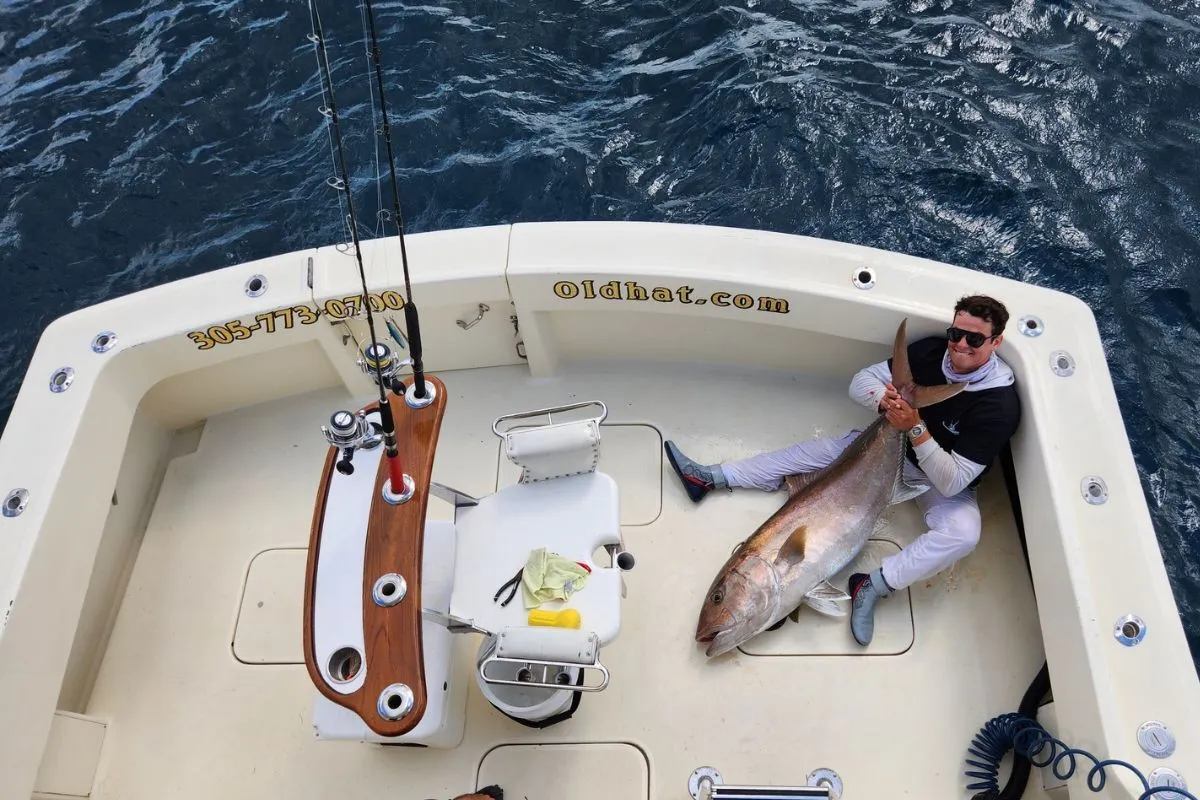
Plenty of anglers run right past broken, low bottom looking for a ledge. Captain Chris Wilkins of Cool Change Fishing Charters, the Homosassa offshore captain known as the Grouperman and an In The Spread instructor, has built his career on grouper along Florida's Nature Coast. On bottom like that, the size and shape of the holes matter as much as the height.
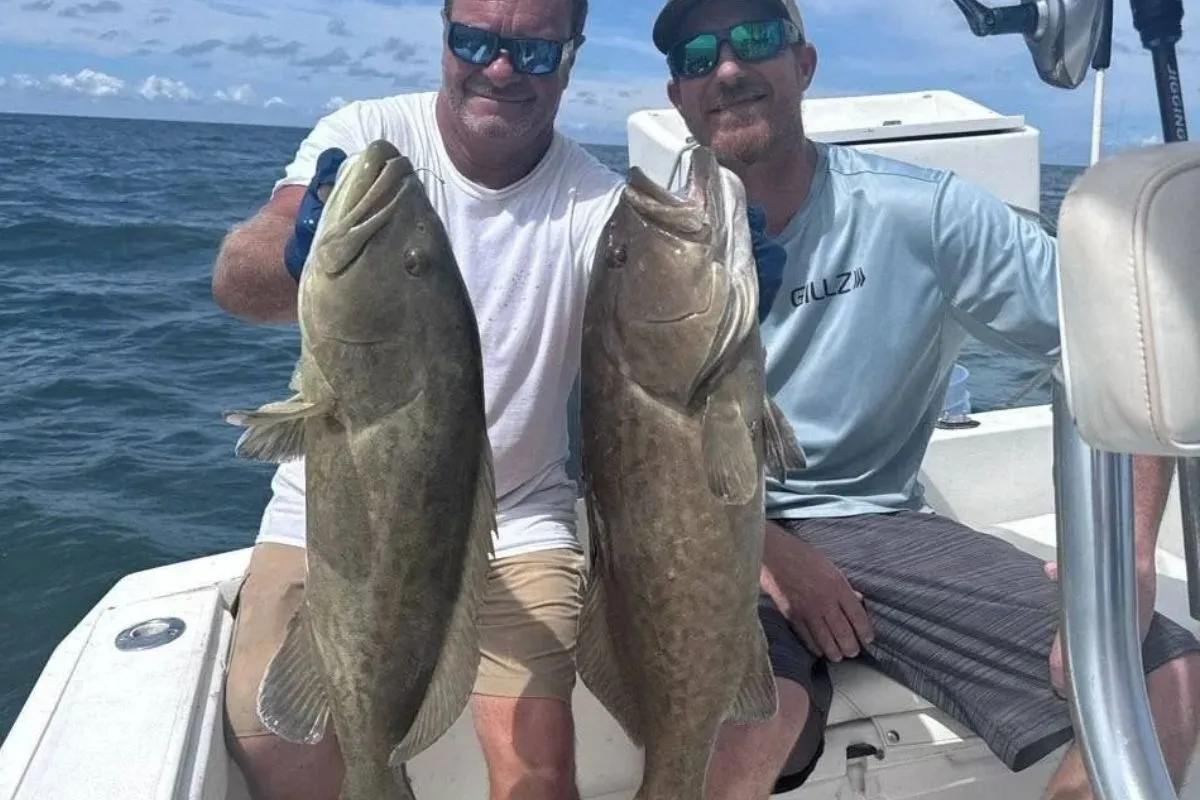
Small fish survive better where the holes are small, because bigger predators cannot follow them in, according to the same artificial reef review. That is why a big steel-hulled wreck, which is mostly open space, tends to hold fewer small reef fish and juveniles than broken natural rock full of cracks and crevices, as an eastern Gulf comparison of wrecks and natural reefs found. Reef complexity sorts fish by size before it sorts them by species.
Then there is the fish that builds its own structure. Red grouper dig into flat sand and low rock with their mouths and fan it clear with their fins, exposing the rock underneath and keeping it clean. Those pits run roughly 15 to 80 feet across, and they are not just red grouper homes. At Pulley Ridge, west of the Dry Tortugas, 208 surveyed red grouper pits held 66 different fish species. For the full technique picture, start with our article on catching grouper with techniques, baits and best spots.
Golden tilefish take the same idea into deep water. In 41 submersible dives off the Mid-Atlantic and southern New England, researchers found tilefish need two things: stable bottom water of about 48 to 57 degrees and a bottom soft enough to dig into, usually clay (a submersible study of tilefish habitat). Their main home is a funnel-shaped burrow dug straight down into flat clay, found from about 260 to 1,000 feet. At Hudson Canyon those burrows averaged about 5 feet across, at more than 3,000 per square mile. Crabs, conger eels, hake and blackbelly rosefish were more common around the burrows than away from them, and the burrow edges were honeycombed with their smaller holes. Temperature picks the depth band, and soft clay picks the spot, which is why deep droppers target clay bottom that would look like nothing on a shallow reef trip.
What Does Each Type of Bottom Look Like on Sonar?
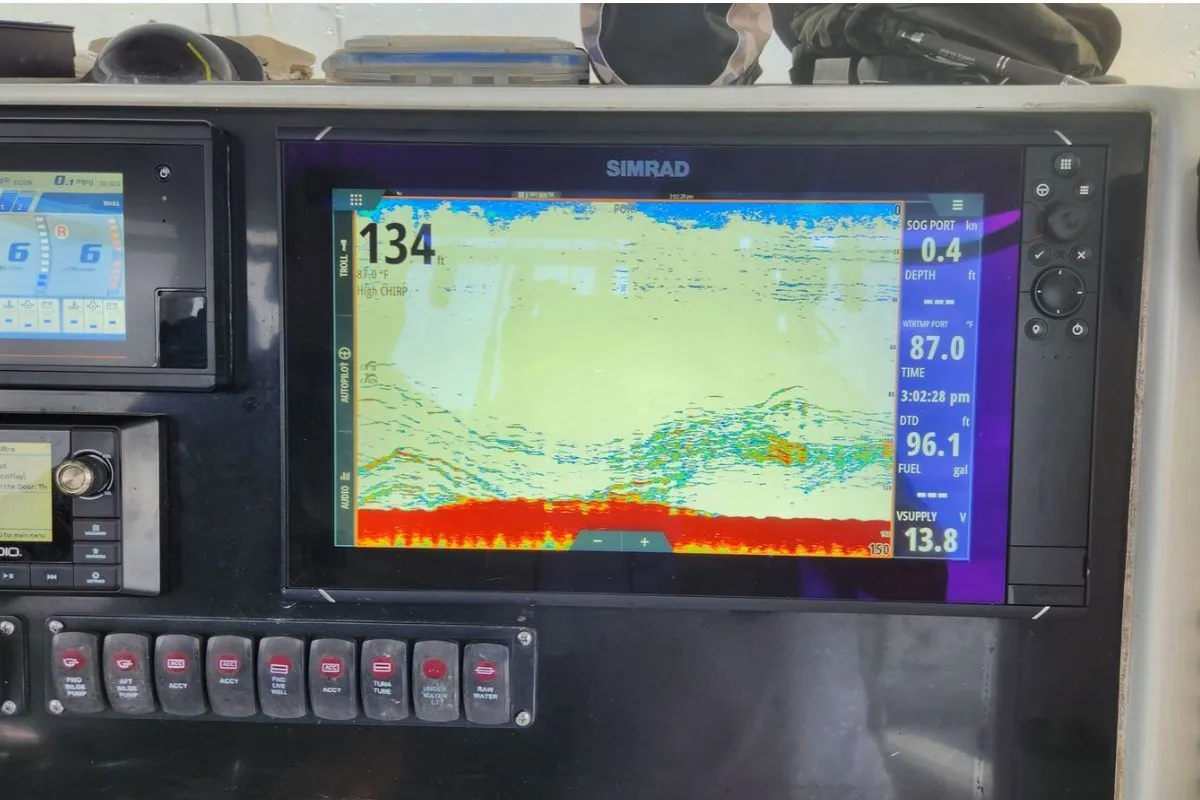
You cannot fish a habitat you cannot see, so it helps to know what each type looks like on the screen. Hard bottom returns a thicker, brighter bottom line than sand or mud, and in shallower water it often throws a second echo at twice the depth. A ledge shows as a sharp step in the bottom line. A wreck shows as a spike rising off the bottom, often with fish stacked above it. Scattered rock and potholes show as subtle bumps and dips that are easy to miss at speed.
Red grouper pits are the hardest to spot. They are wide but usually less than 6 feet deep, and the ones surveyed at Pulley Ridge sat in 200 to 330 feet, where many will barely register on 2D sonar. Side imaging and high-resolution bottom maps are how you find them, along with scattered low rock. Make a slow pass over any new spot before you commit to it.
How Far From a Reef Do Fish Actually Feed?
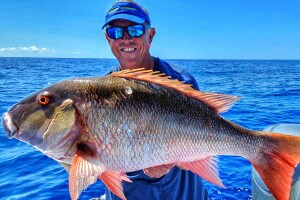
Captain Ryan Van Fleet of Good Karma Sportfishing in the Florida Keys sees one mistake more than any other with mutton snapper: anglers set up right over the wreck or the high point instead of off the edge, where the muttons are actually hunting. Muttons patrol reef edges, the line where hard bottom turns to sand, and sand pockets next to structure. They are on the perimeter, not the peak.
A North Carolina dive study shows how tight the perimeter is for reef fish in general. Divers counted more than 37,000 fish on 24 reefs in 35 to 60 feet and then swam transects out across the sand. Within the first 100 feet off the reef, fish numbers dropped by 43 percent and total fish weight by 74 percent. By 200 to 300 feet out, fish numbers were down to 2 percent of what was on the reef, and more than 40 percent of those transects held no fish at all. Of the fish that were using the sand, 97 percent stayed within about 200 feet of the reef.
The exceptions were roaming predators like jacks and mackerel, which got more common farther out as they moved between reefs. The surveys were done in daylight, and the researchers note that some reef fish forage farther from structure at night. Research on juvenile red snapper off Mississippi also points to earlier work suggesting young snapper can take a good share of their food from the sand and mud around a reef, and that when reefs sit close together the bottom between them gets picked over. Our article on boat positioning techniques for bottom fishing walks through setting up on that perimeter.
Fish the edge, and fish it close.
Which Side of Structure Holds Fish in Current?
Current turns structure on and off. When moving water hits a ledge or wreck, it gets pushed upward and slowed down behind it. Fish use those slower pockets to rest while staying close to whatever the current carries past. On a windward reef face, a Great Barrier Reef study found plankton-feeding fish stacked on the up-current side in what the researchers called a wall of mouths, stripping most of the plankton from the water before it reached the reef. Captains see the same logic on Gulf structure: the grouper and snapper that eat those bait fish set up where the flow sweeps food their way.
Where that rule applies, precision matters. In his deep-water ledge course, Captain Mike Hennessy explains that setting up just ten feet too far off your up-current mark costs you bites. The course also breaks down power drifting, using the outboards to hold baits on a ledge when anchoring is not practical. On the Gulf side, Kevin Adney's grouper instruction centers on managing the drift so baits keep working productive bottom instead of sweeping past it or hanging over the empty gaps between rocks.
Just know that the up-current rule is a strong habit, not a law. It holds up best for bait and ambush feeders. Muttons working an edge and red snapper feeding out over the sand are two fish that often break it. For how current, structure and upwelling stack bait from the bottom up, see our article on how to fish upwelling around offshore structure.
Which Species Hold on Which Structure?
The table below puts it together by species. The middle column tells you what kind of bottom to look for. The bait column tells you where to put your offering once you are there, which matters just as much. Our snapper and grouper bottom fishing tactics article covers the rigging for each of these fish.
The "Where to put the bait" column reflects In The Spread captain experience and common practice, not survey data.
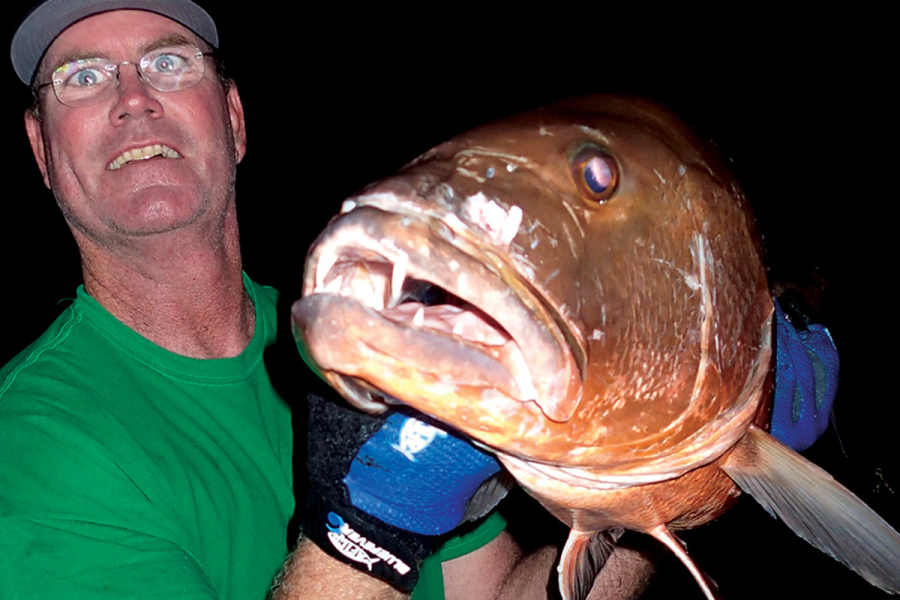
The red snapper row surprises a lot of people. Across the northern Gulf, a Gulf-wide red snapper survey found young red snapper were about 20 times easier to catch on platforms and artificial reefs than on natural reefs, yet those structures held only about 8 percent of the red snapper by weight. The big, older fish mostly live on natural bottom. Artificial reefs give you numbers. Natural bottom gives you size. That is also a fishing pressure lesson: the public numbers get hit hard, and the bigger snapper are more often on low, natural bottom you find and mark yourself.
Reef and Wreck / Bottom Fishing
Is Taller Structure Always Better?
No, and that is worth knowing before you write off a flat piece of bottom. The same North Carolina research team that found more roaming predators on tall wrecks also ran a study of 30 reefs comparing flat and complex bottom and found that flat natural reefs held about the same number of fish, the same weight of fish and the same variety as the rugged ones. Structure in the middle of the complexity range held the most. In the northwestern Gulf, a study of the offshore banks found reef complexity mattered on the mid-shelf banks but not on the Flower Garden Banks, where coral cover is high throughout.
Height matters most where hard bottom is scarce. Where it is plentiful, flat rock can fish just as well.
When Does Good Structure Hold No Fish?
Every bottom fisherman has marked a perfect ledge and caught nothing on it. Structure sets the potential. Conditions decide whether anyone is home.
- Low oxygen: in summer, parts of the northern Gulf shelf go low on oxygen near the bottom, and fish leave. Check NOAA's current hypoxia reports for your area.
- Water temperature: a sharp cold snap or a shifting thermocline can move fish off shallow structure even when the bottom is perfect. Check temperatures at depth, not just at the surface.
- Spawning: gag and scamp gather on high-relief shelf-edge sites, in roughly 165 to 400 feet, to spawn. Seasons and closures change, so confirm them with FWC or NOAA Fisheries.
- Storms: big tropical systems can push reef fish off their usual spots.
- Fish move: a 2022 tracking study found red snapper on northern Gulf artificial reefs stayed a median of about six weeks before moving to other reefs. A separate 2025 West Florida Shelf study, using a different tracking design, averaged about eight months, so residency varies with region and method.
Kevin Adney's answer when the electronics do not show good bottom is simple: drop baits and see if you get bit. The fish settle the question faster than the sounder does. For checking water temperature and conditions before you leave the dock, our article on reading a fishing forecast with data covers what to look at.
Most of the fish in this article come up from 100 to 400 feet, and many suffer barotrauma on the way up. Before you go, check NOAA Fisheries for the current descending device requirements in Gulf and South Atlantic federal waters.
Frequently Asked Questions About Bottom Structure and Fish Location
Do red snapper live on one reef?
It depends on where and how you measure. One tracking study on northern Gulf artificial reefs found red snapper stayed a median of about six weeks before moving to nearby reefs. A separate study on the West Florida Shelf, using a different method, found fish stayed about eight months on average. Snapper are loyal to an area, not always to one spot.
Is low-relief hard bottom worth fishing?
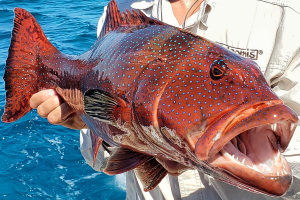
Yes, for the right fish. Red porgy did best on flat rock in Florida surveys, vermilion snapper stacked up around small potholes, and red grouper dig their own homes in flat bottom. Off North Carolina, flat natural reefs held as many fish as rugged ones. Flat bottom holds fewer kinds of fish, not no fish.
Why do I mark fish on structure but get no bites?
You may be marking the wrong fish or fishing the wrong depth. Vermilion snapper often hang 20 to 60 feet off the bottom, so a bait on the bottom sits under them. Tall wrecks also hold amberjack and jacks that may ignore a bottom bait. Change your depth before you change spots.
Does bottom structure matter for deep dropping?
Yes, but depth decides the species first. In surveys from North Carolina to Florida, blueline tilefish, snowy grouper and speckled hind showed up deep, while red snapper and black sea bass stayed shallower. On the deep drop, pick the depth for your target species, then look for hard bottom or mud within that range.
Pick the Depth First, Then the Bottom Structure
From the Texas banks to the Keys to the Georgia and Carolina ledges, the research tells a consistent story. Height and complexity decide which fish show up more than how many. Tall, broken rock and wrecks favor scamp, amberjack and the roaming predators. Flat rock and pothole fields hold red porgy, vermilion and red grouper. Big red snapper live mostly on natural bottom and feed over the sand around it. And all of it sits inside a depth range set by water temperature and season.
So pick your species, pick your depth, then choose the type of bottom, the part of the structure and the side of the current that fish uses. The captains in our reef and wreck fishing courses show those decisions on the water.
If red snapper are your target this season, the red snapper video courses put the same thinking to work on the Gulf's most pressured reef fish.
Key Studies Behind This Article
- FWC side-scan and camera survey of the Elbow, eastern Gulf (Switzer et al. 2020)
- Gray's Reef ledge study, Georgia (Kendall et al. 2009)
- North Carolina reefs and sand flats (Rosemond et al. 2018), predators on artificial reefs (Paxton et al. 2020) and flat vs complex reefs (Paxton et al. 2017)
- Southeast Atlantic reef fish video survey, Cape Hatteras to St. Lucie Inlet (Bacheler et al. 2016)
- Atlantic shelf-edge reef fish and habitat (Schobernd and Sedberry 2009)
- Red snapper on natural and artificial habitat, northern Gulf (Karnauskas et al. 2017)
- Red grouper pits at Pulley Ridge (Harter et al. 2017) and gag and scamp spawning habitat (Koenig et al. 2000)
- Golden tilefish burrow habitat, Mid-Atlantic and southern New England (Grimes, Able and Jones 1986)
- Grouper and reef relief in the Florida Keys (Sluka et al. 1998)
Login
to leave a review.
User Reviews
There are no reviews yet.
Setting Up a Dredge Pulley for Billfish
Saltwater
12.28.2020
High Speed Wahoo Trolling Rig
Saltwater
09.08.2018
Fishing Light Tackle for Yellowfin Tuna
Saltwater
09.08.2018
0