
Off the shelf, the slick is the only thing tying yellowfin to your boat. Get the finding and the feeding right and open water produces like any rig. This covers birds and drift, bait and cadence, depth control, sonar, and the sharks and mistakes that cost you fish.
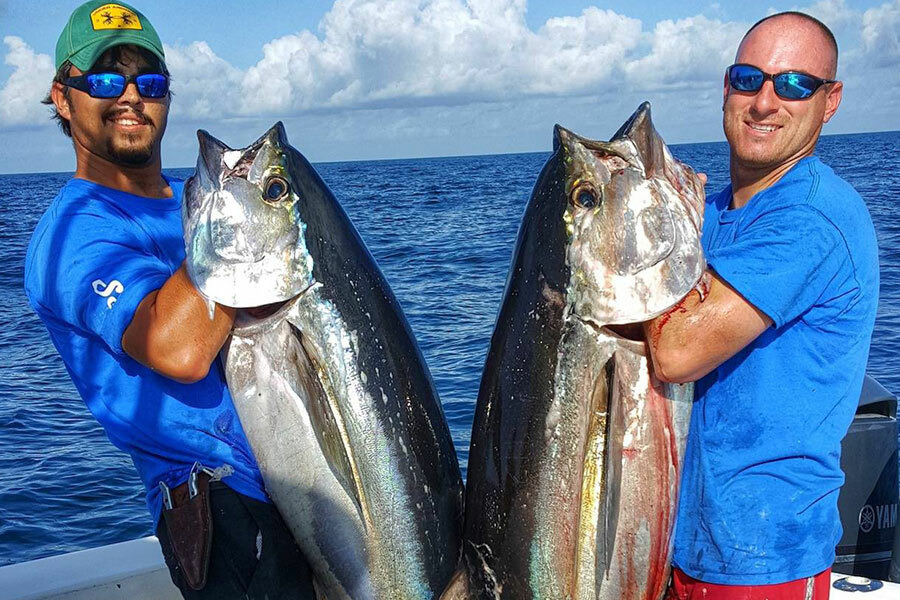
Chunking Yellowfin Tuna in Open Water
Out past the shelf, where there is no rig to anchor to and no trawler throwing bycatch, chunking is a different animal than it is in the Gulf. You are not leaning on somebody else's structure to hold fish. You are building the structure yourself, out of scent and a steady stream of cut bait, on a boat that is drifting across open water with a school of fish that never stops moving. I have done this from the Bahamas to the Northeast canyons to the deep water off the shelf, and the crews who do it well share one trait. They understand that in open water, the slick is the spot.
This is the open-water game, and it rewards a specific set of skills: reading birds and water to put yourself on fish in the first place, running a drift that keeps your baits where the tuna are, and feeding a slick with a rhythm that draws fish up without filling them up. If you want the full picture of how open water chunking fits alongside trolling, jigging, and live baiting, our pillar on catching yellowfin tuna offshore lays out the whole system. This article goes deep on one piece of it.
What is open-water chunking, and why is it different?
Chunking is the practice of cutting baitfish into pieces and feeding them off the stern in a steady cadence, building a drifting trail of scent and small chunks that draws yellowfin up through the water column and into range. You present a hooked bait that behaves exactly like the free chunks around it, and the fish, competing for an easy meal, eats it without the usual inspection. That much is true whether you are tied to a platform or drifting fifty miles from land.
How do you find yellowfin tuna in open water?
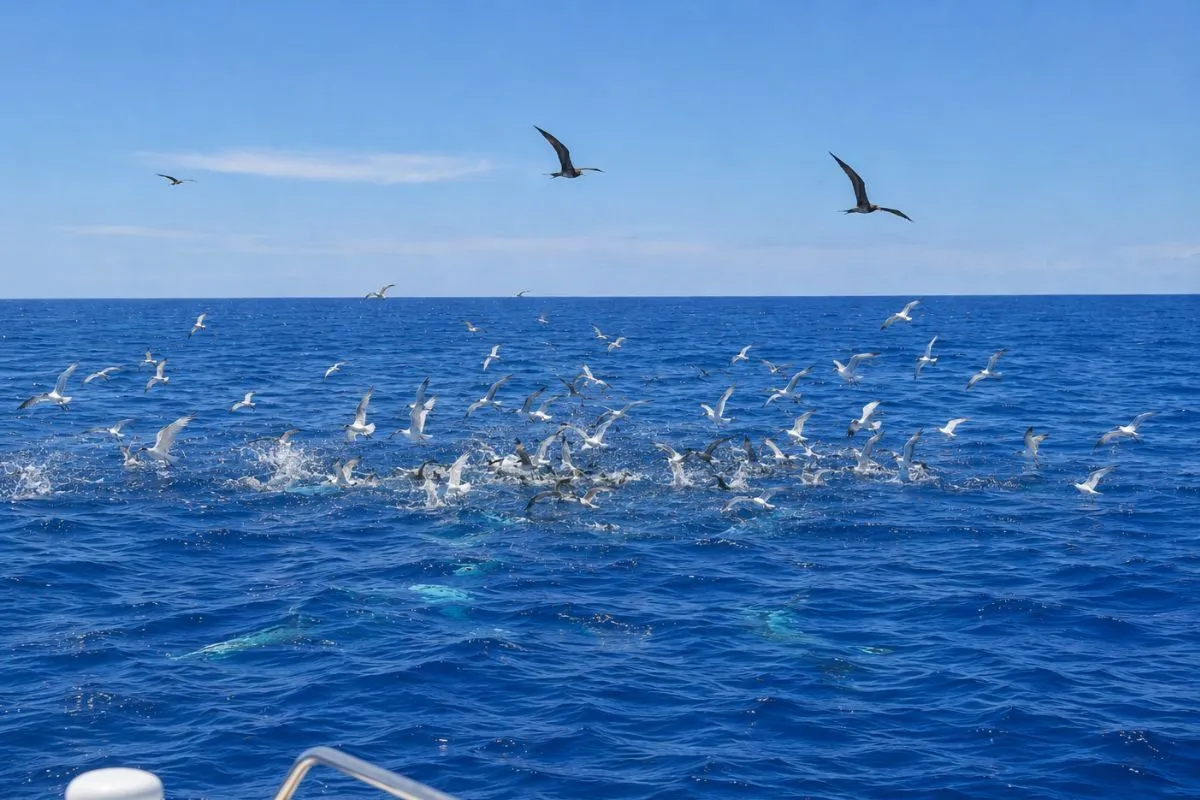
Finding fish is the half of open-water chunking that happens before you ever cut a bait, and yellowfin tuna give themselves away if you know what to read. Birds are the first and loudest signal. Frigatebirds hanging high and then dropping tell you bait is getting pushed up from below. Terns and shearwaters diving hard, and gannets folding into the water, mean the bait is on the surface right now and fish are working it. Learn the difference between birds picking at scattered scraps and birds locked onto a live blitz, because only one of those is worth changing your drift for. On a good radar you can mark flocks of birds miles off and run to them, which turns a lot of empty searching into targeted moves.
Water is the second signal, and the one that keeps you in the right neighborhood between bird sightings. Yellowfin relate to edges. A temperature break of even a degree or two, a color change where clean blue water meets greener nutrient-rich water, a weed line, or a current rip will all stack bait and hold fish along them. Before you leave the dock, reading satellite data for offshore fishing lets you narrow a huge stretch of ocean down to the few edges worth your fuel, so you start your drift on a seam instead of guessing. When the birds, the bait, and the temperature edge all line up in one place, that is where you shut down and start feeding.
Drifting versus anchoring in open water
In open water you are almost always drifting. The depths off the shelf are too great to anchor practically, and the fish are moving anyway, so you use the drift rather than fight it. A drift sets up your entire presentation. The boat moves with the wind and current, your slick streams back and down behind you, and your baits ride in that column at the depth the fish are holding. The art is in controlling it, and the biggest variable is how wind and current interact.
When wind and current run together, you get a clean, narrow, coherent slick and a manageable drift, which is the best case. When they oppose each other, the sea stacks up, the drift stalls or lurches, and the slick smears and disorganizes, scattering your scent trail so fish never follow a clean line up to the boat. Good captains often choose their drift by the current lines rather than the wind alone, setting up so the slick lays out straight. On a hard drift, a sea anchor slows you down and, just as importantly, holds your stern oriented into the slick so your baits present into the trail instead of swinging across it.
Most days you manage the drift with your baits and your feed rather than the throttle, adding weight to keep offerings in the column and staggering baits at different depths until you find the fish. The goal is a drift slow and steady enough that a fish moving up your scent trail arrives in a tight zone where your baits are waiting, not spread thin across open water where it never finds them.
How do you select and cut bait for the slick?
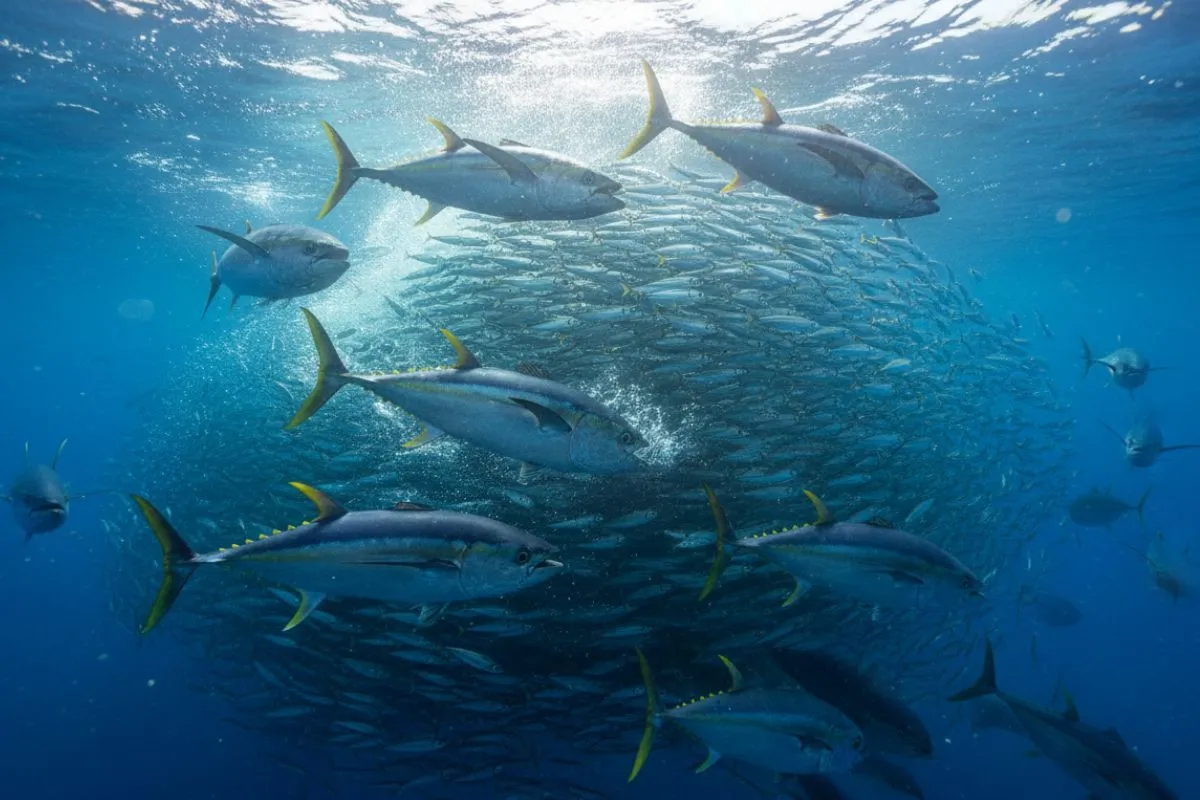
Your slick is only as good as the bait building it. Fresh matters more than anything, because yellowfin in open water have all the time in the world to refuse a soft, off-color chunk. Bonito, mackerel, herring, and sardines all make excellent chunk bait, and matching the local forage helps, so if the fish are eating small stuff, cut smaller. Oily fish throw a stronger scent trail, which is exactly what you want when you are trying to reach fish that could be well down and well behind the boat.
Cut with a plan. Uniform chunks sink at a predictable rate, so your free offerings and your hooked bait fall together and look like one thing. A hooked bait that sinks faster or slower than the freebies stands out, and wary fish will often refuse it. Vary your chunk size to the conditions, cutting smaller in clear, pressured water where fish are picky and going bigger when they are aggressive or holding deep and you want a chunk they can find. Keep your bait cold and firm right up until it goes over the side, work off a clean cutting board, and cut ahead so you are never scrambling to keep the cadence when the bite turns on. Running out of prepared bait in the middle of a hot slick is how good drifts die.
Building a slick without overfeeding
Cadence is the whole skill, and it is where most open-water slicks fail. You are trying to create competition, not a buffet. Feed too much and you fill the school before it ever reaches your hooked bait, and a stuffed tuna is a tuna that swims off. Feed too little and the scent trail thins out and breaks, and the fish drifting up it lose the thread and disappear. The working rhythm is a few chunks every ten to twenty seconds, adjusted constantly to what the fish are telling you.
Tie the cadence to your drift. On a faster drift you feed a little more often to keep the trail unbroken, and on a slow drift you back off so you are not piling bait under the boat. When fish show in the slick and the bites start, resist the urge to dump bait to keep them there. Hold your rhythm, let the competition build, and put your hooked bait in among the freebies at the depth the fish are eating. It is far easier to ramp a slick up than to un-feed a school that you have already filled.
One trick worth knowing is to add menhaden oil to your chunk bucket. The oil rides out with the bait and extends the scent trail well beyond what the chunks alone put out, and it has a second benefit that most anglers overlook. It calms the surface ripple around the boat, which makes it far easier to see fish working up through the slick and to watch how your bait is falling among the freebies.
How do you present the hooked bait?
Everything you have built collapses if the hooked bait behaves differently from the free chunks around it. The presentation is the whole point of the slick, and the mechanics matter. Put the rod in a holder with the reel in freespool and the clicker engaged. Before the sinking bait starts pulling line and putting tension on the drop, reach out past the rod tip, strip five or six feet of slack, and lay it on the surface so the chunk sinks completely unrestricted. A bait that falls against even light drag pressure hesitates and tracks differently from the freebies, and a yellowfin reads that instantly.
From there you have two schools of thought, and they produce different fish. You can drop a bait in the slick and wait for whatever finds it, letting it drift back a hundred yards or so before you retrieve and redeploy. Or you can watch the school, track where the bigger fish are working, and time your bait so it falls into the path of the fish you actually want. That second approach is effectively hand-feeding a chosen tuna, and it is what separates crews who catch numbers from crews who catch size. It takes patience and it takes reading the school, and you retrieve and reset rather than letting a small fish eat a bait you meant for a better one.
When smaller fish are shredding everything before the yellowfin can commit, one answer is to flood the slick. Put out a heavy burst of chunks to oversaturate the bonito and blackfin, filling them up and buying a window where your hooked bait can get down to the fish you want. Stagger your presentations at varying distances back in the chunk line as well, since bunching every bait in one spot just concentrates the competition you are trying to beat.
When a fish eats, do not rush it. Let it peel line for four to six seconds before you push the drag up and start reeling, giving the circle hook time to move to the corner of the jaw, and give a larger bait a little longer still. Fight that first run with the rod still in the holder, which lets you establish control against a fresh, fast fish, and move to a stand-up position once the initial run is done and the fish has settled.
How does depth control change the bite?
Yellowfin never stop moving, and in open water they can eat anywhere from the surface to well down the column, so depth control is often what separates a slow slick from a hot one. There is no structure to pin the school, so you hold fish with an unbroken scent trail and baits spread through the column, letting a fish arriving at any depth find something that falls like a free chunk. Your job is to figure out where they are eating and load that zone.
How do you use sonar to stay on fish?
Electronics turn depth guessing into depth control, and any serious open-water crew leans on the sounder. Good sonar lets you confirm whether tuna are holding thirty feet down or a hundred and fifty, which tells you exactly where to set your baits instead of fishing blind. Watch the density and shape of the marks too, because learning to tell tuna from a bait ball from a shark on the screen keeps you from wasting a drift feeding the wrong thing.
When do light and time of day matter?
Light drives a lot of open-water feeding, and ignoring it leaves fish on the table. The first and last hours of daylight are prime for surface eats, when low light emboldens yellowfin to push bait up and crash it on top, so that is when your free-lines and shallow baits earn their keep. Through the bright middle of the day the fish often slide deeper to escape the light and boat pressure, which is exactly when weighted baits and reading the sounder pay off, because the surface can go quiet while the fish keep eating forty or eighty feet down.
How do you manage sharks in the slick?
A good slick draws everything, and offshore that means sharks will find you, sometimes fast. Once they move in and start taxing hooked fish, you have a decision to make. You can briefly speed up your cadence to pull tuna up through the slick and get bites before the sharks organize, and you fight hooked fish hard on heavier drag to get them to the boat quickly rather than letting a long fight ring the dinner bell. If the tax becomes constant and every fish is getting eaten, the honest move is often to pick up and run, resetting your drift a good distance away and rebuilding a fresh slick on clean water. Feeding sharks all afternoon helps no one, least of all the fishery.
When structure enters the picture
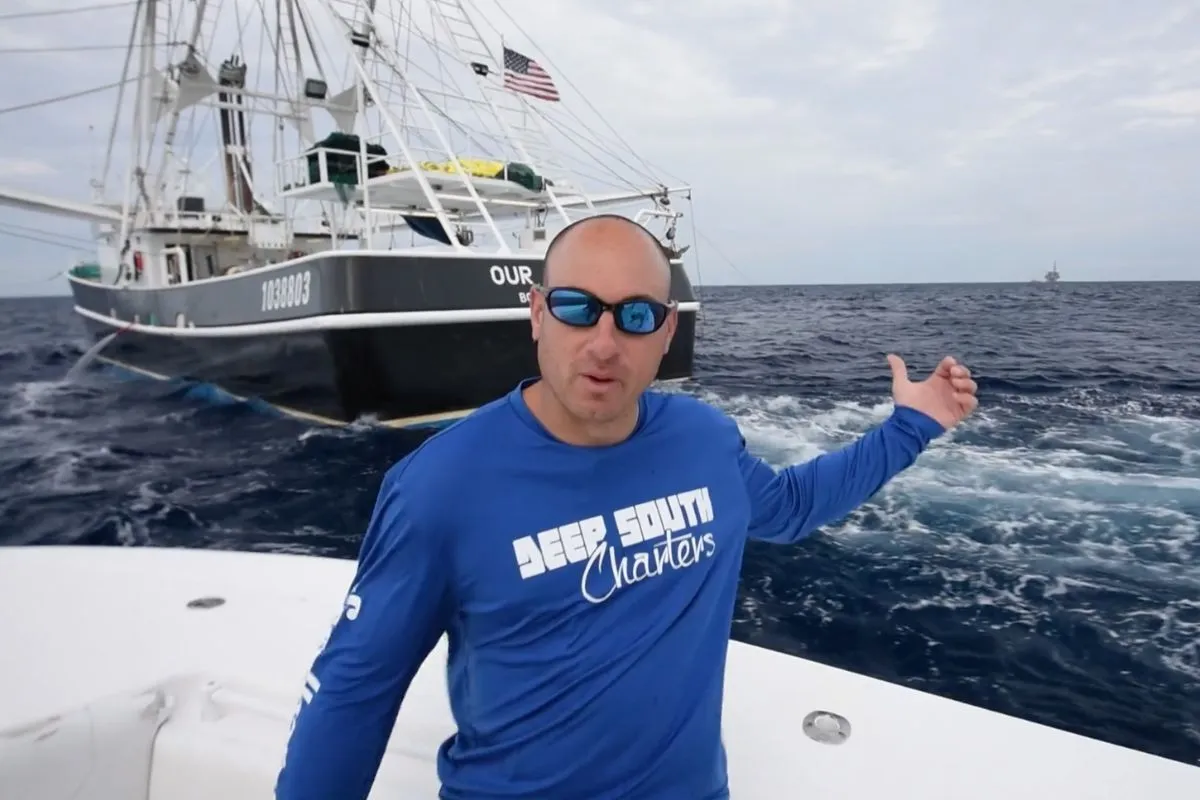
Everything changes the moment you add a rig, a platform, or a working trawler to the equation. Now the structure and the food are concentrating fish for you, the positioning problem becomes an up-current game, and the tactics shift from building your own slick in empty water to peeling fish off somebody else's buffet. That is a genuinely different discipline, most famously practiced in the deep water out of Venice, and it deserves its own treatment. Our breakdown of chunking Venice yellowfin around rigs and trawlers covers that structure game in full. Everything in this article is about the water where none of that help exists.
What tackle do you need for open-water chunking?
Open-water tackle balances finesse against the reality that a big fish may eat forty feet down and a quarter mile back. You need line capacity and drag, and you need a leader the fish will not read. Most crews run conventional reels in the Talica, Tiagra, and similar 20‑ to 50‑size class, with smooth drags and several hundred yards of braid, stepped down to a fluorocarbon leader scaled to the water clarity and the mood of the fish. On competitive fish, 60 to 100 pound fluorocarbon holds up fine, while spooky fish in clean blue water often force you down to 40 or 50 pound to draw a strike. When sharks are working the slick or the light is low and the fish are less leader-shy, many canyon crews start heavier, running 80 to 130 pound so a taxed or hard-fighting fish does not cut them off, and scale down only if the bites stop.
Common open-water chunking mistakes
Most slow days trace back to a handful of repeatable errors. Watch for these:
- Overfeeding the slick and satiating the school before it ever reaches your hooked bait
- Letting the feed cadence go ragged so the scent trail breaks and fish lose the thread
- Fishing every bait at one depth instead of covering the column with free-lines and weighted baits
- Ignoring drift speed and how wind and current interact, which scatters the slick
- Starting a slick before you have confirmed fish are actually in the area
- Fishing leader too heavy for clear, pressured water, then wondering why the fish will not commit
Staying safe and organized on the drift
Open-water chunking gets chaotic fast when a school fires up, and a drifting boat with several fish on is a place where things go wrong. Keep lines clear of the props, especially when the captain needs to bump the boat to chase a fish or reset the drift. Assign roles before the bite so the crew knows who is feeding, who is fighting, and who is on the gaff, and communicate loudly through the chaos. A calm, organized cockpit lands far more of the fish it hooks than a scramble does, and it keeps everyone aboard in one piece.
Chunking Yellowfin Tuna Video Courses
Frequently asked questions about chunking yellowfin tuna in open water
What is the best bait for chunking yellowfin tuna?
Fresh, oily fish make the best chunk bait, with bonito, mackerel, herring, and sardines all producing well. Freshness and matching the size of the local forage matter more than the exact species. Soft, off-color, or freezer-burned bait gets refused by open-water fish that have time to inspect it.
How often should you throw chunks?
A few chunks every ten to twenty seconds is the working rhythm, adjusted to the fish and the drift. The goal is a steady, unbroken scent trail that builds competition without filling the school. Feed a little more often on a fast drift and back off on a slow one.
How do you find yellowfin tuna without structure?
Read birds and water. Frigatebirds dropping and terns diving mark bait getting pushed up, and temperature breaks, color changes, weed lines, and current rips concentrate that bait. Satellite temperature and chlorophyll charts narrow the search before you leave the dock so you start your drift on a productive edge.
How deep should you fish your baits when chunking?
Fish the depth the tuna are holding, which the sounder will show you. Start with a free-line and a couple of baits staggered down the column, then load the zone where you get bites or mark the heaviest fish. Low-light periods favor shallow baits, while bright midday often pushes fish deeper.
How do you deal with sharks in the slick?
Speed up the cadence briefly to pull tuna through ahead of the sharks, fight hooked fish hard on heavier drag to get them boat-side fast, and if every fish is being taxed, pick up and reset your drift on clean water rather than feeding sharks all day.
Bringing it together on the drift
Open-water chunking comes down to two disciplines done well. You find the fish by reading birds and water and starting your drift on the right edge, and you hold them by feeding a clean slick with a rhythm that builds competition and spreading your baits through the column so a fish arriving at any depth finds one that falls like a free chunk. Control your depth with the sounder, mind the light and the sharks, and reset the drift on the water that produces. There is no rig doing the work for you out here. The slick is the structure, and your cadence is what keeps it alive.
Login
to leave a review.
User Reviews
There are no reviews yet.
Complete Dredge Pulley Setup Guide
Saltwater
12.28.2020
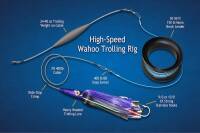
High Speed Wahoo Trolling Rig
Saltwater
09.08.2018
Fishing Light Tackle for Yellowfin Tuna
Saltwater
09.08.2018


0