
Light tackle is not a handicap. It is how you get bites that heavy gear leaves in the water. This breaks down fishing light for yellowfin, why lighter leader beats their eyesight, building a balanced system, landing big fish on light drags, and when going light is the wrong call.
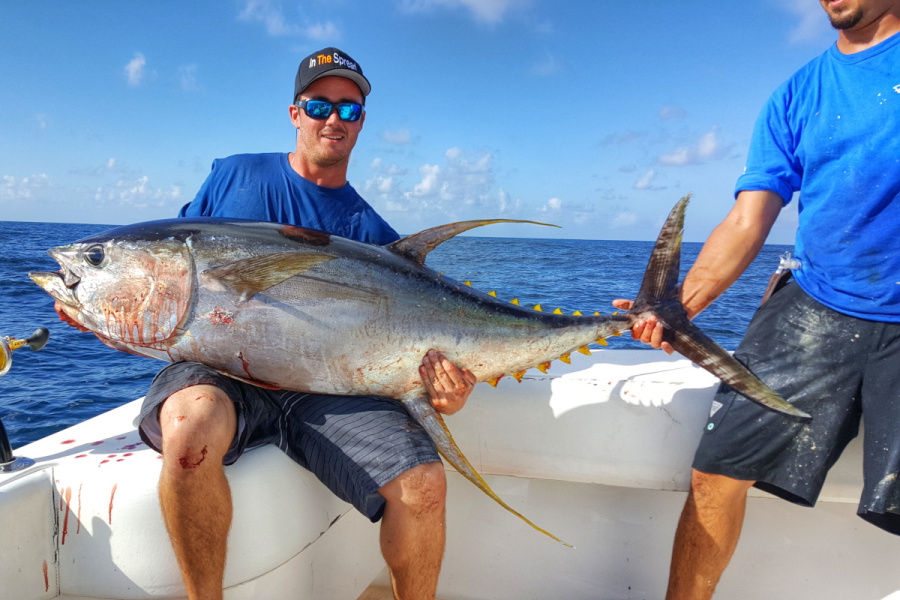
Fishing Light Tackle for Yellowfin Tuna
There is a kind of angler who looks at a hundred-pound yellowfin and reaches for the heaviest rod on the boat, and there is a kind who reaches for the lightest one that can still land it. In the right conditions, the second angler gets more bites and converts more fish, because a lighter, balanced system simply looks and moves better in the water. That sounds backward until you understand what light tackle actually does for you. It is not about handicapping yourself for bragging rights. It is about getting bites that heavier gear leaves on the table, and it is one of the most rewarding ways to fish for these animals anywhere they swim.
What does light tackle mean for yellowfin tuna?
Light tackle is a relative term, and with yellowfin it does not mean undergunned. A trout angler and a tuna angler mean very different things by it. For yellowfin, light tackle means scaling your outfit down from the broomstick-and-winch approach to a balanced setup that still has the backbone to land the fish, just with less margin and more finesse. Think spinning gear and lighter conventional setups, thinner braid, and leader dropped to the lightest the conditions allow. And it is aimed at a specific target, school-size yellowfin in roughly the 20 to 80 pound class in open water or moderate structure, not the true giants that demand heavy stand-up gear.
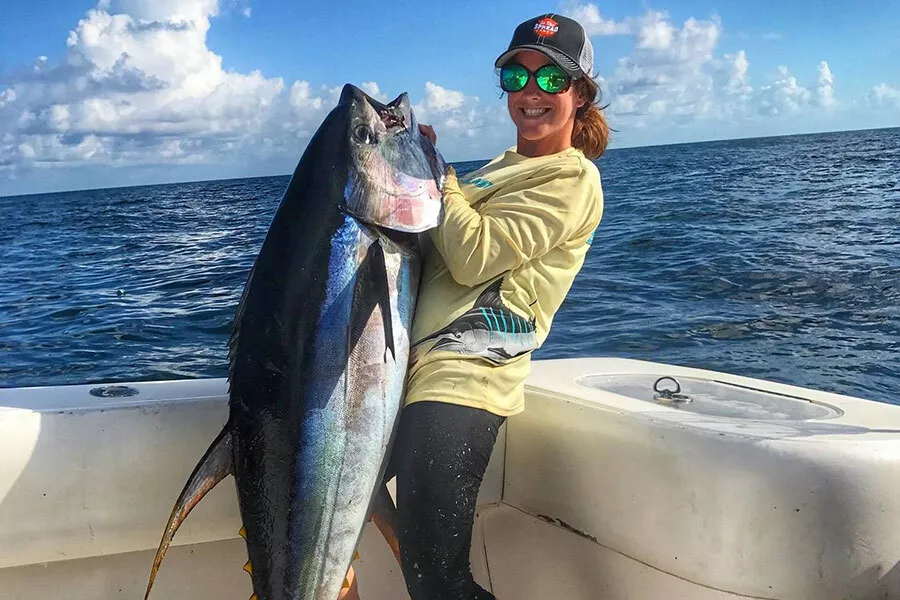
Why fish light tackle for yellowfin?
The biggest reason is simple: lighter leader and line get bites that heavy gear does not. Yellowfin have extremely sharp eyesight and lean on it hard when they feed, especially in clear water, and a stiff, thick leader is one of the first things they read and reject. When fish are up and feeding but picking through your offerings, dropping from 100-pound leader to 50 or even 40 can be the difference between watching them refuse and coming tight. This ties directly to how these fish see and think, which our breakdown of how yellowfin see and refuse baits gets into in depth. Fluorocarbon compounds the advantage, since its thinner diameter and low visibility make the connection much harder to see than mono. Light tackle is really a tool for beating their eyesight.
- Pressured and finicky fish that have seen a fleet of boats go shy of heavy presentations and eat lighter ones
- Smaller, aggressive schools of fish in the 20 to 60 pound class, where heavy gear is overkill and kills the fun
- Clear blue water, where line visibility matters most and thin, low-visibility setups shine
- Natural bait and lure action, which a lighter outfit preserves and a stiff heavy one deadens
The balanced-system principle
Here is the mistake that sinks most light-tackle efforts: treating "light" as one component instead of the whole outfit. A light leader tied to heavy main line makes no sense, and neither does a powerful rod paired with an undersized reel. A light-tackle outfit has to work as a system, with the drag, the rod action, the main line, and the leader all matched to each other and to the fish you are realistically targeting. When one piece is out of balance, that piece becomes the failure point, and the fish finds it every time.
Get the balance right and the tackle does the work instead of the angler. The rod loads and cushions, the drag gives line smoothly under a run, and the whole system absorbs the shock of a big fish instead of transferring it to a single weak link. That is the real skill in light-tackle fishing, and it is why the anglers who are good at it land fish that look impossible for the gear in their hands. They are not stronger. Their systems are balanced.
A simple example makes it concrete. Put 50-pound leader on a rod and drag set to fight with the right pressure for that leader, and the outfit fishes in balance, giving line smoothly on a run and protecting the weakest link. Put that same 50-pound leader behind a locked-down heavy drag and a stiff, unforgiving rod, and the first hard run parts it at the knot. Same leader, opposite outcome, decided entirely by whether the system was matched.
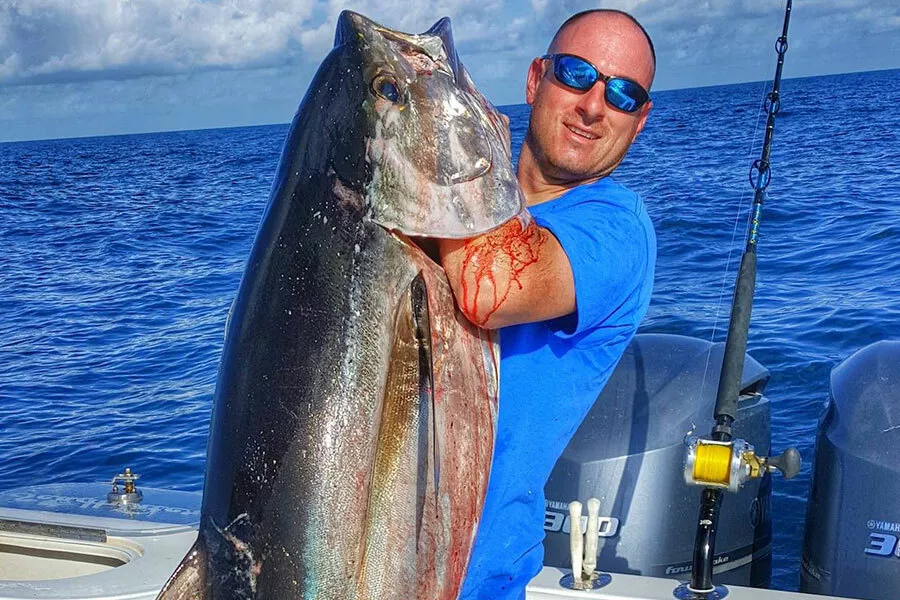
What gear do you need for light-tackle yellowfin?
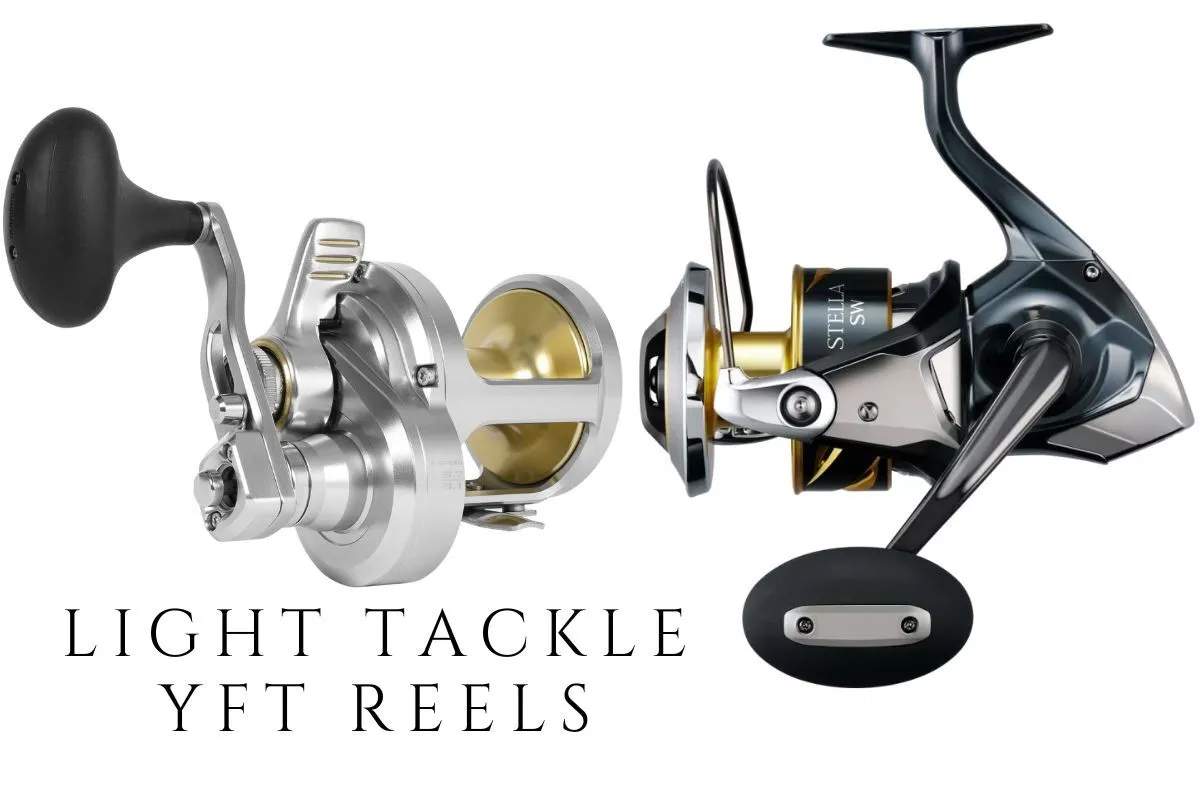
Light-tackle yellowfin runs on two families of reel, and which you reach for depends on how you are fishing. For live-bait chumming and chunking, a compact two-speed lever-drag conventional is the workhorse. Captain Josh Howard fishes a Shimano Talica 25 for his Venice live-bait chumming, and it is a good example of the class, with enough drag and capacity to stop a heavy Gulf yellowfin in a frame small enough to fish all day. Equivalents that do the same job include the Okuma Makaira 10II and 15II, the Daiwa Saltiga lever drag 15, and the more budget-friendly Penn Fathom 15LD2 and 25LD2, along with West Coast style conventionals like the Avet SX and MXJ. The two-speed gearing is what makes these reels shine, giving you high gear to pick up line fast when a fish charges the boat and low gear for torque once it settles into a deep circle. Look for real capacity of 250 to 300 yards of 40 to 50 pound braid and a smooth drag that holds 12 to 18 pounds of working pressure without fading on a long run.
For casting poppers, stickbaits, and jigs, a quality spinning outfit is the tool. A rod in roughly the 20 to 30 pound class with a moderate-fast action gives you cushioning and lifting power without being a club, paired with a smooth-drag spinning reel in the 6000 to 10000 class sized to hold plenty of thin braid. Braided main line in the 30 to 65 pound range gives you capacity and low stretch for direct contact.
Whichever family you fish, step your fluorocarbon leader down only as far as the fish demand. A practical ladder is to start around 80 to 100 pound when the fish are chewing, drop to 60 to 80 when they turn hesitant, and go into the 40 to 60 pound range only when you are clearly seeing refusals on heavier leader and the fish size and structure let you fish that light responsibly. The lightest end is an advanced, clear-water finesse choice, not a starting point. Keep your main line roughly matched to your leader too, running 40 to 65 pound braid to 40 to 60 pound leader so the braid never becomes the weak link under drag.
Light tackle is not just a bait game. It shines with artificials, and smaller tuna-grade stickbaits, cup-faced poppers, and vertical jigs in roughly the 3 to 7 ounce class fish beautifully on these outfits, letting you cast long, work the lure naturally, and stay in direct contact through the fight. Whatever you throw, your knots matter more on light tackle, so tie a slim, strong braid-to-fluorocarbon connection like an FG or Slim Beauty and seat it well to get the leader's full breaking strength.
- Casting school fish, 20 to 50 pounds: an 8000 to 10000 spinning reel, 50 pound braid, 40 to 60 pound fluorocarbon leader, a 7 to 8 foot rod, and stickbaits or small live baits
- Live-bait or chunking, 50 to 80 pound Gulf fish: a Talica 25 or Makaira 15 class two-speed conventional, 50 to 65 pound braid, 60 to 80 pound fluorocarbon leader, and circle hooks matched to the bait
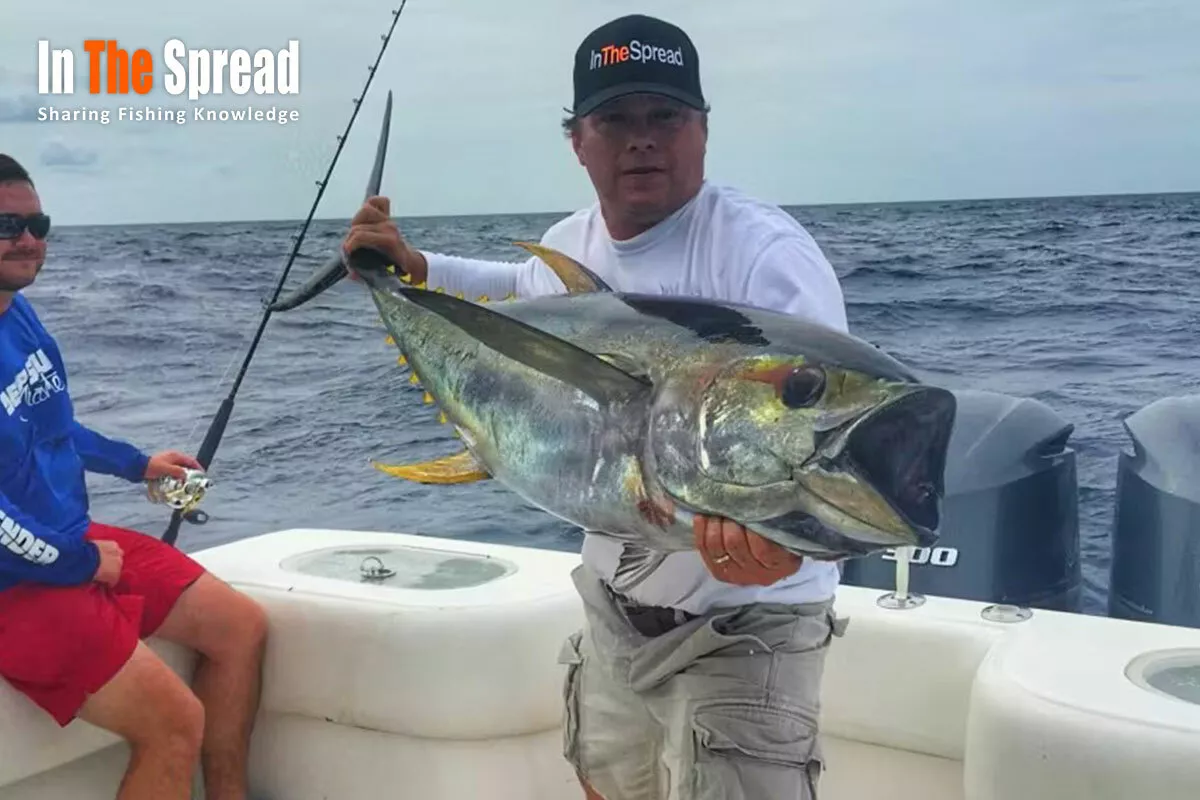
How do you fight a big yellowfin on light gear?
This is where light tackle is won or lost. A big yellowfin on light gear cannot be horsed, and the angler who tries breaks off every time. The fight is about patience and drag, not power. Set your drag before the fish ever eats, light enough that a blistering first run does not part the line but firm enough to keep steady pressure and tire the fish. On light tackle, that drag is your most important tool, and a smooth, consistent one is worth more than any amount of rod muscle.
Let the fish run when it wants to run. Pressuring a green fish into its first run is how leaders pop and hooks pull. You keep steady, moderate pressure, you let the drag and the rod do their work, and you use the boat, backing down or turning to change the angle and shorten the fight, rather than trying to lift a fish that outweighs your tackle. When a yellowfin sounds and starts the death spiral beneath the boat, you fight it with short, smooth pumps and never slack line. The fight takes longer than it would on heavy gear, and that is the trade. You accept the longer battle in exchange for the bite that got you here.
How do you decide to go light on a given day?
Rigging light is a read, not a default, and the smart move is often to let the fish make the decision for you. Start with a moderate setup and drop lighter only when the fish tell you to. If they are eating well on 80 or 100 pound leader, there is no reason to fish lighter and give up strength. But when you watch fish come up, inspect a bait, and slide off without eating, that refusal is your signal to step down, and you keep dropping leader until you start getting bit.
When is light tackle the wrong call?
Light tackle is a tool, not a religion, and part of fishing it well is knowing when to leave it in the rocket launcher. There are days and places where going light is a mistake that costs you fish and, worse, kills fish you meant to release.
Do not fish light when you are working heavy structure. Around oil rigs, platforms, and trawlers, a big yellowfin will turn and cut you off on the structure before you can stop it, which is exactly the game covered in chunking big yellowfin around Venice structure, where more rod and heavier leader are the right answer. Step up when you are targeting genuine giants, the 150-pound-plus class that will simply outlast light gear over a fight long enough to exhaust the fish past recovery. And step up when sharks are working the area, because a long light-tackle fight rings the dinner bell and you lose the fish to a tax you could have avoided. The principle underneath all of this is worth stating plainly: fish as light as you need to get the bite, but as heavy as you can to end the fight quickly. A long fight is not a trophy. It is exhaustion, and an exhausted tuna builds up lactic acid and can die hours or even days after it swims off looking fine, which is exactly why prolonged light-tackle battles draw hard objections from experienced captains. That risk multiplies with sharks working the area and when you plan to release.
If you are keeping the fish, land it cleanly and avoid a break-off that leaves gear trailing a fish. If you are releasing, lean toward enough tackle to finish the fight in a reasonable window, keep the fish in the water, support it upright rather than letting it pinwheel on its side, minimize its time at the boat, and let it swim off strongly on its own. Even around rigs and trawlers, where you drop leader for bites, keep the rod and drag stout enough to turn a fish away from the steel, because light leader on a strong rod beats a fully light system there. Light tackle rewards the right conditions. It punishes the wrong ones.
Where light tackle shines by fishery
The light-tackle approach travels, but it earns its keep most in specific situations. In the Bahamas, where the average yellowfin runs under 50 pounds and the water is gin-clear, light tackle is not just fun, it is the right tool, letting you present small baits naturally and drop leader to fish that inspect everything. Off Venice and through the Gulf, light tackle has a dedicated following among anglers like Captain Josh Howard, who use it on the smaller, aggressive fish and on days when heavier leader gets refused, while keeping heavier gear ready for the giants and the structure. On the Pacific coast and around the dolphin schools of Central America, matching lighter leader to the mood of a picky, well-worked school is often what turns lookers into biters.
Frequently asked questions about light-tackle yellowfin tuna
What is considered light tackle for yellowfin tuna?
For yellowfin, light tackle generally means spinning or lighter conventional outfits in roughly the 20 to 30 pound class, thin braided main line, and fluorocarbon leader dropped as light as conditions allow, often 40 to 60 pound. It is a relative term that means scaling down from heavy stand-up gear while keeping enough backbone to land the fish, aimed at school-size fish in roughly the 20 to 80 pound class rather than the giants that demand heavy stand-up outfits.
Why does lighter leader get more bites?
Yellowfin hunt by sight and inspect everything before eating. A thick, stiff leader is one of the first things they detect and refuse, especially in clear water and on pressured fish. Dropping to lighter leader makes your presentation look and move more naturally, which draws strikes that heavier leader does not, and lighter fluorocarbon, with its thinner diameter and reduced visibility, hides the connection even better.
How do you land a big yellowfin on light tackle?
Patience and drag, not power. Set a smooth drag light enough to survive the first run, let the fish run when it wants, keep steady moderate pressure, and use the boat to change the angle and shorten the fight. Never horse a green fish, and accept that a light-tackle fight takes longer.
When should you not use light tackle for yellowfin?
Around heavy structure like rigs and trawlers where a big fish cuts you off, when targeting true giants over 150 pounds that will outlast the gear, and when sharks are working the area and a long fight invites a tax. In those cases, step up to heavier rod and leader.
Is light tackle bad for the fish you release?
It can be if you misuse it. A fight long enough to exhaust a fish past recovery hurts survival, so light tackle is best matched to fish sizes the gear can land in a reasonable time. For giants or shark-heavy water, heavier gear that ends the fight faster is the more responsible choice.
Can you catch big yellowfin on spinning tackle?
Yes. A quality spinning outfit with a strong, smooth drag and enough braided line capacity will land yellowfin well over 100 pounds when the drag is set right and the fight is managed with patience. The limit is rarely the reel and almost always the leader and the angler's discipline. Past that range you are into specialist giant-spinning territory, with high-end gear and a planned fight strategy well beyond the everyday light-tackle setups this article covers.
Yellowfin Tuna Video Courses
Fishing light, fishing smart
Catching yellowfin on light tackle is not about proving anything. It is about getting bit when heavier gear will not, and earning a fight that respects one of the ocean's great predators. It comes down to a handful of things done well: understanding that light is a balanced system and not a single component, dropping leader and line to beat their eyesight, managing a smooth drag with patience through a longer fight, and having the judgment to know when the conditions call for more gear instead. Get those right and you will catch fish on days the heavy-tackle crowd goes home frustrated.
Login
to leave a review.
User Reviews
There are no reviews yet.
Setting Up a Dredge Pulley for Billfish
Saltwater
12.28.2020
High Speed Wahoo Trolling Rig
Saltwater
09.08.2018
Fishing Light Tackle for Yellowfin Tuna
Saltwater
09.08.2018
0