
The anglers who catch yellowfin consistently understand the fish, not just the tackle. This goes inside how these sight-hunting, high-speed predators feed, why they refuse, how they use the water column, and how their behavior shifts with conditions, so you can read a school and adjust.
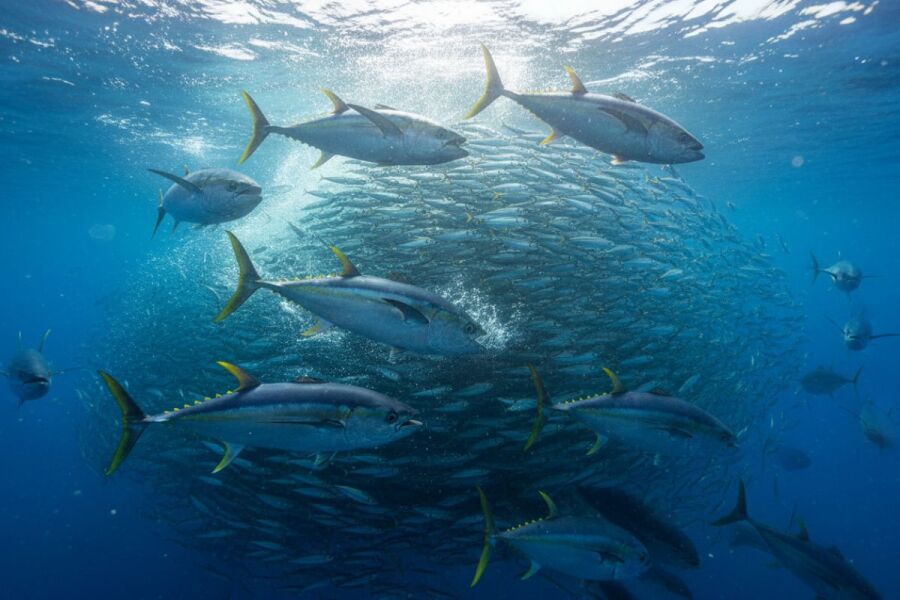
Understanding Yellowfin Tuna Behavior and Feeding
You can rig the perfect bait, run the right spread, and put your boat in exactly the right water, and a yellowfin will still swim up, look at your offering, and refuse it. I have watched it happen in a lot of oceans. The anglers who catch these fish consistently are not the ones with the most expensive tackle. They are the ones who understand what the fish is doing and why, and who adjust before the window closes. Everything mechanical about catching yellowfin, the baits, the lures, the drift, sits on top of one foundation: reading the behavior of the fish.
This article is that foundation. It digs into how yellowfin tuna sense the world, why they move the way they do, how they decide what to eat and what to ignore, and how their behavior shifts with the conditions. For the how, where, and when of actually catching them, our pillar on catching yellowfin tuna offshore lays out the techniques. Here we go inside the fish.
What makes yellowfin tuna such difficult predators?
Yellowfin tuna are hard to catch for reasons that have nothing to do with rarity. They are abundant in the right water. They are hard because they are elite predators equipped with acute senses, blistering speed, and a selective, calculating approach to feeding. A yellowfin does not eat everything it sees. It inspects, compares, and rejects, and it does all of that faster than you can react.
How good is a yellowfin tuna's eyesight?
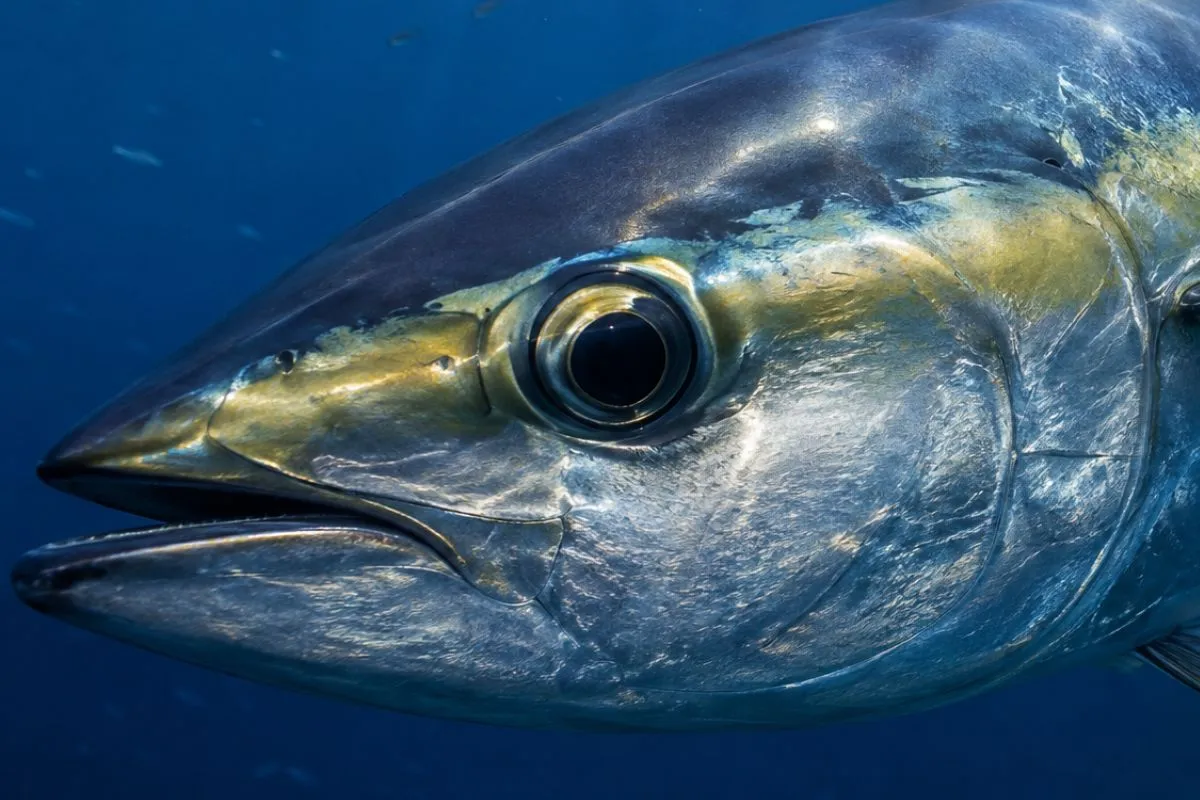
A yellowfin's eyesight is its primary weapon and your primary obstacle. These fish have large, well developed eyes and hunt largely by sight, and their vision is sharp enough to read details of your presentation that you would never think twice about. Line diameter, the stiffness and shine of a leader, the shadow of a hook, a swivel catching light, a bait that spins or falls at an unnatural rate, all of it registers. When a fish follows your offering and turns away at the last second, its eyes just told it something was wrong.
Their large eyes also give them an edge in low light. Yellowfin see well in the dim conditions of early morning, late evening, and deeper in the water column, which is a big reason the first and last hours of the day produce and why fish will eat down deep in the middle of a bright day. Their vision is tuned to the blue-green light that dominates open water, right where their prey shows up best. The practical lesson from their eyesight is not a specific leader size. It is a mindset. Everything you put in the water is being inspected by an animal built to find flaws, so the closer your presentation looks and behaves like the real thing, the more fish you convert.
How do speed and constant movement shape their behavior?
Yellowfin are built from the nose to tail for speed, and that engineering dictates how they live. They are capable of bursts approaching 50 miles per hour, and like other tunas they are regionally warm blooded, using a heat exchange system to keep their muscles warmer than the surrounding water so they can sustain high output over long distances. A fish built like that has a high metabolism, and a high metabolism means it has to feed almost constantly. Yellowfin spend a large share of their time in motion, covering enormous distances and positioning around food, with true rest phases far shorter than the hours they spend traveling and feeding.
How do yellowfin tuna use the water column?
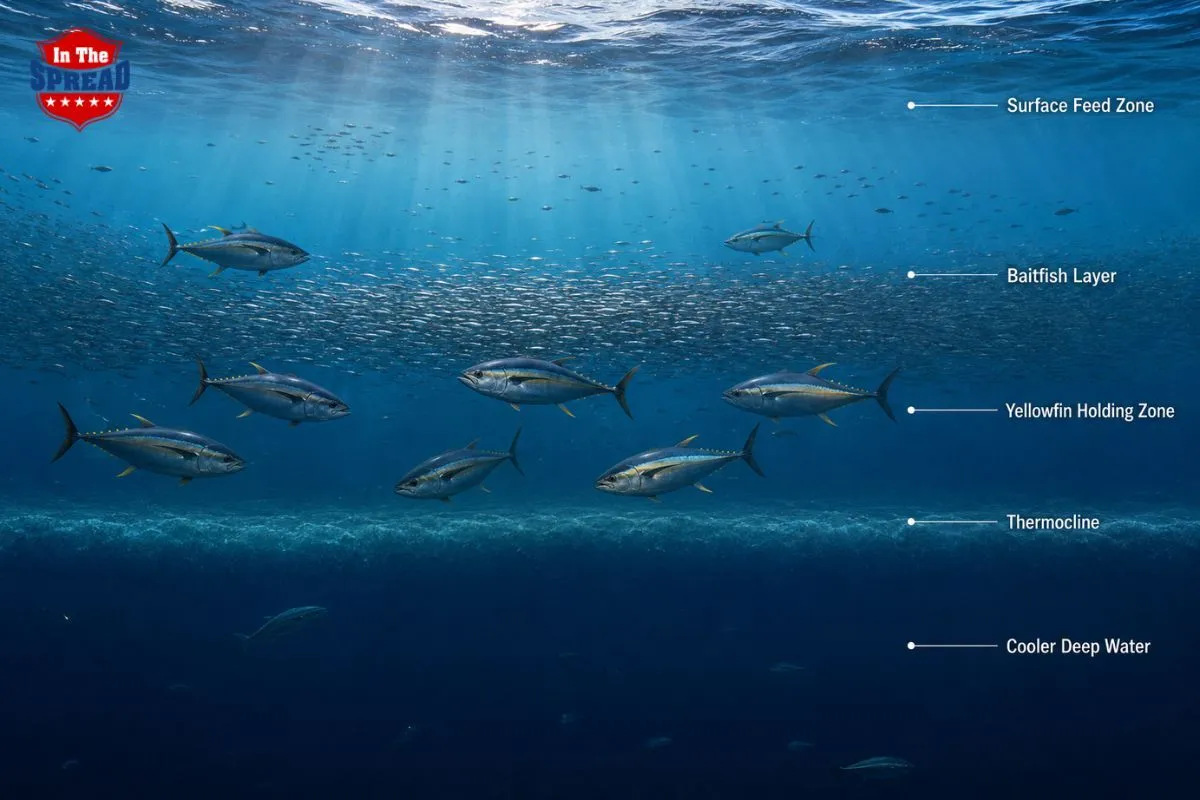
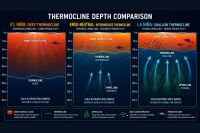
Yellowfin are surface-oriented predators, but they work a specific slice of the water column, and knowing it helps you find and reach them. They spend most of their time in the upper part of the water, generally the top several hundred feet, holding above or around the thermocline where warm surface water meets the cooler layer beneath. That boundary tends to trap bait, so fish and forage often stack along it. Deeper down, low-oxygen layers set a floor that yellowfin avoid, which is part of why bites so often cluster in particular depth bands rather than spreading evenly through the column. When the thermocline sits shallow, the fish stack just above it and are easier to reach, and when it drops deep, they can be harder to mark and pull up. Reading that layer, on your sounder and in how the fish respond, tells you where in the column to put your baits.
Why are yellowfin tuna such selective feeders?
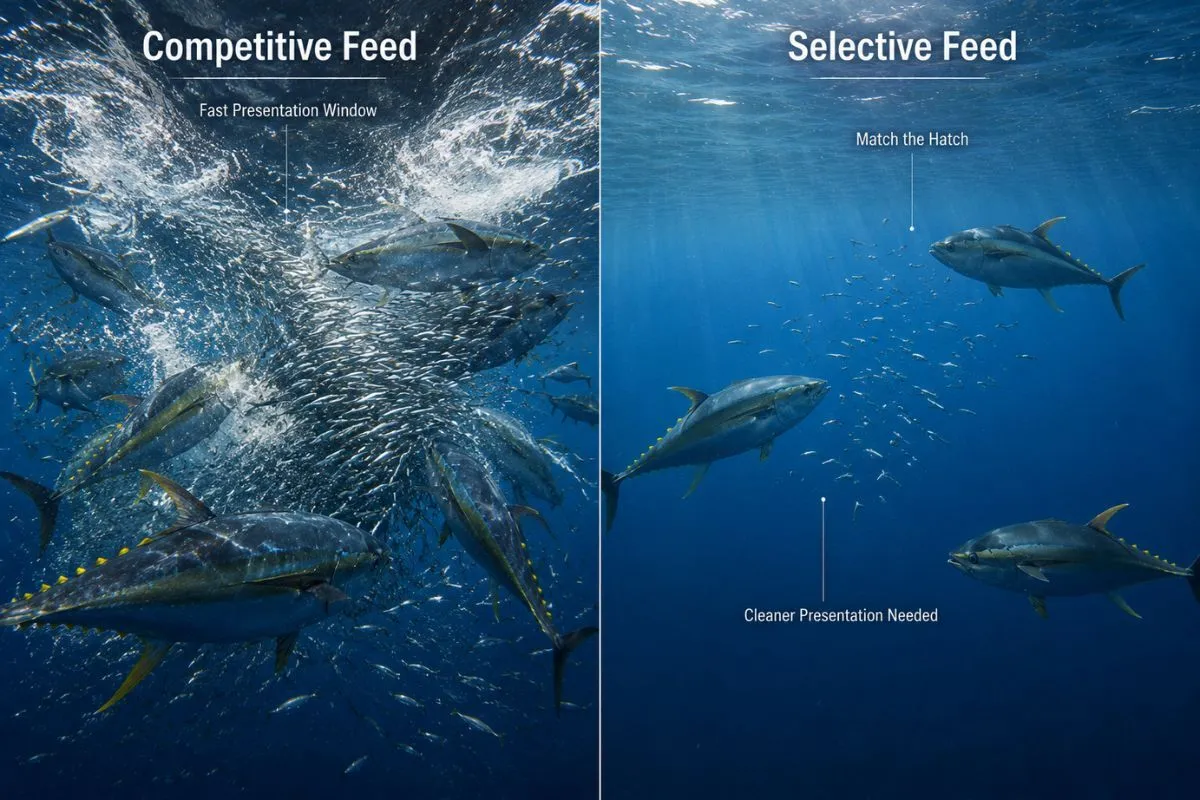
Selectivity is the behavior that frustrates more anglers than any other. When yellowfin lock onto a particular size and species of bait, they will eat that and ignore everything else, including a perfectly good offering that simply does not match. This is why matching the hatch matters so much with these fish. A large bait looks wrong to a fish keyed on small anchovies, and a fish eating flying fish wants a longer profile. Being right about what they are eating that day is often more important than any other decision you make.
Size and age change the equation too. Smaller yellowfin tend to run in tight, aggressive schools and feed with less caution, competing hard and eating readily. The bigger, older fish, the ones most anglers are chasing, have survived precisely by being careful, so they are often warier, more selective, and quicker to reject a flawed presentation. When you are hunting a genuine trophy, assume you are dealing with the most cautious fish in the ocean and present accordingly.
How do yellowfin tuna feed as a school?
Individually cautious, yellowfin become a different animal in a competitive school. When they herd bait into a tight ball and attack it together, competition takes over and caution drops. Each fish is racing the others for the meal, and a fish worried about missing out is far less worried about the small imperfections in your presentation. That competitive feeding frenzy is the single best opening an angler gets with these fish, and much of tuna fishing is about creating or capitalizing on it.
What do yellowfin tuna eat, and why does it drive everything?
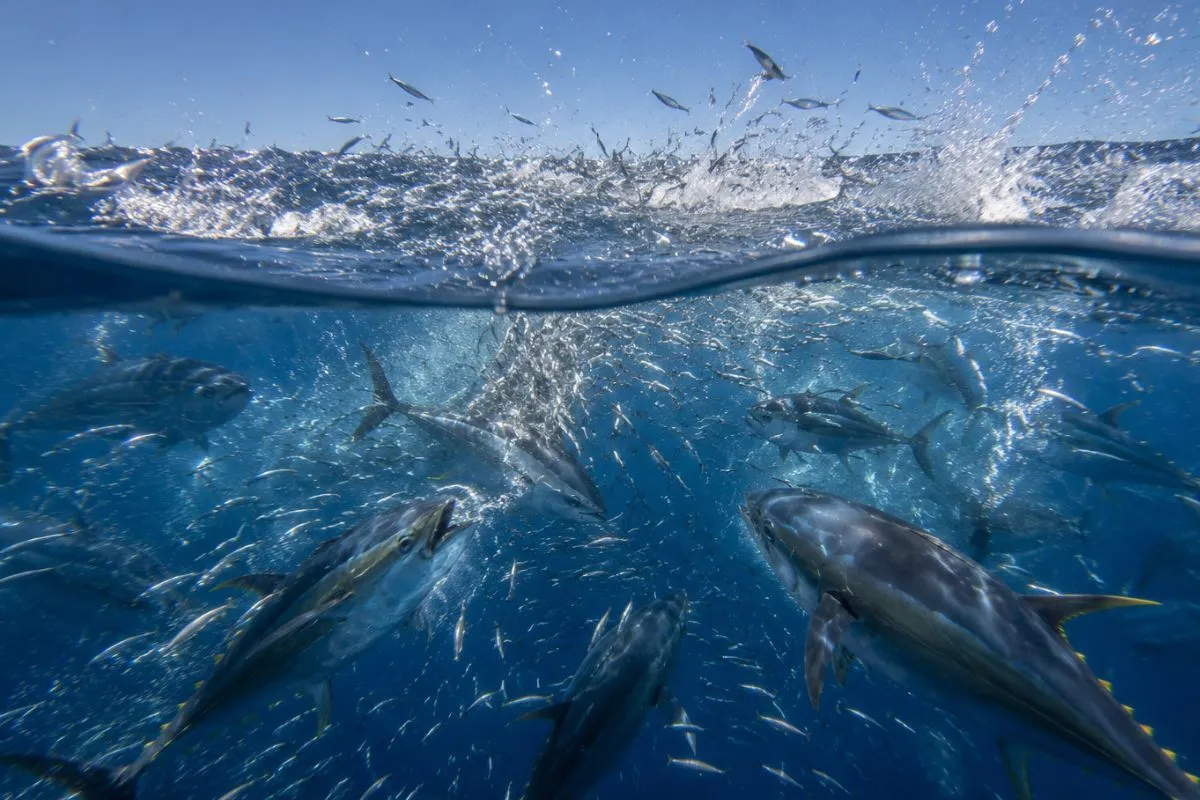
Diet is the engine behind yellowfin location and behavior. They are opportunistic predators with a broad menu, feeding on anchovies, sardines, mackerel, flying fish, and other small pelagics, along with squid and pelagic crustaceans. During daylight they push schools of baitfish toward the surface and tear through them, which creates the visible feeds anglers live for. At night and in deeper water they shift toward squid and small vertically migrating prey.
Because their diet shifts by region, season, and even time of day, so does their behavior. Where the bait is thick, the fish concentrate and feed with confidence. Where it thins out, they roam and get harder to pin down. Understanding what they are eating in your water tells you both where to look and what to throw, because the two questions are really the same question. Follow the forage and you are following the fish, and match the forage and you are speaking their language.
How do yellowfin relate to birds, dolphins, and structure?
Much of yellowfin behavior is about association, and reading those associations is how you find and stay on fish. They relate to birds because birds mark bait getting pushed up, so working birds is really reading the tuna's own behavior at a distance. They relate to structure, rigs, weed lines, and current edges because those features aggregate the bait they hunt. And in many fisheries they associate tightly with dolphins.
How does yellowfin behavior change with conditions?
Yellowfin behavior is not fixed. It shifts with the water and the sky, and the anglers who adjust with it stay on fish while everyone else wonders where they went. Water temperature is a major driver. These fish hold most consistently in warm water, and they feed with more energy inside their comfort range, so temperature breaks that concentrate bait also concentrate active, feeding fish. Push outside that range and the fish get sluggish or leave.
How do you read the mood of a school?
This is where behavior knowledge turns into fish. Every observation above feeds one skill: sizing up the mood of the fish in front of you and matching your approach to it. Aggressive, competitive fish crashing bait on the surface will eat a lure thrown into the chaos or a bait dropped into a hot slick, and you fish them fast and hard while the window is open. Picky fish sipping scattered bait in clean, calm water demand the opposite, a careful, matched presentation on lighter leader, moved with restraint. And fish that have gone shut down or deep after pressure often call for resting the spot, changing your approach, or simply moving to fresher fish. Sometimes a hot bite switches off even though the school never left, because yellowfin that have fed hard or traveled far downshift into a lower-activity mode to process the meal. Recognizing that the fish are resting rather than gone keeps you from abandoning good water too early.
Yellowfin Tuna Behavior Video Courses
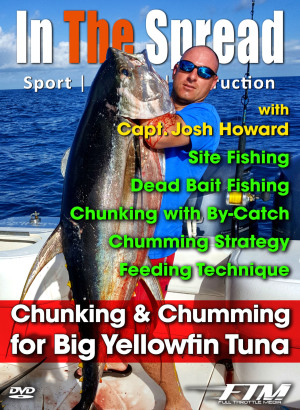
Venice, Louisiana is known for its abundant yellowfin tuna fishing, with captains and crews using advanced tactics and techniques. Capt. Josh Howard utilizes trawl boat by-catch to create a healthy chum slick, while In The Spread fishing video teaches ideal baits, chumming, and chunking. Fishing in the Gulf of Mexico relies on working fixed or mobile fish aggregators, making trowl boats an excellent fishing opportunity.
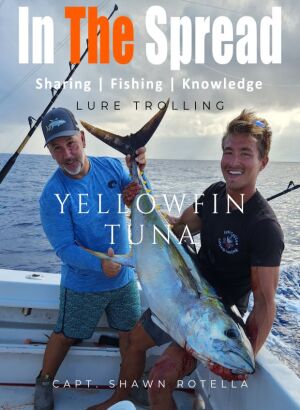
Yellowfin tuna trolling tactics shift dramatically when skipjack schools appear, demanding lure adjustments most anglers miss. Captain Shawn Rotella's Kona expertise reveals how predatory patterns, tide influences, and habitat structures determine which lure colors and trolling speeds trigger strikes from Thunnus albacares, plus post-catch gilling and cooling techniques preserving quality for premium table fare.
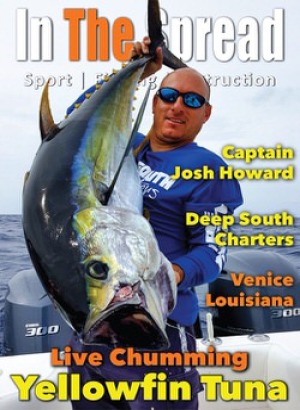
Yellowfin tuna around Venice trawlers feed competitively on bycatch discharge, creating brief windows where aggressive strikes can overwhelm standard tackle and technique. Captain Josh Howard explains how live bait selection matches trawler discharge, why hook and drag specifications prevent lost fish around moving vessels, and when these mobile feeding situations produce versus platform fishing.
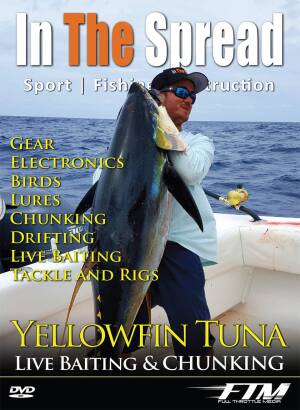
Yellowfin tuna reject more baits than they strike when chunking and drifting. RJ Boyle explains how chum distribution rate, bait matching, and drift positioning determine whether competitive feeding behavior triggers or fish simply feed selectively on free chunks without committing to hooked offerings.
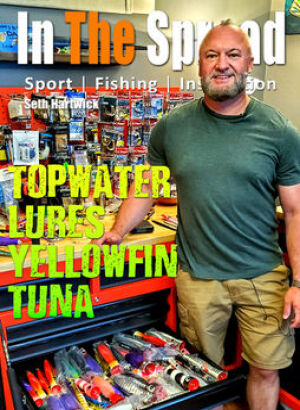
Topwater yellowfin tuna fishing evolved into refined styles where popper and stickbait quality, build, and price vary dramatically. Seth Hartwick's extensive lure testing reveals which designs justify investment, how sea conditions affect lure selection and placement, and what tackle components including hooks, split rings, swivels, and leaders create reliable setups withstanding violent tuna strikes.
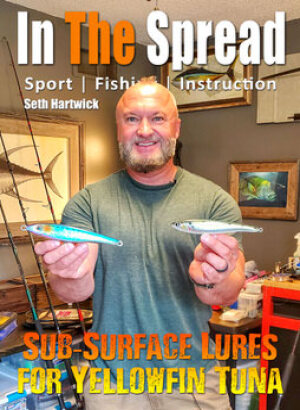
Yellowfin tuna feed in the top three to five meters using the surface as an edge to trap baitfish, making sub-surface lures more effective than topwater presentations. Sinking stickbaits reach these feeding zones while avoiding bird interference that dominates surface activity, requiring proper terminal tackle pairing with hooks and split rings maintaining lure action during violent strikes.
Frequently asked questions about yellowfin tuna behavior
Why do yellowfin tuna refuse baits and lures?
Yellowfin hunt by sight and inspect everything before eating. They refuse presentations that look or move unnaturally, that use leader they can see, or that do not match the size and species of bait they are keyed on. A refusal usually means your offering did not match what the fish were eating or how the real food behaves.
What is the best time of day to catch yellowfin based on behavior?
The low-light windows at dawn and dusk are usually the most productive, because yellowfin feed more aggressively and push bait to the surface when the light is soft. Through bright midday they often move deeper and turn warier, so deep presentations tend to outproduce surface work.
Do yellowfin tuna feed on the surface or deep?
Both, depending on light, bait, and pressure. They drive bait to the surface and feed on top during low light and active feeds, and they hold and feed deeper in bright conditions, under pressure, or when their forage is down in the column. Reading which one is happening tells you where to present.
How does water temperature affect yellowfin behavior?
Yellowfin hold and feed most actively in warm water within their comfort range, and temperature breaks concentrate both bait and active fish. Water that is too cool slows them down or pushes them out, so finding the right temperature is often the same as finding feeding fish. Catch rates run highest inside a particular warm-water band, and outside it the fish may still be around but less active or holding deeper.
Why do yellowfin tuna run with dolphins?
In many fisheries yellowfin associate with dolphin pods, likely gaining both feeding opportunities and reduced predation risk in the mixed group, though the exact drivers vary by region. For anglers, the behavior is a gift, because locating the porpoise often means locating the tuna traveling with them.
Reading the fish is the real skill
Catching yellowfin tuna consistently comes down to understanding the animal. They are sight-hunting, high-speed, selective predators that are always moving, always feeding, and always inspecting what you put in front of them. Their eyesight demands a clean presentation, their constant movement means you find them by finding food, their selectivity rewards matching the hatch, and their competitive feeding gives you the openings you need. Read how their behavior shifts with temperature, light, and pressure, size up the mood of the school, and adjust, and the mechanical parts of tuna fishing start to click into place.
Login
to leave a review.
User Reviews
There are no reviews yet.
Setting Up a Dredge Pulley for Billfish
Saltwater
12.28.2020
High Speed Wahoo Trolling Rig
Saltwater
09.08.2018
Fishing Light Tackle for Yellowfin Tuna
Saltwater
09.08.2018

0