
Red snapper fishing across the Gulf and Atlantic involves more moving parts than most offshore species. Seasons vary by state, gear requirements are written into federal code, and several states require electronic catch reporting before you clean a fish. Here is the full picture, plus how to find and catch them once the season opens.
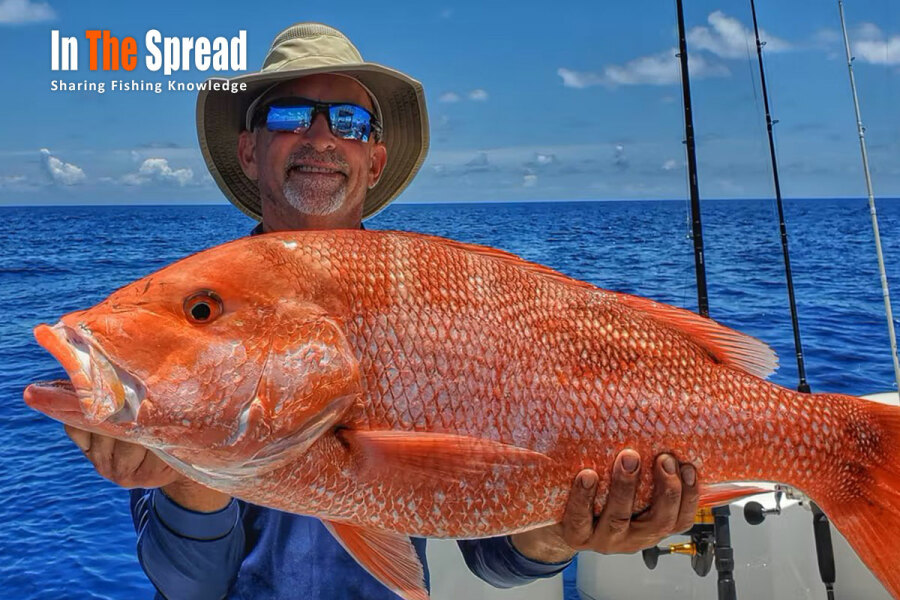
Red Snapper Fishing Across the Gulf and Atlantic
Red snapper are one of the most sought-after offshore species on the Gulf Coast, and for serious anglers they are worth the preparation it takes to fish for them legally. They are aggressive, they fight on heavy structure, and they are as good on the table as any fish that swims. But fishing for them legally is more involved than most species. Seasons vary by state, bag limits differ between private and for-hire vessels, specific gear is required under federal code, and several states require electronic catch reporting before you ever clean a fish.
This article covers how red snapper seasons are set, what the regulations look like across Gulf and Atlantic states, what gear you are legally required to carry, and how to actually find and catch fish once the season opens. Seasons, dates, and bag limits are set annually and can change. Always verify current rules with your state fish and wildlife agency or NOAA Fisheries before your trip.
How Red Snapper Seasons Are Set
Most anglers treat the season announcement as something that just happens each spring. Understanding the machinery behind it matters, because it explains why seasons open and close the way they do and why you cannot assume one year mirrors the next.
Red snapper management operates under federal fishery management plans administered by NOAA Fisheries, in coordination with the Gulf of Mexico Fishery Management Council and the South Atlantic Fishery Management Council. Each council sets an annual catch limit based on stock assessment data. That limit is then divided among the commercial sector, the for-hire recreational sector, and private recreational anglers.
Once allocations are set, individual Gulf states can apply to NOAA for state-based private angler management plans. That is why Florida, Louisiana, Alabama, Mississippi, and Texas each run different seasons even though they are all fishing the same water. Each plan is built around a specific harvest quota. When that quota is reached, the season closes, regardless of the calendar. If fish are caught faster than projected, the season closes early. If harvest runs behind, some states have added open days mid-season. Neither outcome is guaranteed, which is why checking for in-season closure notices before any late-season trip is not optional.
Gulf of Mexico Red Snapper Seasons and Regulations
The Gulf of Mexico red snapper population has rebuilt significantly from historic lows. The stock is not currently overfished, and the Gulf supports seasons measured in weeks and months rather than days. That is the payoff from decades of strict management, and the season structure reflects it.
Federal Gulf Waters: For-Hire and Charter Vessels
Federally permitted for-hire and charter vessels fishing in Gulf federal waters follow a federal season set annually by NOAA. The season typically opens in early summer and runs several months. Private recreational anglers in federal waters follow their departure state's approved plan, not the federal for-hire season.
- Bag limit: 2 red snapper per person per day
- Minimum size: 16 inches total length
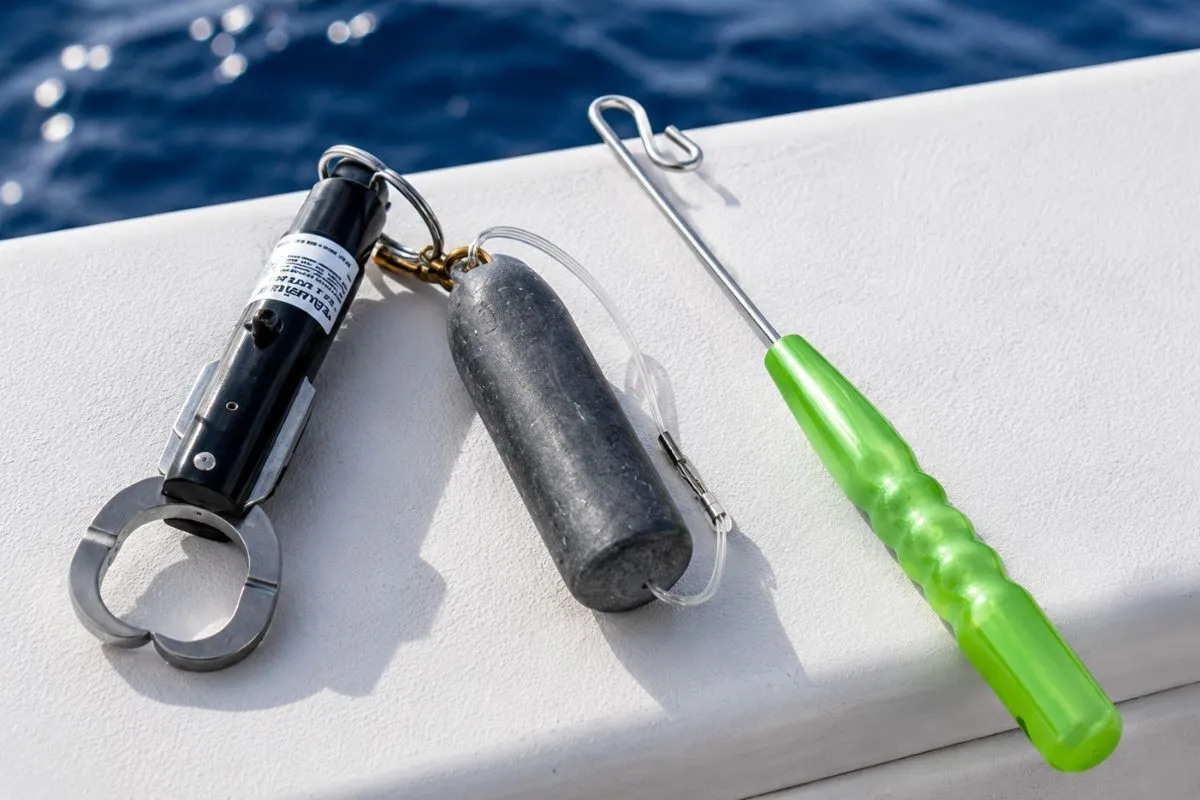
- Required gear: Venting tool or descending device rigged and ready when fishing for reef fish
- Confirm current season dates at NOAA Fisheries Red Snapper in the Gulf of Mexico
Florida Gulf Coast Red Snapper Season
Florida private recreational anglers fish under one of the more generous Gulf seasons, built on the state's data investment through its State Reef Fish Angler program. Florida typically runs a summer daily block followed by fall weekend and holiday dates, with total open days driven by quota pace.
- Typical season structure: Summer daily opener followed by fall weekends and select holidays; total days vary annually
- Bag limit: 2 red snapper per person per day, within the 10-snapper aggregate limit
- Minimum size: 16 inches total length
- State Reef Fish Angler (SRFA) designation required for all private vessel anglers; free, but must be in place before you fish; follow FWC instructions for any assigned trip-level reports
- Confirm the current calendar at FWC each year; Florida adjusts dates based on quota pace
Alabama Red Snapper Season
Alabama typically opens one of the earliest Gulf seasons and runs daily through late June before shifting to extended weekend schedules.
- Typical season structure: Daily opener in May or early June, then 4-day weekends (Friday through Monday) until the quota is reached
- Bag limit: 2 red snapper per person per day
- Minimum size: 16 inches total length
- Alabama Gulf Reef Fish Endorsement required
- Snapper Check reporting required within 24 hours of landing
- Confirm current dates at Outdoor Alabama
Mississippi Red Snapper Season
Mississippi runs a compact season, typically six to eight weeks of daily fishing in summer until the quota is met.
- Typical season structure: Daily opener running approximately six weeks in summer
- Bag limit: 2 red snapper per person per day
- Minimum size: 16 inches total length
- Mississippi Recreational Offshore Landing Permit (MS-ROLP) required
- Tails n' Scales reporting required: open your trip report before departure and close it at landing; MDMR treats an incomplete report as a violation
- Confirm current dates at Mississippi DMR
Louisiana Red Snapper Season
Louisiana operates under one of the most generous bag limits in the Gulf, reflecting a higher per-angler allocation under its NOAA-approved state plan.
- Typical season structure: Opens in spring and runs seven days a week until the quota is met
- Bag limit: 4 red snapper per person per day
- Minimum size: 16 inches total length
- Recreational Offshore Landing Permit (ROLP) required
- Louisiana's 4-fish bag reflects its state allocation; mid-season quota updates can close the season earlier than expected
- Confirm current rules at Louisiana Wildlife and Fisheries
Texas Red Snapper Season
Texas has a structural advantage over every other Gulf state. Its state waters extend 9 nautical miles from shore, and red snapper fishing in those waters is open year-round under state rules.
Texas state waters (within 9 nautical miles):
- Season: Open year-round
- Bag limit: 4 red snapper per person per day
- Minimum size: 15 inches total length
- Venting tool or descending device required for reef fish showing barotrauma
Texas federal waters (beyond 9 nautical miles):
- Bag limit: 2 red snapper per person per day
- Minimum size: 16 inches total length
- Standard saltwater fishing license with saltwater endorsement required; no separate reef fish stamp needed
- Circle hooks required when fishing with natural bait
- Confirm federal season dates and current rules at Texas Parks and Wildlife
Atlantic Red Snapper Seasons and Regulations
The Atlantic is a fundamentally different fishery. The South Atlantic red snapper population is in active recovery under a long-term rebuilding plan, and recreational opportunity reflects that reality. Federal seasons in South Atlantic waters are measured in days per year, not months, and the management environment is more volatile than the Gulf. Stock assessments, legal challenges, and experimental fishing permit programs can all affect season structure from year to year with little advance notice. Verification here is especially critical.
Federal South Atlantic Waters
The federal South Atlantic recreational season is set annually by NOAA Fisheries. Historically it has been one to two days per year. The stock has improved in recent assessments and no longer meets the technical definition of overfished, but overfishing relative to the rebuilding target has continued to occur. That is why the season window stays so tight. Check NOAA Fisheries South Atlantic and the South Atlantic Fishery Management Council for the current year's announcement each spring.
- Season: Extremely limited; typically 1 to 2 days per year; verify annually Bag limit: 1 red snapper per person during the open season
- Minimum size: No minimum size in federal South Atlantic waters
- Descending device required: must be on board, rigged, and attached to at least 16 ounces of weight and 60 feet of line; failure to use it on a fish showing barotrauma is a violation
- Dehooking tools required
- Non-offset, non-stainless steel circle hooks required when fishing with natural bait north of 28 degrees North latitude
South Atlantic States: Georgia, South Carolina, and North Carolina
Georgia, South Carolina, and North Carolina all follow the federal South Atlantic season. When the federal season is not open, there is no recreational red snapper harvest in federal waters off these states. The bag limit (1 fish), gear requirements, and descending device specification are the same for all three. Use these agency links for annual season announcements: Georgia DNR, SCDNR Marine Resources, NC Division of Marine Fisheries.
Florida Atlantic Coast: The Exception
Florida's Atlantic state waters are the most meaningful exception in the South Atlantic picture. While the federal season remains extremely limited, Florida Atlantic state waters are open year-round under FWC rules.
- Season: Open year-round in Florida Atlantic state waters (within 3 nautical miles)
- Bag limit: 2 red snapper per person per day, within the 10-snapper aggregate
- Minimum size: 20 inches total length
- Confirm any updates at FWC
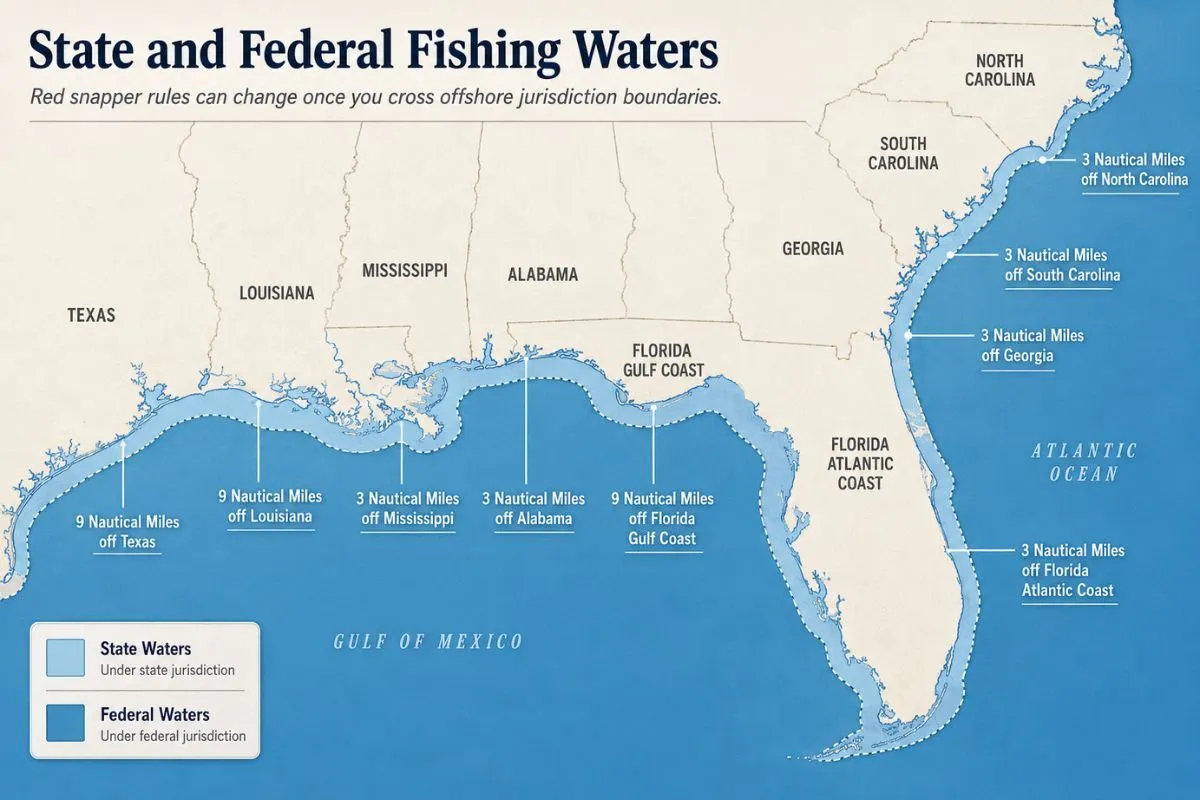
State vs. Federal Water Boundaries: Which Rules Apply to You
Where state water ends and federal water begins determines your season, your bag limit, and your reporting obligation. This is not a detail you can guess at.
Gulf of Mexico state water boundaries:
- Texas: 9 nautical miles
- Louisiana: 9 nautical miles
- Florida (Gulf): 9 nautical miles
- Alabama: 3 nautical miles
- Mississippi: 3 nautical miles
South Atlantic state water boundaries:
- Florida (Atlantic): 3 nautical miles
- Georgia, South Carolina, North Carolina: 3 nautical miles each
Private anglers in Gulf federal waters fish under their departure state's approved management plan. Leave from Port Aransas in Texas and you fish under Texas rules in both state and federal water. Leave from Pensacola in Florida and you fish under Florida private angler rules once you cross into federal water. The 9-mile Texas boundary is the most consequential in the Gulf because it puts a large band of productive reef structure within year-round, 4-fish access before federal rules ever apply.
Required Gear: Descending Devices, Circle Hooks, and Dehooking Tools
Federal regulations for reef fish in both the Gulf and South Atlantic require specific gear when targeting red snapper. These are legal requirements backed by active enforcement.
Descending devices are the most critical piece of required equipment, and they are also the most important tool for the fishery's long-term health. Red snapper caught from 50 feet or deeper frequently develop barotrauma, a condition where rapid pressure change causes the swim bladder to expand and prevents the fish from swimming back down. A fish with advanced barotrauma released at the surface has very low survival odds. A fish sent back to 50 feet or deeper on a descending device before release has a dramatically higher chance of recovery. In South Atlantic federal waters the device must be attached to at least 16 ounces of weight and 60 feet of line. In Gulf federal waters, a descending device or a venting tool must be rigged and ready on deck.
Circle hooks are federally required when fishing with natural bait in South Atlantic federal waters north of 28 degrees North latitude, and in Texas federal waters. They must be non-offset and non-stainless steel. Beyond the legal requirement, circle hooks reduce gut-hooking across all reef species and produce better bite-to-land ratios on snapper because they set in the corner of the mouth when you maintain steady pressure rather than swinging on the strike.
Catch Reporting: What Each State Requires
Several Gulf states require electronic catch reporting as part of their quota management system. These reports feed real-time harvest data that triggers season closures. Failing to report is a violation even when the catch itself was legal. Reporting systems and platform names evolve; always confirm the current system with your state agency before you fish.
- Alabama: Snapper Check, within 24 hours of landing
- Mississippi: Tails n' Scales; open the trip report before departure, close it at landing; an incomplete report is a violation
- Louisiana: ROLP permit carries a reporting requirement; confirm the current platform at LDWF
- Florida: SRFA designation ties into FWC survey programs; follow any assigned trip-level reporting instructions from FWC
- Texas: Harvest monitored through TPWD survey programs; confirm current reporting requirements at TPWD before fishing
What Happens When the Quota Closes Early
Gulf red snapper seasons close when cumulative harvest hits the allocation, which can happen days or weeks before the announced end date. Alabama and Louisiana are most susceptible to early closures because of early openers and high participation. Check your state agency website and NOAA Fisheries for in-season closure notices before any trip planned near the end of the season window. Catching red snapper after a quota closure is the same violation as fishing out of season. Private and for-hire quotas are separate, so a closure in one sector does not affect the other.
Tackle and Rigging for Red Snapper
Red snapper are not leader-shy, but they live around structure that destroys light terminal gear. Getting the rigging right matters as much as getting on the right bottom.
Rod and reel selection starts with depth. For typical Gulf snapper water of 60 to 150 feet, a medium-heavy conventional rod in the 6 to 7 foot range paired with a lever-drag reel handles most situations. Spool with 50 to 65 pound braided mainline. Braid gives you the sensitivity to detect a subtle pick-up and the backbone to pull fish away from structure before they reach it. Beyond 150 feet, step up to 65 to 80 pound braid.
Terminal rigs: the knocker rig is the workhorse. An egg sinker slides directly to the hook on your leader, keeping the bait close to structure and giving immediate bite detection when a snapper picks it up. Use just enough weight to reach bottom, typically 2 to 6 ounces in most Gulf depths, heavier in strong current. The Carolina rig is a secondary choice when fish are suspended above structure or current is light enough to allow a more natural bait drift.
Hook selection: non-offset circle hooks in the 5/0 to 8/0 range cover most presentations, with 6/0 and 7/0 doing the most work. Match hook size to bait size for cut offerings. A smaller chunk of bonito or squid fits a 5/0; a whole pinfish or large cut gets a 7/0 or 8/0.
Where to Find Red Snapper: Structure, Electronics, Current, and Bait
Regulations tell you when you can fish. Structure tells you where the fish are. Red snapper are obligate structure fish. They do not roam open bottom. If you are not positioned over hard bottom with vertical relief and current, you are likely not on fish.
What Structure Holds Red Snapper
Red snapper use structure for two reasons: predation and current relief. They position where structure breaks the flow, then face into the current to intercept baitfish moving above and ahead of them. The specific structure type matters less than the combination of hard bottom, current edge, and relief from the surrounding bottom.
Our article on reading offshore structure to find fish breaks down why natural and man-made features concentrate everything from baitfish to apex predators. The same logic applies directly to snapper.
- Natural limestone ledges and rocky outcroppings in 60 to 200 feet of water
- Artificial reefs including purpose-sunk vessels, concrete modules, and reef balls
- Decommissioned oil and gas structures and their surrounding debris fields
- Hard bottom transitions where sand gives way to reef rock
On the Atlantic, red snapper concentrate on natural ledges and reef systems from 60 to over 300 feet, with some ledge systems off Georgia and the Carolinas holding fish beyond 400 feet.
Reading Electronics to Find Snapper
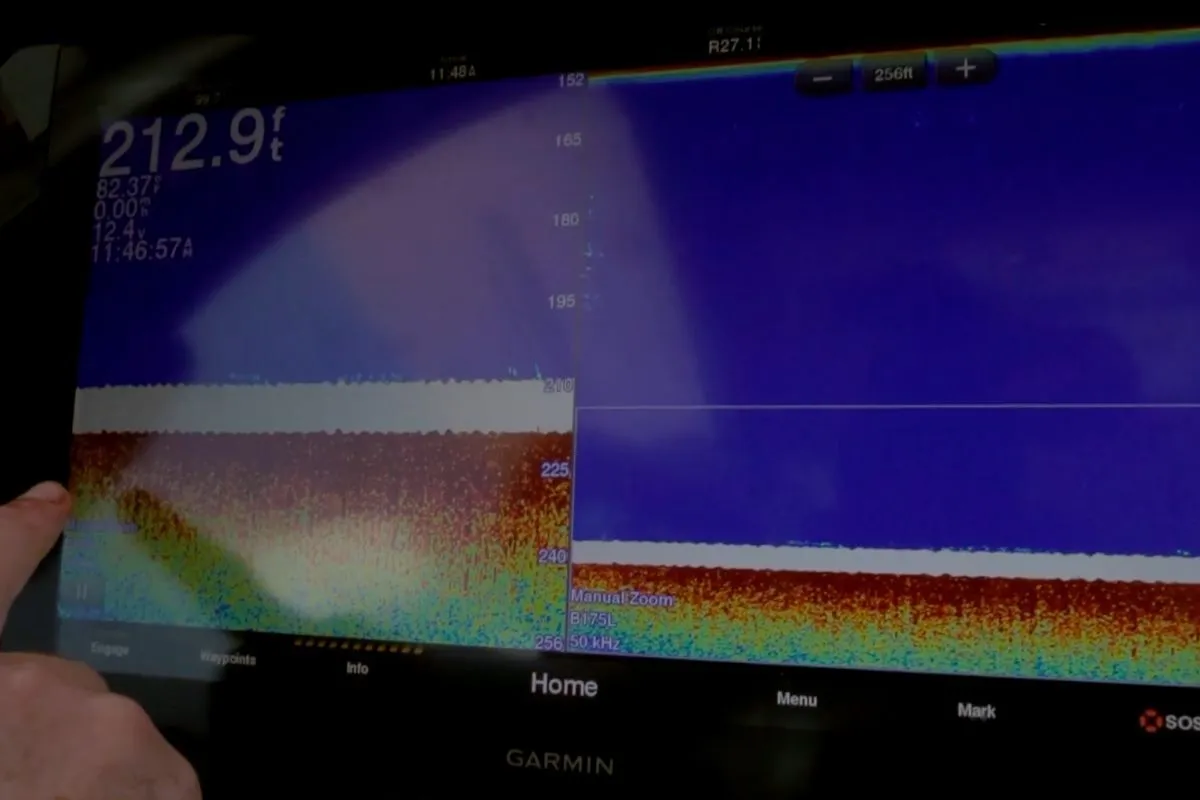
Your fishfinder is your most important snapper tool after the rod. Hard bottom shows as a thick, bright sonar return with a secondary echo below the first line. Soft mud shows as a thin, faded return with no secondary echo. Red snapper want the hard bottom signal. When you see that return combined with bait suspended 10 to 40 feet above the bottom and individual fish arches sitting just above the bottom mark, you are on the right address.
Depth, Season, and Where Bigger Fish Hold
Depth and fish size are reliably correlated in red snapper. Shallow structure in 60 to 100 feet tends to hold smaller, younger fish. That is true across the Gulf and is consistently reported by captains who fish both depth ranges. The larger fish, those in the 15 to 25 pound class, are more reliably found in 100 to 250 feet on structure that does not see heavy weekend pressure. If quantity is the goal, the shallower reefs deliver it. If quality is the goal, deeper and less-documented bottom is worth the run.
How Current Controls the Bite
Current is the variable most anglers underestimate. Red snapper feed into the current, positioning upcurrent of structure where they can see food arriving before it passes. When current is running, fish are feeding. When current stalls between tidal transitions, the bite often softens or goes quiet entirely.
Bait by Depth and Season
Live bait outperforms cut bait in most Gulf snapper situations when you can keep it alive at depth. Pinfish and pogies are the Gulf standard. Pinfish survive livewells well, are available around grass flats, and represent natural prey. Pogies create a scent trail in the water column that draws fish from a distance. Hook both through the back behind the dorsal fin for a natural swimming presentation.
Gulf vs. Atlantic: Why the Seasons Are So Different
The gap between Gulf and Atlantic red snapper seasons is not policy discretion. It is a direct reflection of two populations at different points in their recovery.
The South Atlantic population has a different trajectory. Decades of pressure pushed the stock into severe depletion. Recent assessments have shown the population is no longer classified as overfished, which is meaningful progress. But overfishing relative to the rebuilding target has continued to occur, and the plan runs to 2044. That is why the federal recreational season in the South Atlantic has historically been one to two days per year. It is not excessive caution. It is the harvest rate the biology allows without pushing the stock off its recovery path.
Frequently Asked Questions About Red Snapper Fishing
What is the bag limit for red snapper?
In Gulf federal waters, the standard bag limit is 2 red snapper per person per day for private recreational anglers. Louisiana allows 4 per person per day under its state plan. Texas allows 4 per person in state waters within 9 nautical miles and 2 per person in federal water. In South Atlantic federal waters, the limit is 1 per person during the open season. Florida Atlantic state waters allow 2 per person with a 20-inch minimum size.
When does red snapper season open in the Gulf of Mexico?
Federal for-hire seasons typically open in early June and run through summer into fall. Private recreational seasons vary: Louisiana typically opens first in spring, followed by Alabama and Mississippi in late May, with Florida opening around Memorial Day weekend. Texas state waters are open year-round. Calendar dates change annually; always verify with your state's fish and wildlife agency.
Do I need a permit or special license to catch red snapper?
Yes, in most Gulf states. Florida requires the free State Reef Fish Angler (SRFA) designation. Alabama requires a Gulf Reef Fish Endorsement. Mississippi requires a Recreational Offshore Landing Permit (MS-ROLP). Louisiana requires a Recreational Offshore Landing Permit (ROLP). Texas requires a standard saltwater fishing license with a saltwater endorsement and no separate reef fish stamp. Federally permitted for-hire vessels must hold a valid federal Gulf reef fish permit.
What is the minimum size limit for red snapper?
Gulf federal waters and most Gulf states require 16 inches total length. Texas state waters allow a 15-inch minimum. Florida Atlantic state waters require 20 inches total length. Federal South Atlantic waters have no minimum size requirement, though the extremely limited season means most fish encountered will exceed any practical threshold.
What do I do if a red snapper cannot swim back down after release?
Use a descending device to return the fish to depth. Snapper caught from 50 feet or deeper frequently develop barotrauma, where the swim bladder expands under rapid pressure change and prevents the fish from diving under its own power. Lowering the fish to 50 feet or deeper on a descending device before release allows it to equalize and recover. In federal Gulf and South Atlantic waters, having a descending device or venting tool rigged and ready is a legal requirement when fishing reef fish.
Can red snapper season close before the announced end date?
Yes. Gulf seasons run on quotas. When cumulative harvest reaches the allocation, the season closes regardless of the calendar. This can happen days or weeks before the originally announced end date. Check your state agency and NOAA Fisheries for in-season closure notices before any trip near the end of the season window. Private and for-hire quotas are separate, so a closure in one sector does not close the other.
Does the federal South Atlantic season apply to state waters?
No. Federal South Atlantic regulations apply in federal waters beyond 3 nautical miles for most states. Florida's Atlantic state waters are open year-round with a 2-fish bag limit and 20-inch minimum under FWC rules, which provides far more consistent access than the brief federal season allows.
Know the Rules, Work the Structure
Red snapper fishing rewards preparation at both ends. The regulatory side keeps you legal and supports a fishery that took decades to rebuild. The fishing side puts you on the right bottom with the right gear at the right moment in the tide cycle.
The rules covered here reflect the current management framework, but they evolve every season. Get in the habit of checking your departure state's agency and NOAA Fisheries each year before your first trip. That check takes a few minutes and removes the risk entirely.
When you are ready to go deeper on technique, the reef and wreck fishing video courses at In The Spread cover the structure, species, and presentation strategies that apply across both coasts. For snapper specifically, the red snapper fishing courses put you in the boat with captains who fish this water every season.
Regulatory information reflects the current management framework as of publication. Seasons, bag limits, gear requirements, and reporting obligations change annually and may be affected by stock assessments, court decisions, or agency rulemaking. Always verify current regulations with the relevant state fish and wildlife agency or NOAA Fisheries before your trip.
Seth Horne Founder and CEO
Login
to leave a review.
User Reviews
There are no reviews yet.
Setting Up a Dredge Pulley for Billfish
Saltwater
12.28.2020
High Speed Wahoo Trolling Rig
Saltwater
09.08.2018
Fishing Light Tackle for Yellowfin Tuna
Saltwater
09.08.2018
0