
Alabama artificial reefs give Orange Beach and Fort Morgan anglers more structure than they can fish. Capt. Vlad Moldoveanu shows which side of a reef red snapper hold on, how he sorts amberjack from snapper on sonar, why he takes two or three fish and moves, and how the reef coast carries into Pensacola and Destin.
Alabama Artificial Reefs: Fishing Fort Morgan to Destin
Alabama artificial reefs form the largest artificial reef program in the United States, thousands of pyramids, chicken coops, ships and rubble piles spread across a bottom that is mostly featureless sand and mud. Fishing them comes down to three decisions: which reef, which side of it, and which bait. Red snapper, amberjack, triggerfish, vermilion snapper and gag grouper all live on them.
In August I fished the inside reef off Fort Morgan with Capt. Vlad Moldoveanu of MSC Fishing, a longtime In The Spread subscriber who now teaches here. What follows is the common approach to each decision, then what Vlad does and why. The fishing instruction comes from Fort Morgan; the public reef resources for Pensacola and Destin come at the end.
If you are new to working structure, start with our bottom fishing fundamentals.
Why Alabama's Artificial Reefs Lead the Gulf of Mexico
Alabama's offshore reef zones cover roughly 1,093 square miles of permitted bottom, not continuous reef, and the state lets the public design, build and drop their own reefs there under a Marine Resources Division permit. That partnership has put more than 25,000 artificial reefs on the bottom since the program began.
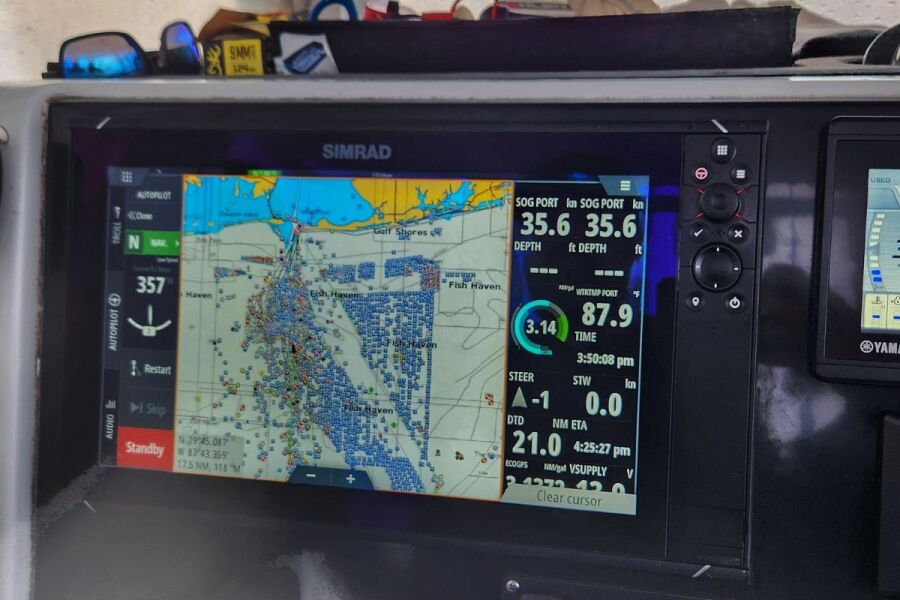
The bottom is why the system works. With almost no natural hard bottom off Alabama, every reef is an island, and the fish stack on it. Vlad calls the open mud between reefs a desert. Some big snapper do sit out in it, but a bait on or right next to the structure is where the fishing is. The state's own seafood program calls Alabama the red snapper capital of the world, and the reefs are why.
Vlad fishes the west end of the coast off Fort Morgan point, where the state has dropped thousands of reefs in shallow water on a mudflat and, he says, not many boats run out. Louisiana is a different fishery altogether, built on oil and gas platforms. For reef fishing beyond the Gulf of Mexico, read our piece on reef fishing techniques and species.
Alabama's Reef Zones from the Beach to the Inside Reef
Inside Mobile Bay and Bon Secour Bay sit public inshore reefs. Within nine nautical miles of Baldwin County, the nearshore zones hold the Allen liberty ship, more than 240 structures in the Trolling Corridor and 138 reef sites in the R.V. Minton zones. The big offshore zones run beyond that.
The 2021 expansion added 23 square miles to the six to nine mile zone near Gulf Shores and Fort Morgan and 24 square miles off Orange Beach. The Blankenship Reef Zone off Dauphin Island added 63 square miles in 75 to 110 feet.
Vlad uses "inside reef" for the closer offshore reefs we fished, in 100 to 135 feet, not the bay or nearshore reefs above. He calls that shallow, and for some species it is. He starts targeting amberjack around 150 feet, finds the best of it from 200 to 230, and catches them as deep as 800 feet beside the deepwater rigs. For grouper he would run out to about 230 feet. The inside reef is red snapper, triggerfish and vermilion snapper country, with amberjack and gag mixed in.
Super Pyramids, Chicken Coops and Which Alabama Reefs Hold Bigger Snapper
Taller structure holds more fish. NOAA researchers who surveyed artificial reefs off North Carolina with echosounders found fish density tracked a reef's vertical relief more closely than its footprint, and isolated structures held more fish than ones set close together. That study measured how many fish, not how big, and it wasn't done on Alabama reefs.
There is a wrinkle anglers argue about. Plenty of captains find their biggest snapper on small, overlooked spots, because the big, well-known reefs take the most fishing pressure.
Vlad sides with height, and his sonar backs it up. "Bigger the structure, the bigger the fish," he says, and the state drops both pyramids and super pyramids, so you can choose. In his fishing, the taller ones hold more snapper and bigger snapper. That is where Vlad's experience goes past the research.
What most anglers miss is age. In Vlad's experience, the manmade chicken coop reefs break down after about eight years, and a new reef can hold good fish within two or three. A spot that held only small snapper last season can hold keepers this season. His rule is short: check your spots, don't believe them.
Reading an Alabama Reef on Sonar Before You Drop
Reading a reef on sonar starts with finding the structure and reading the marks around it before a bait goes down. Fish stacked on the structure mean something is home, and bigger arches usually mean bigger fish, though arch size also changes with how a fish crosses the beam. A bare screen gives you no target.
Vlad's reads go further. Snapper suspend over the structure, amberjack hold a little off it, and grouper sit tight to the bottom, and fish marked up off the reef are feeding. These are his reads, on his own unit and settings. He sets his gain by turning it up until specks appear, then backing off. He runs a scroll speed of four or five in this shallow water, medium noise rejection, and the same palette every trip, so a mark always means the same thing. Small to medium marks over the reef are 16 to 20 inch keepers. A thicker, deeper-colored line is a bigger fish, and the big arches sit a little away from the structure, out of the small stuff.
Then he drops "right in his living room," on the red marks, never while the boat is moving. No bite in five seconds, he has the angler go deeper.
The table below is how the species on an Alabama inside reef sort out, built from Vlad's on-camera reads.
Which Side of the Reef Do Red Snapper Hold On?
Most captains set up up-current of a reef so the bait falls onto the up-current edge, where reef fish face into the current and wait for food to come to them. Red snapper hold right on the hard edge of the structure, so the goal is a bait on or beside it, not out on open bottom.
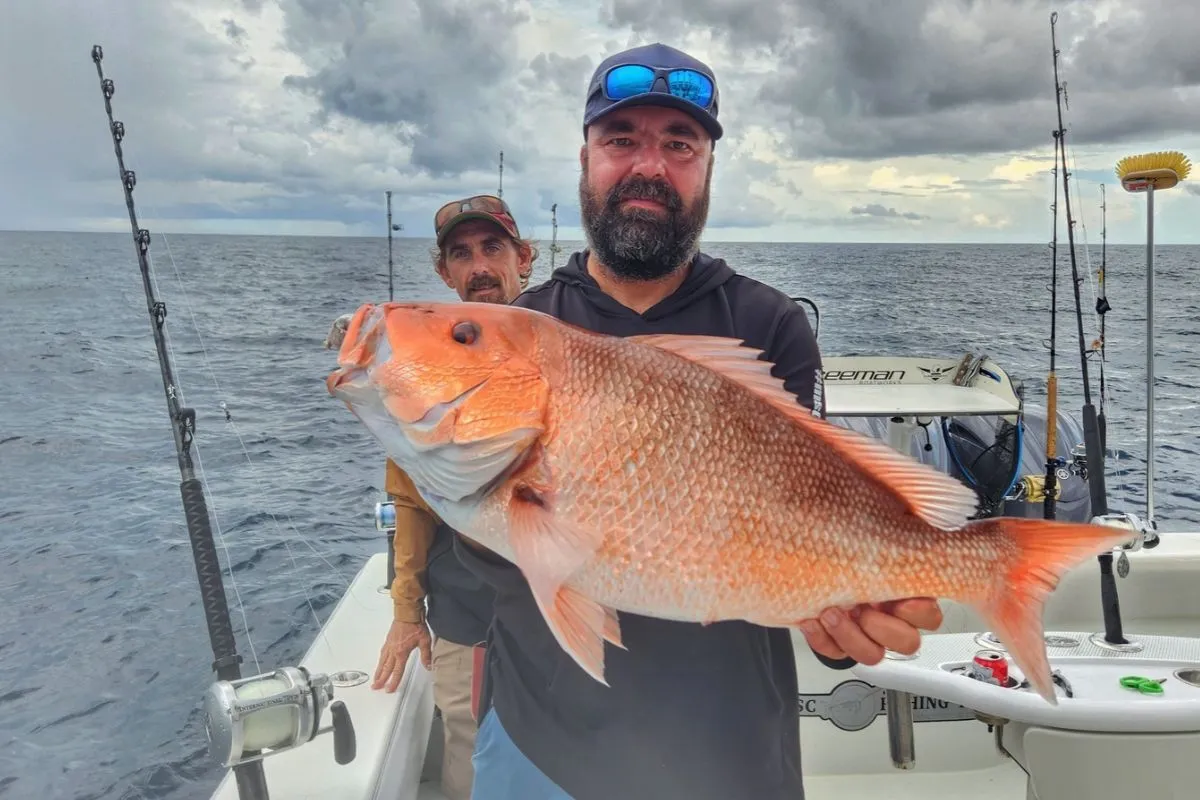
Off Fort Morgan, Vlad finds the red snapper on the up-current side too, though he says plenty of anglers expect them down-current. The side shifts as the current changes, and on a really good spot they surround the whole reef. That is why he stops a little off each spot first to read his drift before he commits.
On his center console he backs the stern into the current, so the lines run forward and stay out of the outboards, and calls each drop off the screen. Our article on positioning a boat for bottom fishing covers anchoring and drifting in more detail.
Knocker, Chicken and Carolina Rigs for Alabama Reefs
Three rigs cover nearly everything on an Alabama reef. The knocker rig, an egg sinker sliding down onto the hook, is the standard red snapper rig in the Gulf of Mexico and keeps the bait tight to the structure. A multi-hook chicken rig works triggerfish and vermilion snapper. A Carolina rig lets a live bait swim.
Vlad's choice comes down to the bait. Live bait goes on the Carolina, because a live bait pinned to a knocker has nowhere to swim and dies. Dead bait goes on the knocker, and so does anyone who rarely fishes, because they can feel the bite and the bait doesn't need to move. He calls the Carolina his amberjack rig, big snapper rig and big grouper rig.
Reef advice splits on tackle weight. Some captains say there is no such thing as too heavy, while others go lighter for pressured fish. Vlad is firmly in the lighter camp. A lot of anglers go super heavy on everything, he says, and "you don't need to go super heavy. The lighter, the better." These reef fish have seen a lot of rigs come down. The details he won't skip:
- Six to eight feet of 60 to 80 pound fluorocarbon on the knocker, because the main line isn't abrasion resistant and gets nicked on teeth and on the reef
- A clear bead on the Carolina, because a green one drew hits from Spanish mackerel and kingfish
- Drag set at about a quarter of the line's strength on the strike, never full unless he has to
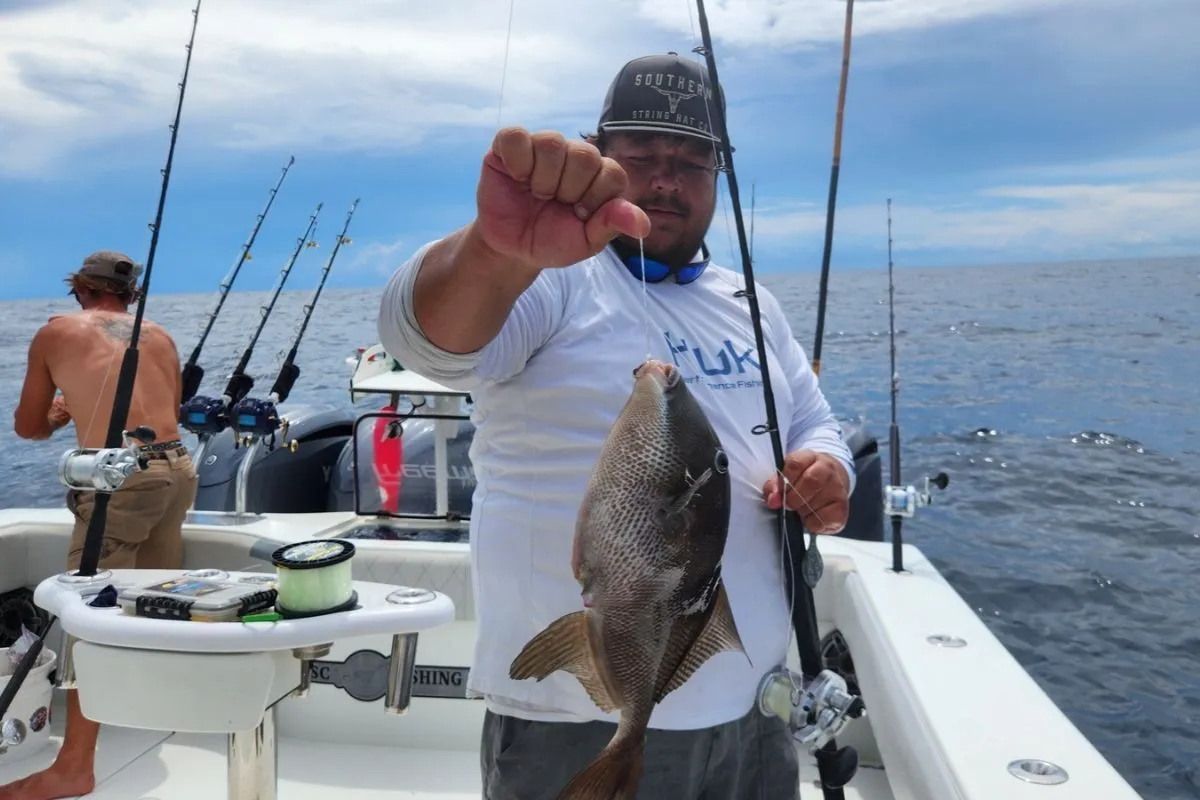
For triggerfish he ties a chicken rig with about a 4/0 hook, baits it with squid hooked twice and leaves the hook point exposed. Hook and release gear rules for Gulf of Mexico reef fish differ between federal, Alabama and Florida waters, so check NOAA Fisheries, Alabama Marine Resources and FWC before you rig.
Our best bait for red snapper breakdown covers squid, cut bait and live bait.
Live Bait, Amberjack and the Big Marks Off the Reef
Live bait catches bigger fish on Alabama's reefs. Hardtails, the blue runners Gulf of Mexico anglers catch on sabiki rigs around structure, are the standard amberjack bait, dropped on a Carolina rig with a long leader and heavy line near the structure.
Vlad's crew loads hardtails off the ships anchored offshore, where bait stacks along the anchor chain. They use a ship-tracking app to find ships that have sat at anchor three or four days, read the bait as a red glob on the sonar and skip the horn bellies, which they say fish pick up and spit out. They shake each bait into a pressurized live well instead of grabbing it.
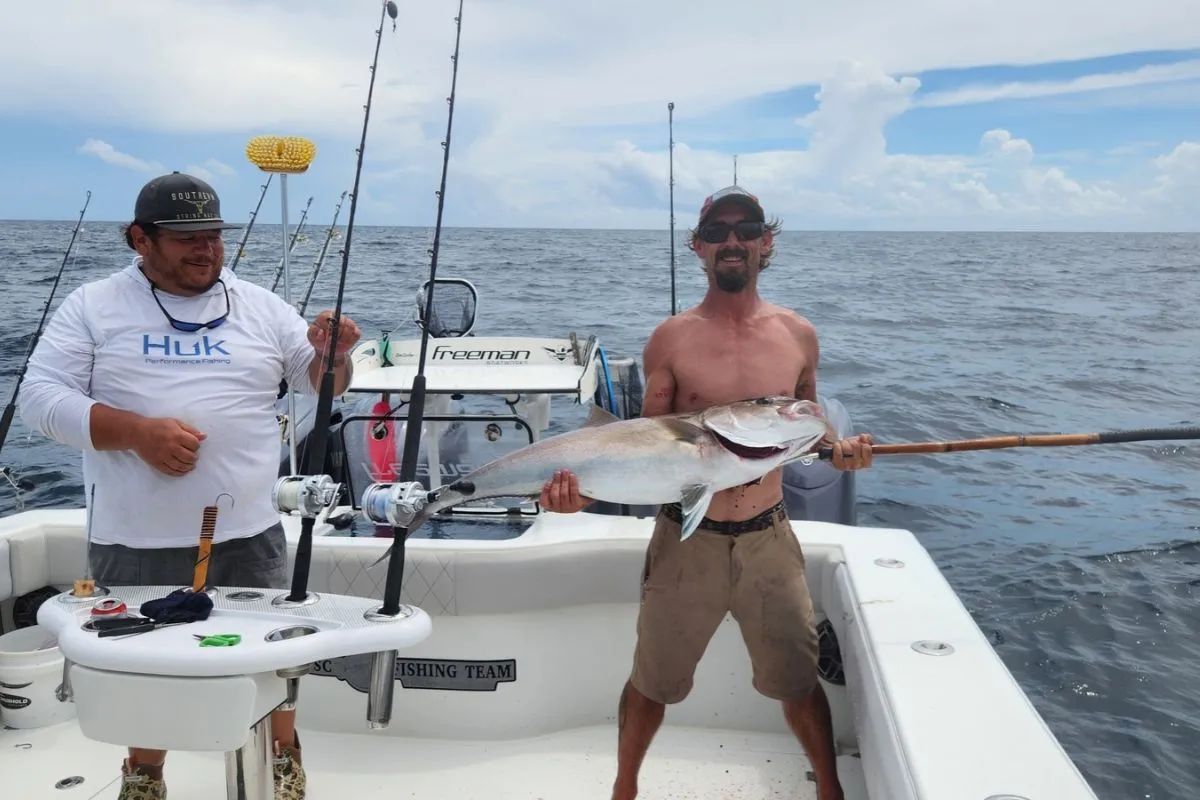
On the reef, the read is what separates jacks from snapper. Big amberjack show as large individual arches up and away from the structure. Vlad gives them two drops with a live hardtail on an 8 to 12 foot leader. If they won't eat, he switches to dead bait for snapper, because live bait catches the jacks and dead bait catches the snapper. When a jack eats, he fights it off the reef over flat bottom, where it has nothing to break him off on. His live bait amberjack video off Fort Morgan shows the hookset and the fight.
For jigging them instead, read our article on fishing greater amberjack on wrecks and reefs.
Fishing Alabama Reefs the Charter Fleet Has Worked All Summer
By late summer, the reefs closest to Orange Beach and Fort Morgan have been fished hard since the season opened. The usual advice: find reefs fewer boats fish, move when all you catch is small snapper, go lighter on leader and hook for wary fish, and use live bait to reach the bigger ones.
Vlad's version is more specific: take two or three snapper off a reef and move. A reef stripped of its fish is slow to come back, and in his experience snapper draw more snapper, so leaving some keeps the spot alive. Live bait picks out the bigger fish, because cut squid draws everything on the reef and the small ones get there first.
He also keeps his spots organized, because after enough seasons you have more numbers than you can remember. He rates each waypoint by color, gives the spots he checked this year their own color, and names some after the people he fished them with so the memory comes back. His red snapper video off Fort Morgan walks through it.
Finding Alabama's Public Reef Maps and Coordinates
Alabama's Marine Resources Division publishes its public reefs on interactive maps at Outdoor Alabama, split into inshore, nearshore and offshore zones. The nearshore coordinates download as a file, the offshore map lists when each reef went down and what it was built from, and the inshore maps link to side-scan images of each reef.
Download the waypoint files and search around each one with your sounder instead of assuming the boat icon sits on intact structure. Remember every boat on the coast has the same numbers. Vlad marks public reefs with an X so he can tell them from spots he found himself, and he reads every reef on his sonar before anyone drops.
The Outdoor Alabama offshore reef zone map is the place to begin.
Pensacola and Destin Artificial Reefs Across the State Line
The reef coast doesn't stop at Perdido Pass. Escambia County off Pensacola and Okaloosa County off Destin run active artificial reef programs, and with Bay County they are the only Florida counties where individuals can apply to deploy unpublished reefs inside existing county-held permit areas. The same pyramids and chicken coops sit on their bottom.
Pensacola's Artificial Reefs
Escambia County lists more than 500 public reef sites, and its Escambia Southeast site, nearly nine square nautical miles, is the largest permitted artificial reef site in Florida waters. In 2026 the county added 43 reef sites, built from 217 concrete modules, in 45 to 55 feet about four and a half nautical miles from Pensacola Pass, deployed by an Orange Beach, Alabama reef builder. Coordinates are on the county's public artificial reefs list.
Destin's Artificial Reefs
Okaloosa County has deployed 564 reef sites off Destin and Fort Walton Beach since 1976, more than 300 of them since 2019, with recent modules set from 65 to 292 feet. The county publishes coordinates on its Destin-Fort Walton Beach artificial reef maps.
We haven't filmed there yet, but Vlad's read on super pyramids, chicken coops, reef height and reef age is about the same kinds of structure on the Florida side.
Alabama Artificial Reef Fishing Questions
Do you need to vent red snapper caught on Alabama's shallow reefs?
On our trip, Vlad released inside reef snapper without venting and they swam straight down. Fish from 100 feet can still show barotrauma, so judge each fish. When expanding gas pushes the stomach out, never puncture it; vent behind the pectoral fin with a venting tool or use a descending device. Check NOAA Fisheries for release gear rules.
What size red snapper is best to eat?
Vlad keeps mid-size red snapper for the table and calls them the best eating. He says the biggest snapper are very old fish and finds their meat lower quality. He releases plenty of legal fish that fall below the size he likes to keep. Check Alabama Marine Resources for the current size and bag limits.
How do you tell a triggerfish bite from a red snapper bite?
A triggerfish nibbles, biting chunks out of the bait with its teeth, and to Vlad a bait that comes up with a clean chunk missing means triggers. A red snapper taps a few times, then loads up and pulls the rod down. Wait for that pull before you lift and reel.
Can you fish Alabama's artificial reefs from a small boat?
Yes, on the right day. Alabama has public reefs inside Mobile Bay and Bon Secour Bay, and nearshore reef zones within nine nautical miles of Baldwin County, including the Trolling Corridor and the R.V. Minton reefs. Pick a calm day and know your boat's limits before you run offshore.
Fish Alabama's Reefs Like a Charter Captain
The anglers who do well on Alabama's reefs read each reef before they drop. Find taller structure, read which side the snapper are on, match the rig to the bait, and leave a reef with fish still on it. Red snapper seasons and limits change every year, so check our red snapper season and regulations article and Alabama Marine Resources before you go, and for trips off Pensacola or Destin, check FWC and NOAA Fisheries for the waters you will fish.
Every reef video we film goes in our reef and wreck fishing videos.
Reef & Wreck Fishing
Login
to leave a review.
User Reviews
There are no reviews yet.
Setting Up a Dredge Pulley for Billfish
Saltwater
12.28.2020
High Speed Wahoo Trolling Rig
Saltwater
09.08.2018
Fishing Light Tackle for Yellowfin Tuna
Saltwater
09.08.2018
0