
Lead is not a spec, it is a steering wheel. Ten to twelve pounds gets you started, and the line angle tells you the rest. Structure, current, drift, and the drop sequences that put a bait on the bottom clean instead of balled up in the dark.
Deep Dropping for Daytime Swordfish
The hardest part of daytime swordfishing is not the fish. It is getting a bait to the bottom, in one piece, without tangling it, and knowing where it is once it gets there.
Why Swordfish Hold Deep in the Daytime
Follow the food and the depth explains itself.
Zooplankton make their way down into deep water every morning and rise again as the sun sets. This is diel vertical migration, and it happens across the world's oceans every single day. The reason has long been understood as a trade-off: feed in the rich surface layer, or avoid being eaten while you are up there.
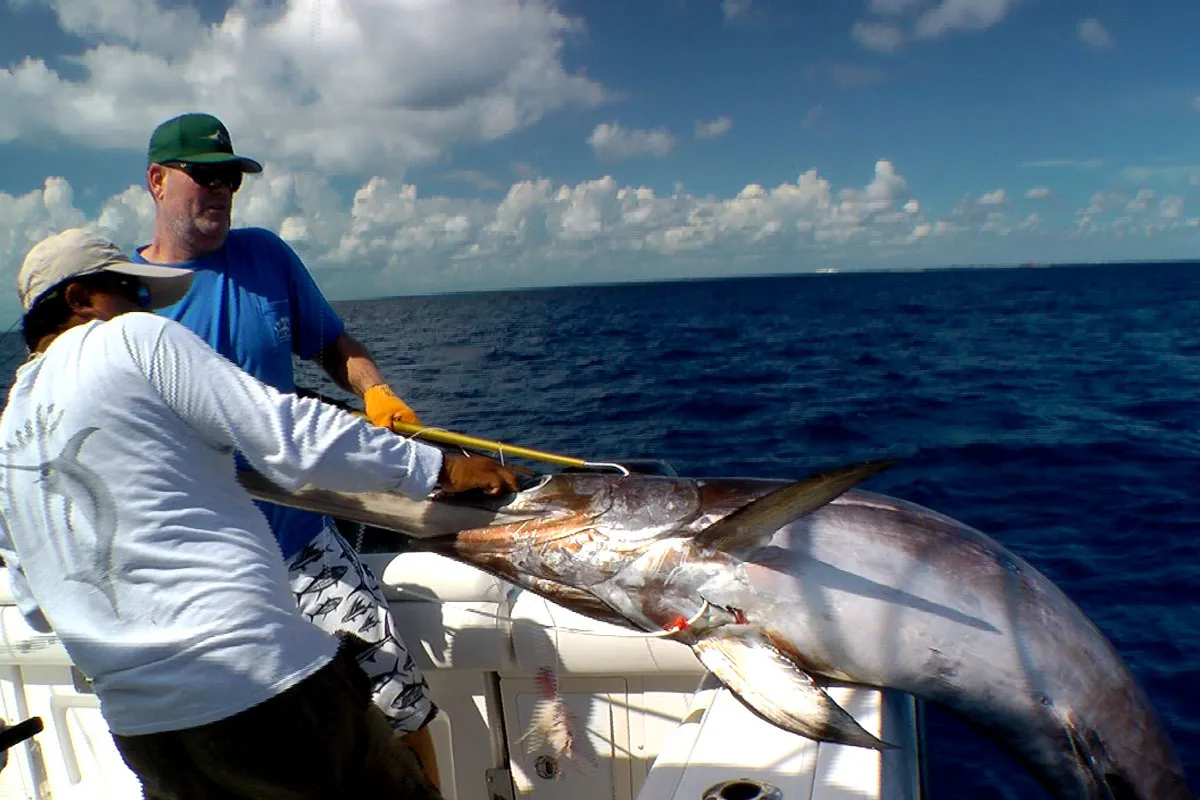
That mass of zooplankton is what gets called the deep scattering layer, and mixed into it are the squid and baitfish that feed on it. It is a moving conveyor of food, and as it sinks by day and rises by night, everything that eats it moves with it. Swordfish are simply the largest thing in that chain. They are not choosing to be at 1,500 feet at noon. They are following the squid, which are following the plankton.
Reading Bottom Structure for Swordfish
Find the bait, find the fish. It sounds simple and it is.
Baitfish seek the protection of structure. At depth, they hold to natural formations: seamounts, rock piles, ledges, anything that gives them refuge. In the Gulf Stream the current runs at a good clip, and anything suspended in it is either moving with it or fighting to hold position. Bait gets swept along, which creates a conveyor belt of food for a swordfish holding tight to structure.
It is exactly like a trout in a stream. Watch a trout and it slips in and out of the current to snag food and then slides back into the slack water behind a rock. No large fish wants to burn energy fighting current it does not have to fight. Swordfish are no different. If the structure and the current combine so that food is carried past, over, or around the fish, that is a spot worth sitting on.
- Seamounts and ridges that rise off the seafloor and create current breaks
- Ledges and drop-offs where depth transitions sharply and temperature layers meet
- Rock piles and hard bottom that hold crustaceans and smaller fish
- Depressions and divots that create eddies where bait gets trapped
- Canyon edges that funnel baitfish along a predictable line

Two Ways to Find Productive Bottom
I know successful captains who work this completely differently, and both of them catch fish.
The old school approach is pure record keeping. Charts, decades of experience, and a discipline about marking every single bite and every hookup until the numbers list becomes a database. No exotic electronics. Just relentless pattern recognition, built one fish at a time. Those spot lists read like classified documents and they are guarded like them.
The high tech approach runs advanced bottom mapping sonar that paints every rock, ledge, and contour. Those crews know the seafloor the way you know your own driveway, and they can put a bait on a target the size of a pickup truck at 1,600 feet.
Setting Up the Drop
Choosing Your Lead
Lead weight is not a number you set once. It is the variable you use to control line angle, and line angle is what determines whether you are actually fishing where you think you are.
- 6 to 8 pounds works in lighter current, on slightly shallower drops, or when you want a slower sink and a more natural presentation on the way down
- 8 to 12 pounds is the everyday band and where most drops in this fishery live
- 12 to 15 pounds and up comes into play in heavy current, in wind-against-current, or any time you simply have to pin a bait near the bottom and hold it there
Some crews run a two-weight system, a 10 to 12 pound primary paired with a lighter 6 to 8 pound breakaway, which gives you control over both the sink rate and the line angle in a rip.
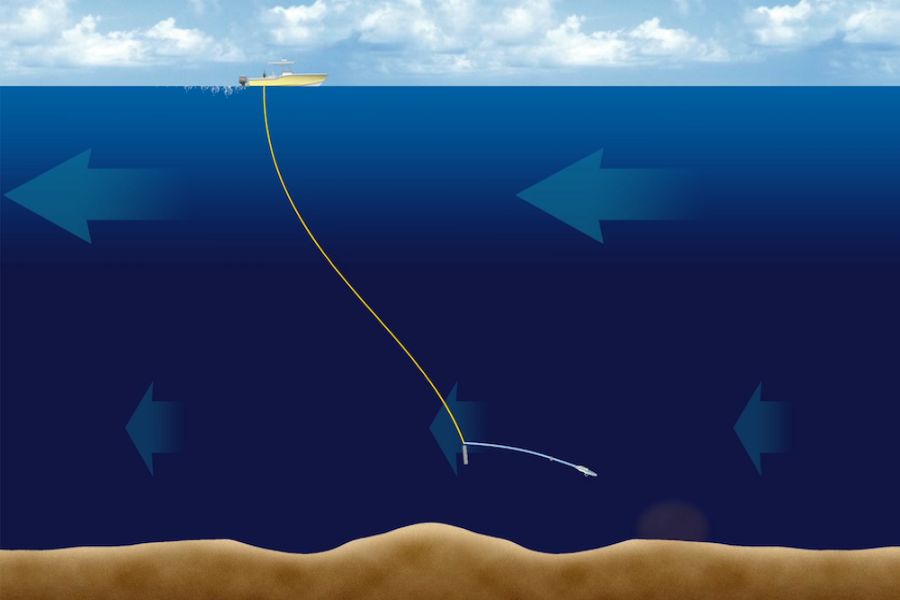
Here is the rule that matters. Start mid-range, around 10 to 12 pounds, drop, and then watch how far your line scopes relative to the depth you are fishing. If it is scoping hard and you cannot hold the strike zone, step up a couple of pounds. If you are hanging straight up and down but struggling to feel a bite or you suspect the bait is not swimming right, you can usually get away with less. You are adjusting until you drop close to vertical, and then you leave it alone.
Streamlining the Rig
Some crews run a breakaway system, others a stick lead on a longline clip. How you get the presentation down is largely preference.
What is not preference is streamlining. Your leader and weight have to be set up so that everything runs clean on the way down. A heavy lead pulling a long leader through 1,500 feet of moving water is exactly the situation that produces a wrap, and if your leader tangles the main line or the bait fouls in the leader, the drop is dead. You will not know it. You will soak a useless presentation for forty minutes and reel up a mess.
Because the reel is doing the lifting on this program, it is worth being deliberate about which one you buy. Our breakdown of choosing an electric reel for daytime swordfishing covers what actually matters when you are winching a fish and a heavy lead up from a quarter mile down.
How to Drop Baits in Light Current
Current, or the lack of it, determines exactly how you drop. It is all about keeping the rig from tangling.
With little or no current, you have to create the stretch yourself, and you do it with the boat. Drive a course in the shape of a C as you play line out. That curve is what keeps the leader trailing behind the lead instead of falling on top of it.
- Idle forward slowly as you begin lowering the bait
- Thumb the spool lightly to control the descent and keep the spool from overrunning
- Keep moving forward until the lead and leader have fully stretched out behind the boat
- Increase free-spool speed gradually as the rig drops away and down
- Watch the counter and slow the descent about 50 feet before you expect to touch bottom
In low current you want the line scoped out behind the boat, meaning there is still some angle in the line coming off the rod tip. As it starts to come straight up and down, feed some line and drive forward again. Think of it as bottom jigging on a very large scale. You are working the bait up and down while covering ground.
How to Drop Baits in Heavy Current
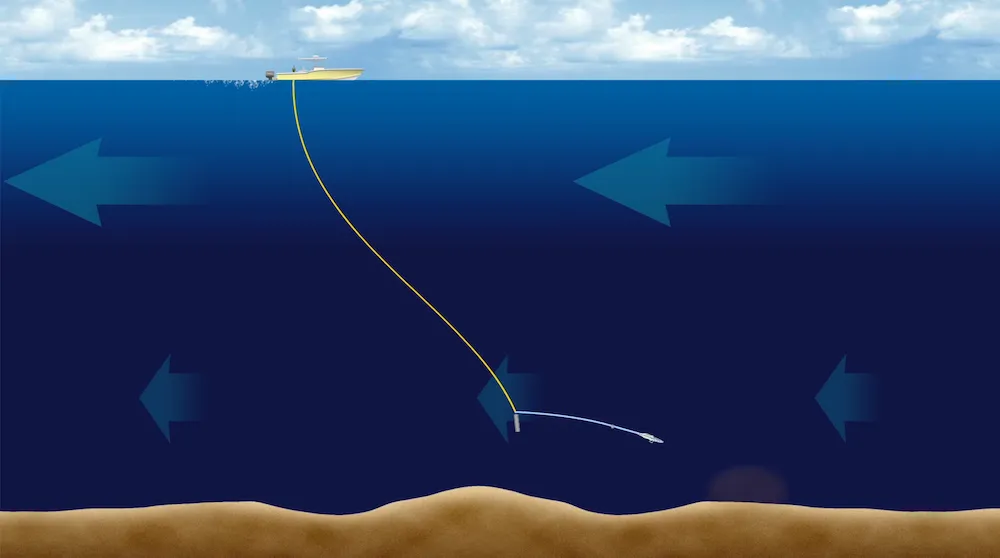
South Florida current changes the whole problem. And the complication people miss is that the surface current and the deep current are often not doing the same thing, which is what makes a rig swing wildly or pile up on itself on the way down.
Here you use the current instead of fighting it:
- Start with the current. Begin the drop driving in the same direction the surface flow is moving
- Stretch everything out. Get well clear, with the rig trailing cleanly behind you, before you commit
- Go to free spool and drop the bait toward the bottom
- Turn into the current and drive back up the line until it is straight up and down off the rod tip
- Stem the tide. Facing into the current, you are effectively trolling backwards. The current pushes the boat back while you bump in and out of gear to hold your speed against it
Managing the Drift
Whether there is current or not, the objective is the same: cover ground while working the bait up and down a hundred feet or so off the bottom.
With current, the boat is being swept and your job is to manage how fast. You do that by stemming. In the Northeast canyons or the Gulf of Mexico, where the current is far lighter, you bump troll at whatever speed you want. Either way, you are trying to make time over the bottom.
Watch the bottom machine and you will notice something. A lot of bites come on the backside of structure. The fish is lying in wait for prey to be swept past it, sitting in the slack water where it does not have to work. You can watch that same behavior in almost any predator that lives in current.
Reading the Swordfish Bite
You would expect the bite from a fish like this to be violent. It is the opposite.
Here is the part that costs people fish. Because a swordfish tries a bait by swatting it, if you miss that bite and the bait just hangs there dead, the fish will often swim off. A stunned baitfish does not hover motionless. It falls, or it flees.
So you move it. Engage the reel and bring the bait up about a hundred feet, then drop it right back down. That turns your bait into fleeing prey and then puts it back in front of the fish falling from above, which is exactly what the animal expects a wounded baitfish to do. The committed bite usually comes on the way down, and you may run that cycle more than once.
Dropping Mistakes That Cost You the Day
These come up constantly, and every one of them is preventable at the rail.
- Free-spooling too fast, which tangles the leader and costs you clean bottom contact
- Driving over your own rig, which happens when you fail to account for current push
- Putting out too much line, which makes an already subtle bite impossible to detect
- Failing to stretch the leader before the drop, which twists terminal tackle and ruins the presentation
- Ignoring line angle, because if the line is more than about 45 degrees off vertical, your bait is not where the counter says it is
Swordfish Fishing Courses
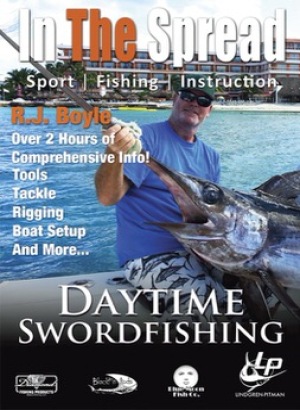
Daytime swordfishing operates at 1,200 to 2,000 feet where broadbill feed actively, creating technical challenges absent in nighttime surface fishing. RJ Boyle explains why depth fundamentally changes tackle requirements, how bait presentation at extreme depth affects strike detection, and what boat positioning precision maintains contact with baits along steep drop-offs where swordfish concentrate during daylight hours.
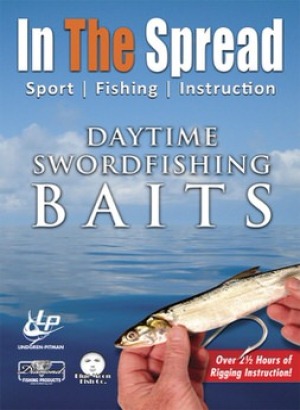
Daytime swordfish become selective when feeding slows due to moon phase or tide, making bait freshness and rigging quality critical rather than optional. RJ Boyle demonstrates seven bait options and specific rigging techniques for each, explaining when ladyfish, squid, dolphin belly, or bonito produce better results based on depth, current, and swordfish feeding behavior at extreme depths.
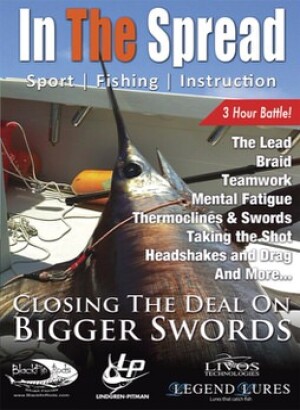
Learn proven swordfishing tactics for landing 500 to 800 pound fish with RJ Boyle. This video covers lead removal timing, harpoon shot execution, drag manipulation strategies, and wheelman boat positioning techniques that determine success when fighting trophy-class swordfish in challenging offshore conditions.

RJ Boyle's comprehensive daytime swordfishing seminar covers the art and science of targeting broadbill swordfish. Learn depth understanding, equipment requirements, advanced rigging techniques, current stratification analysis, and how oceanographic knowledge combines with tactical execution for consistent success in this technical offshore fishery.
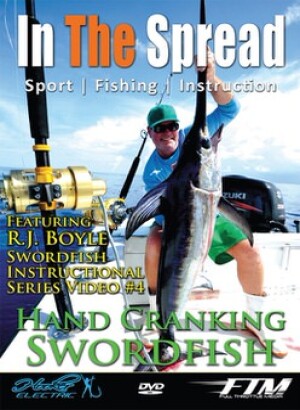
RJ Boyle reveals hand crank swordfishing techniques for IGFA-compliant record catches. This video covers tackle specifications for manual cranking, bait deployment at depth, recognizing swordfish bites, fight management strategies, and when hand cranking succeeds versus power-assisted methods in daytime offshore fishing.
Frequently Asked Questions About Deep Dropping for Swordfish
How long do you soak a bait for swordfish?
Typical soak times run 20 to 45 minutes per drop. Some crews check baits every 20 minutes to be certain the presentation is still intact and fishing correctly. Others let a bait sit longer over proven structure. There is no single right answer, and it is worth experimenting in your own water, but a bait that has been down 45 minutes without a touch is worth pulling and inspecting regardless.
How deep do you drop for daytime swordfish?
The working band is 1,200 to 1,800 feet, with 1,200 to 1,600 being a sensible place to start. Once your lead touches bottom, crank up so the bait is fishing roughly a hundred feet off. Tagging data shows swordfish holding deeper than that through the day, and crews will probe toward 2,000 feet when conditions allow, but the 1,200 to 1,800 range is where the practical fishery lives.
How much lead do you need for daytime swordfishing?
Most crews run 8 to 15 pounds, with 10 to 12 pounds a sensible starting point for a 1,200 to 1,800 foot drop. Use 6 to 8 pounds in light current when you want a slower, more natural sink, and step up to 12 to 15 pounds or more in heavy current or wind-against-current when you have to pin the bait near the bottom. The way to dial it in is to watch your line angle. If the line is scoping too hard to hold the strike zone, add a couple of pounds. If you are vertical but struggling to detect the bite, you can often go lighter.
How do you keep your rig from tangling on the drop?
Stretch it out before it descends. Drive the boat to keep the lead and leader trailing cleanly behind you, thumb the spool to control the rate, and never simply open the reel and let the whole thing free-fall. In no current, drive a C-shaped course. In heavy current, run with the flow to stretch out, then turn and stem the tide as the bait goes down.
What does a swordfish bite feel like at 1,500 feet?
Almost like nothing. The rod tip twitches, or a small load comes on and then comes off. Swordfish often swat a bait with the bill before eating it, so the first contact is frequently not an eating attempt at all. Do not swing on it. Engage the reel, lift the bait about a hundred feet, and drop it back down to trigger the commitment.
How much does it cost to get started in daytime swordfishing?
Expect a meaningful investment in specialized tackle, typically several thousand dollars for electric reels, heavy rods, braid, and terminal gear, plus a few hundred per trip in fuel and bait depending on how far you run. It costs more than most offshore fishing. It also asks more of you, and it gives back accordingly.
Why do so many swordfish bites come on the backside of structure?
Because the fish is doing what every predator in current does. It sits in the slack water behind the structure where it does not have to burn energy, and it lets the current deliver prey to it. Work the downcurrent side of a seamount, ledge, or ridge and you are fishing the ambush point rather than the obstacle.
Getting the Drop Right
There is a lot that goes into swordfishing. The boat setup, the harpoons, the rods and reels, the baits, the fuel, and a crew that actually communicates. But if you had to pick one skill that separates the boats that catch fish from the boats that tell stories, it is the drop.
Getting a rig cleanly to 1,500 feet, knowing precisely where it is, keeping it in the strike zone as you work past structure, and recognizing a bite that looks like the rod tip breathing. That is the craft. Everything else is equipment.
None of it is mysterious and none of it requires talent. It requires knowing what to do and then doing it enough times that it stops being difficult. Drive the C in slack water. Stem the tide when it is ripping. Watch your line angle. Move the bait when a fish swats it. Take the time to acquire all the knowledge you can and go get tight.
When you are ready for the full picture, our complete breakdown of how to catch swordfish covers tackle, night drifting, and the fight.
Login
to leave a review.
User Reviews

Robert
11.27.2023
0
Setting Up a Dredge Pulley for Billfish
Saltwater
12.28.2020
High Speed Wahoo Trolling Rig
Saltwater
09.08.2018
Fishing Light Tackle for Yellowfin Tuna
Saltwater
09.08.2018


0