
Half the anglers on the water call a gag a black and a scamp a red. The species you land sets your size limit, your depth, and your fight. This breaks down every Florida grouper worth knowing and exactly how to tell them apart.
Identifying Florida's Grouper Species
Ask ten anglers to name the fish in the cooler and half of them will call a gag a black and a scamp a red. It is an easy mistake to make, because several of Florida's grouper species share the same bottom, wear close to the same colors, and only separate out when you know what to look at. But it is a mistake that matters. The grouper species in front of you decides the size limit you are held to, the depth you should have been fishing, and the kind of fight you are about to lose if your drag is light. Learning to tell them apart is not trivia. It is the first piece of actually fishing this bottom well, and it pairs with the technique side of the program covered in our breakdown of how to catch grouper.
Florida holds more grouper species than any angler needs to memorize, but a working handful accounts for nearly everything you will put in the boat, from the shallow Nature Coast rock to deep drops past 800 feet. This lays out what each one is, where it lives, how deep, how big, and how to know it on sight. Where two species get confused, we take them head to head.
Why Grouper Identification Matters in Florida
There are three reasons to get the species right, and none of them are academic.
The first is legal. Florida manages grouper species by species, with different seasons, minimum sizes, and bag limits for gag, red, black, and the rest, and those rules split again between the Gulf and the Atlantic and between state and federal water. A gag and a red grouper caught on the same wreck can carry entirely different size limits on the same day. Call the fish wrong and you can be over the limit or under the minimum without knowing it.
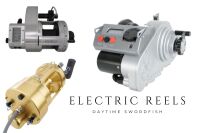
The second is depth. Each species sets up in its own band of water. Find a gag on shallow rock and you are on a fishery a small boat can reach; mark a snowy grouper and you are looking at a 700-foot drop and an electric reel. Knowing which fish lives where tells you how far to run and what to rig before you ever leave the dock.
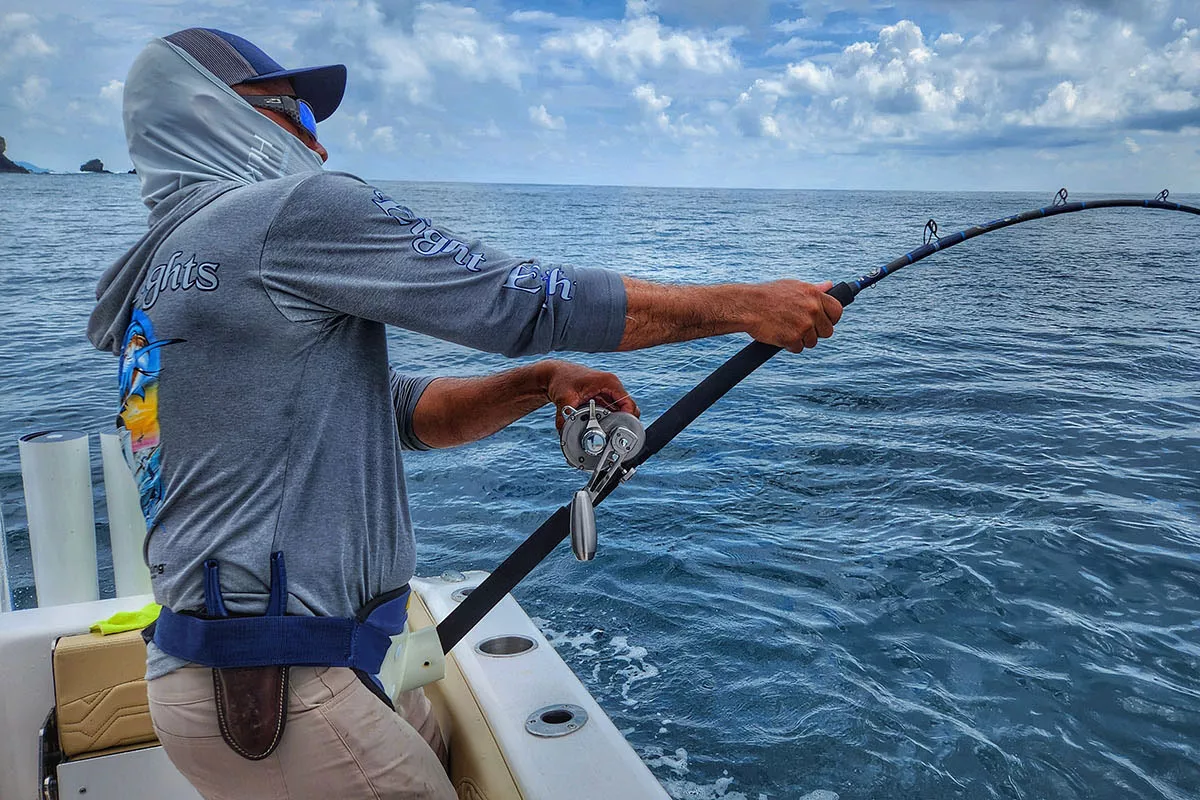
The third is the fight. A twenty-pound gag and a twenty-pound black do not pull the same. Knowing what ate your bait the instant it loads up tells you how hard to lean on the fish in the first two seconds, which is the window where most grouper are won or lost. Identification is not something you do at the dock with a tape. It starts the moment the rod bends.
How to Tell a Gag From a Black Grouper
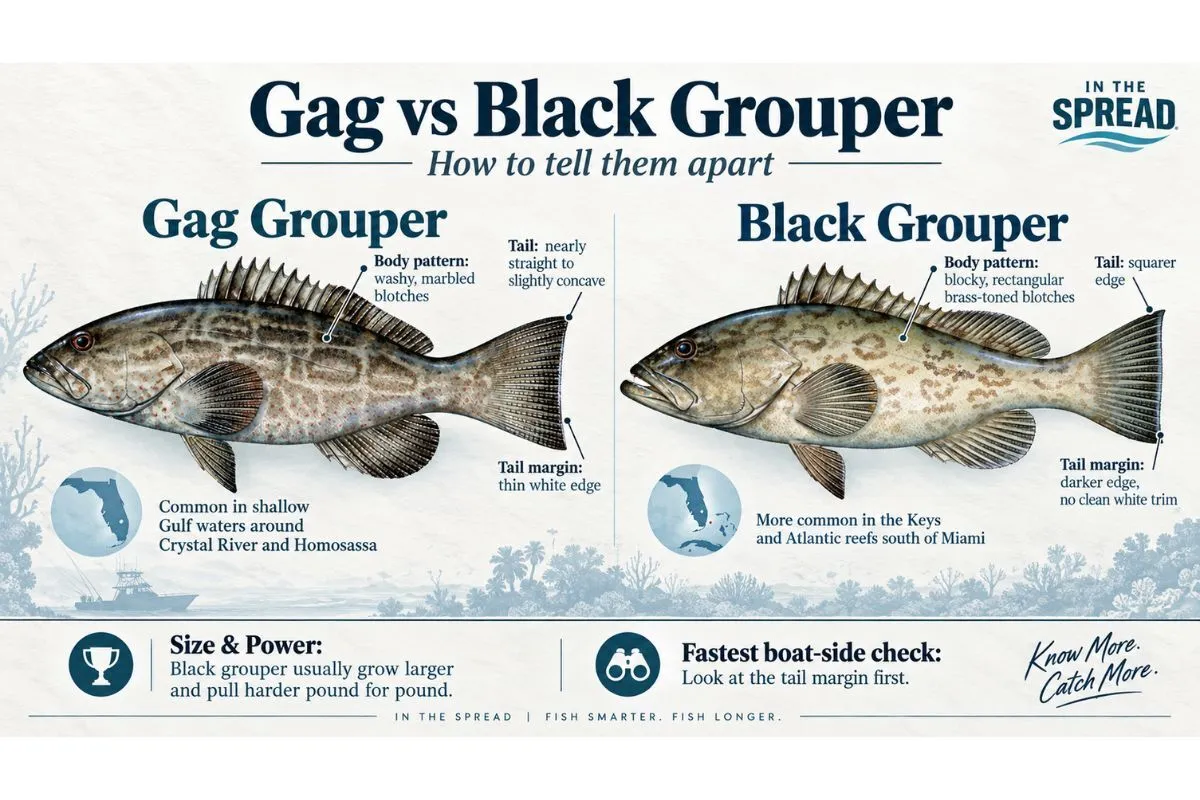
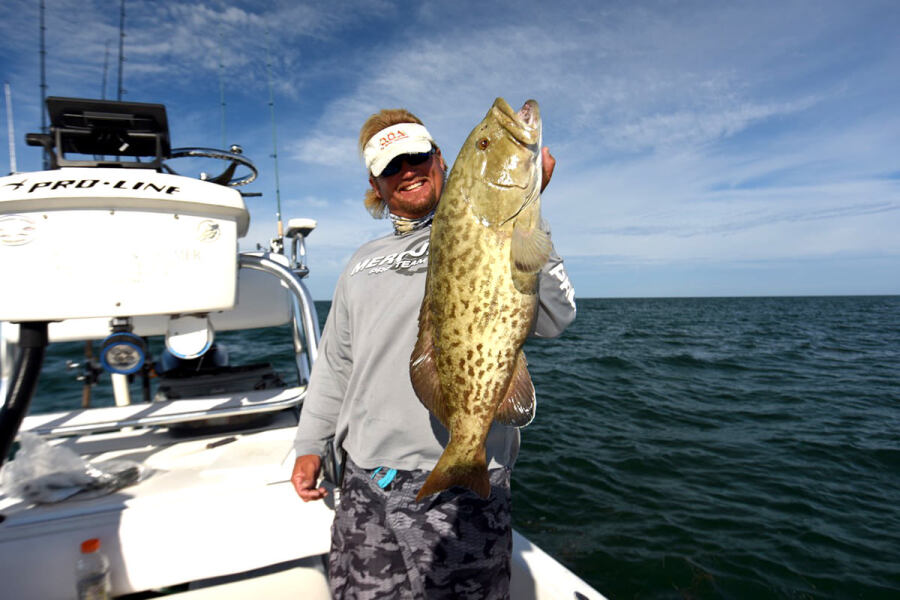
This is the confusion that trips up the most anglers, because gag and black grouper overlap in range and share structure, and they look nearly identical to an untrained eye. Neither fish is exclusive to one coast, either. Both turn up on the Gulf and the Atlantic; the difference is abundance, with gags the common shallow fish on the Gulf and blacks the common fish in the Keys and the Atlantic reefs. Get these two straight and you have solved most of your grouper ID problems.
Look at the tail first. A gag grouper has a tail with a nearly straight or slightly concave edge, and on many fish the fin margins carry a thin white line. A black grouper shows a tail edge closer to square with a darker margin and no clean white trim. Be careful with that white-margin rule on smaller fish, though, because juvenile gags and mature females often show dark blue-black outer edges on the tail, anal, and pelvic fins, which can fool you into calling a gag a black. The body markings help: a gag wears washy, blotchy marks that run together into a marbled look, while a black grouper carries more organized, blocky rectangular blotches in tighter rows, almost like brass-colored tiling over a darker base.
For the fish that will not sort out by color, there is a definitive in-hand check: the preopercle, the bony edge of the gill cover at the cheek. On a gag it is angular and notched, with a distinct lobe at the corner. On a black grouper it is gently rounded, with no lobe. That one feature separates the two even on a big or faded fish, when the tail and the markings have stopped being reliable.
Size and power are the last tell. Black grouper grow larger, and most anglers who have fought both will tell you a black pulls harder pound for pound. A fish that simply overwhelms you off the bottom on gear that should have handled it is more often a black than a gag. When you are genuinely unsure at the boat, work the tail, then the preopercle, and let the two agree before you call it.
Gag Grouper
Gag grouper, Mycteroperca microlepis, are the backbone of the shallow Gulf fishery and the fish most Florida anglers picture when they think grouper. They hold anywhere from about 10 feet out past 100, on rocky outcrops, limestone ledges, the edges of grass flats, and nearshore reefs. That shallow accessibility is what makes them special: on the Nature Coast, gags live on rock in water skinny enough to sight-fish, a fishery detailed in our resource on shallow-water grouper on the Nature Coast.
They are aggressive feeders, and that is the good news. The bad news arrives the instant they feel the hook, because a gag's entire instinct is to turn and bury itself in the nearest structure. They will run down a trolled plug or a fast jig when they are fired up, then try to reef you the moment they are stuck. Gags are excellent table fare and run smaller on average than black grouper, though a mature Gulf gag past twenty pounds is a serious fish on any tackle. On the water, look for the marbled body and the white-edged tail, and expect the fish to be somewhere it can reach cover in one hard dive.
Black Grouper
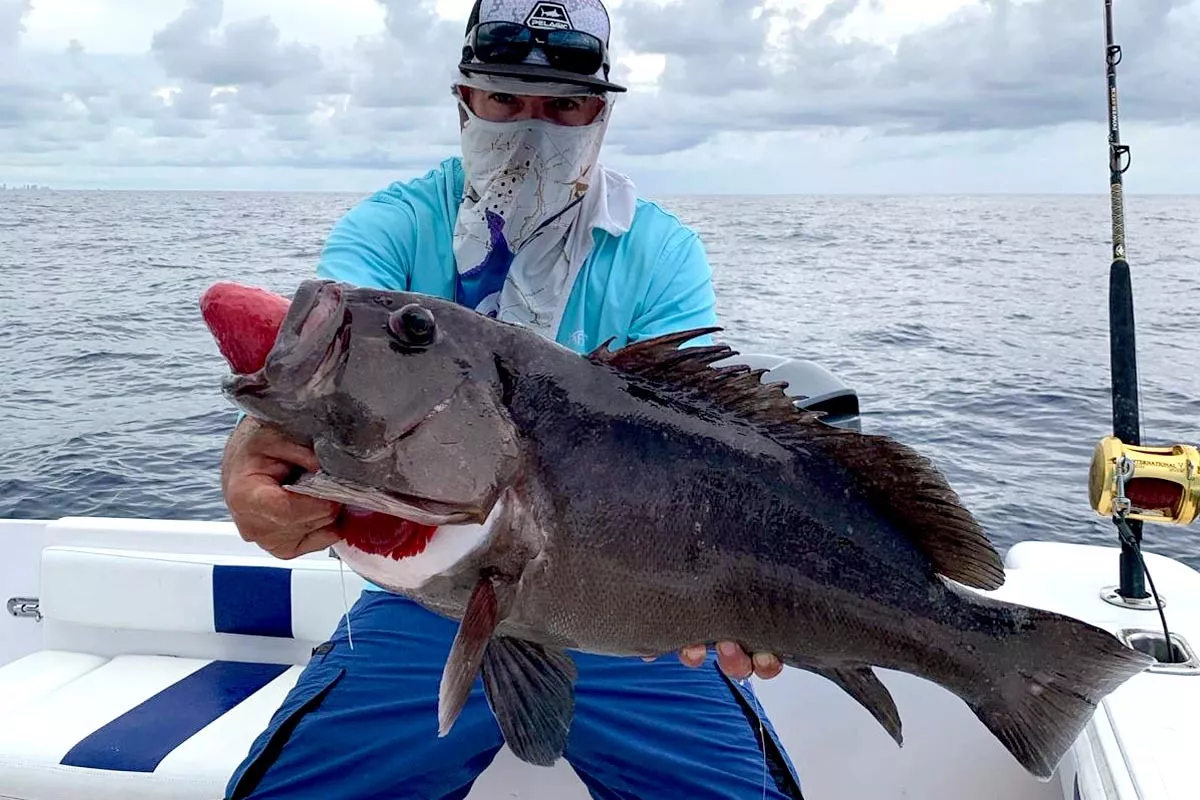
Black grouper, Mycteroperca bonaci, are the bigger, meaner cousin. They grow larger than gags and are known for more raw power for their size, and a big black grouper on a Keys wreck is one of the hardest-pulling fish in shallow water. They favor slightly deeper Atlantic reefs and offshore wrecks and become the dominant grouper in the Florida Keys and the grounds south of Miami, though they turn up on the Gulf side too.
The identification cues are the ones covered above: blocky, organized blotches over a brassy base, a squared tail with a dark margin, no white fin trim, and a rounded preopercle. Where a gag gives you one hard dive, a big black gives you a longer, sustained fight that does not quit, and it takes heavier tackle and a locked drag to keep its head coming. If you are fishing clear Keys water over a patch reef or a wreck and a fish eats and simply does not stop, you are almost certainly tied to a black.
Red Grouper
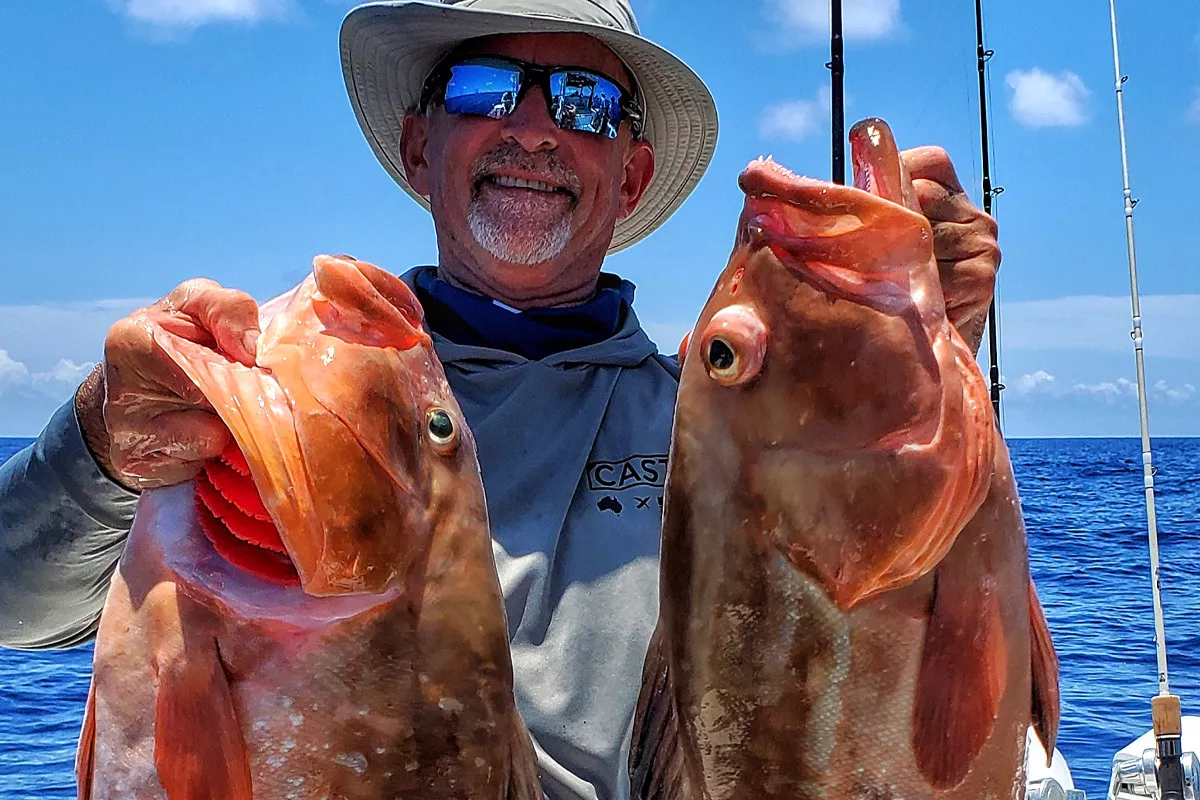
Red grouper, Epinephelus morio, are the workhorse of the Gulf, and arguably the most commercially significant grouper in the state. They live deeper than the shallow gags, roughly 80 to 300 feet, out on the Gulf shelf, and they have a habit no other Florida grouper shares: they actively excavate the sand and sediment around limestone outcrops to build and maintain their own holes. Find a red grouper and you have often found a spot the fish itself engineered.
They are easy to separate from gags and blacks once you have seen one. Red grouper carry a reddish-brown to rusty body, often with pale blotches and scattered small dark spots, and a more evenly sloped profile without the marbled or blocky patterning of the Mycteroperca species. They feed more deliberately than a gag, holding tighter to the bottom and taking a bait with less of the reaction-strike aggression, which is why patience over a red grouper hole pays. They are outstanding eating and, on the Gulf, one of the most reliable grouper an offshore angler can target.
Scamp Grouper
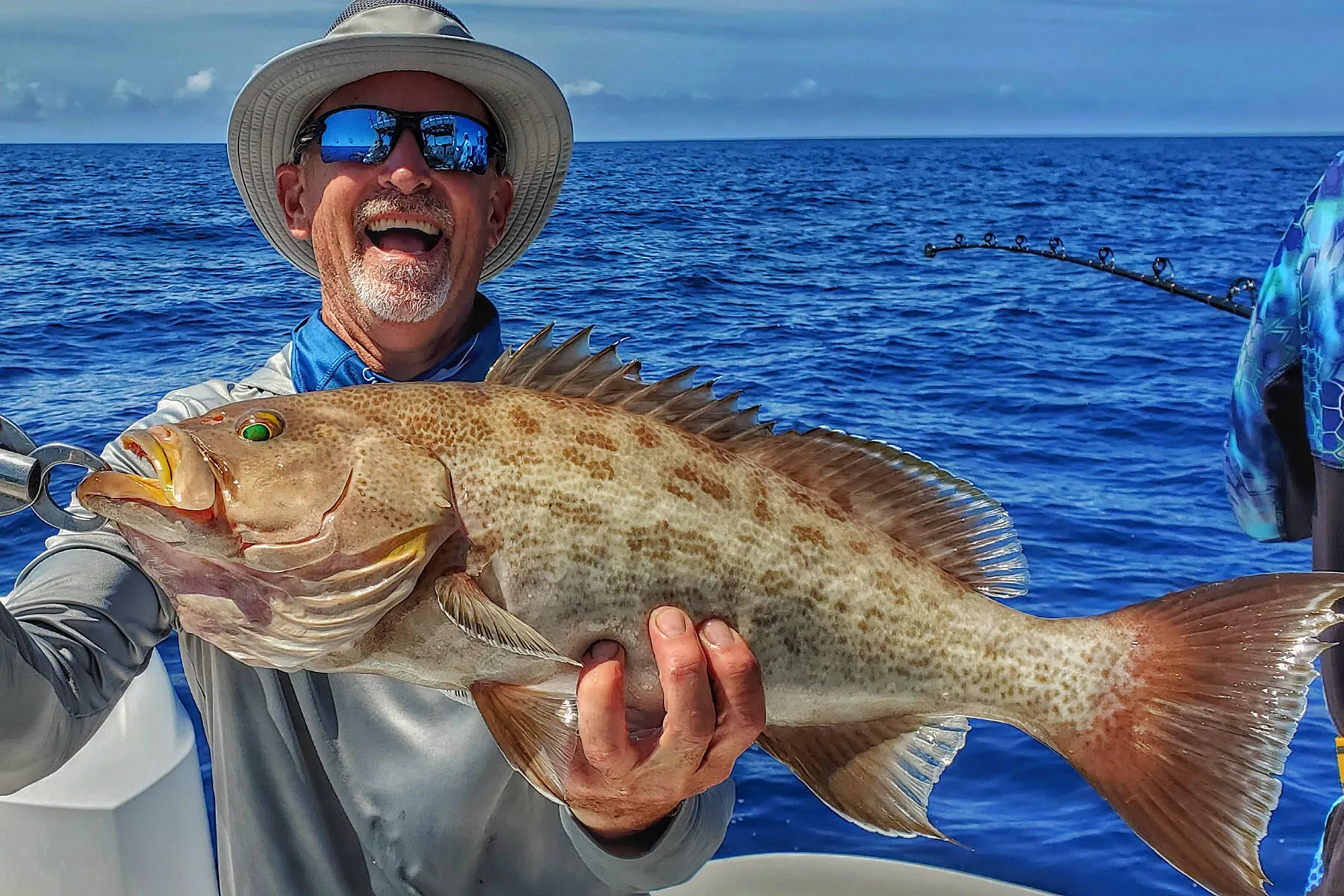
Scamp, Mycteroperca phenax, are the connoisseur's grouper and a species too many anglers overlook or misidentify. They run smaller than gags and blacks, rarely getting huge, but they are widely considered the best eating of all the Gulf grouper, and a mixed bag off the Panhandle often carries a few. Scamp hold on deeper natural limestone and reef structure, commonly out in the 80 to 200-foot range alongside red grouper and gags, favoring high-relief hard bottom.
Identifying a scamp comes down to the pattern and the tail. They wear small, close-set dark spots and brushy markings over a tan to gray-brown body, and mature fish develop trailing, broom-like points on the tail and rear fins, the tell that gives them the local name "broomtail." The look-alike to know is the yellowmouth grouper, which shares that fine spotting closely. You separate the two at the mouth: the yellowmouth shows yellow in the corners and lining of the mouth that the scamp lacks, and the scamp's broomtail points run longer and more ragged. If you boat a smaller, finely spotted grouper off Panhandle or deep central Gulf structure with ragged fin tips and no yellow in the mouth, you are holding a scamp, and you are holding the best filet in the box.
Goliath Grouper
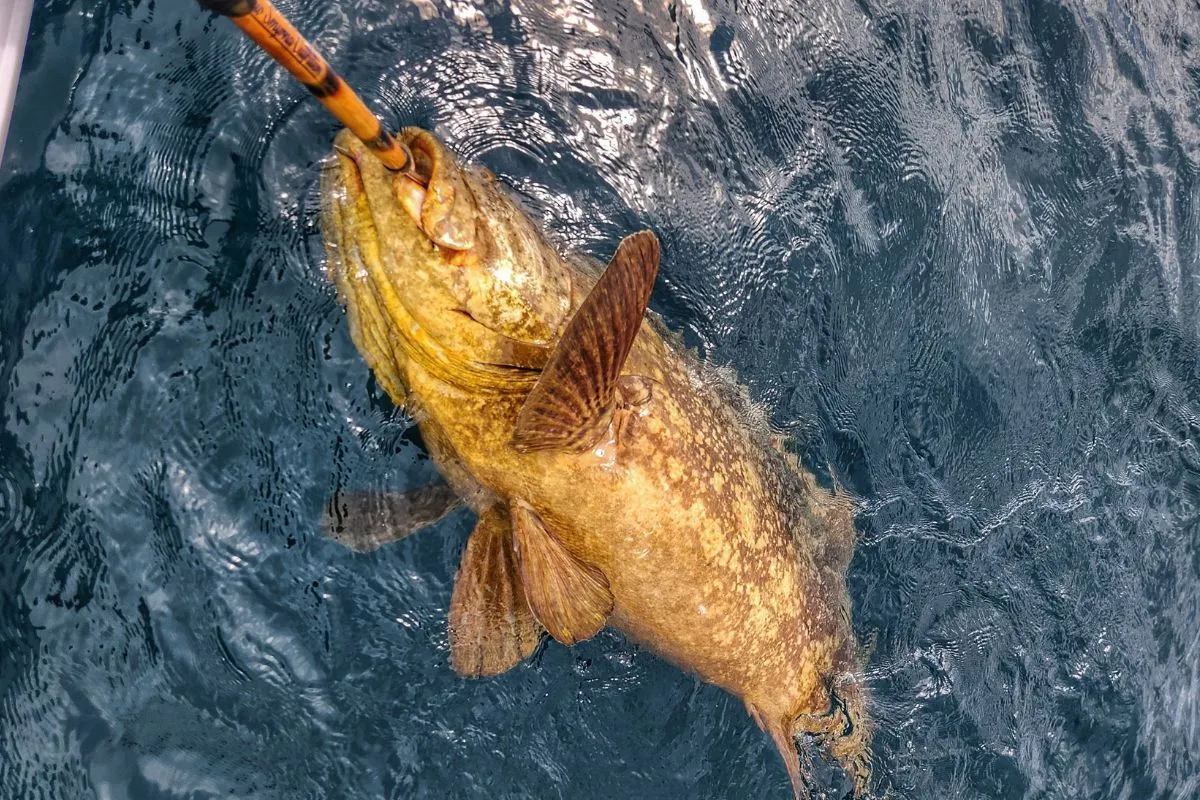
Goliath grouper, Epinephelus itajara, are the giants, and there is no mistaking one. They can exceed 600 pounds, with the largest fish reported to approach 800 pounds and eight feet, and they feed by opening their massive mouths to create a suction that pulls a bait, or a whole hooked fish, in from a distance. Anyone who has had a goliath inhale a struggling snapper boatside knows the sound of it.
For identification, size alone usually settles it, but look also for the broad, heavy body, the small eyes set in a huge head, the rounded fins, and the dark blotches and spots that mottle a tawny to gray-green base, more pronounced on younger fish. What matters most with goliaths is the regulatory picture. They were fully protected for decades, and while Florida has opened a narrow recreational harvest, it is tightly bounded: state waters only, a random-draw permit with an application window in the fall, a slot limit on the fish that can be taken, and large stretches of coast excluded, including the Atlantic side from around Martin County south through the Keys and the heavy dive-tourism zones. Adult goliath remain off-limits statewide. Treat any goliath as a catch-photograph-release fish unless you personally hold a current permit and know the exact rules for the water you are fishing, and confirm the program details with the FWC before you plan a trip around it.
Snowy, Yellowedge, and the Deep-Water Grouper
These are the deep-water grouper, the fish that live where sunlight does not reach and only a deep drop will touch them.
Snowy grouper, Hyporthodus niveatus, hold on hard bottom and ledge structure well offshore, commonly from about 300 to 800 feet and sometimes deeper. A snowy is dark-bodied, nearly chocolate to blackish in larger fish, and juveniles and mid-size fish carry distinct white or pearl spots scattered across the body, the mark that names them. Yellowedge grouper, Hyporthodus flavolimbatus, share that deep zone and often come up on the same drops. You separate a yellowedge by the vivid yellow trim running along the edges of the fins over a grayish-brown body. One practical note from the captains who fish them: yellowedge are toothy, and many deep-drop crews step up to a heavier or wire-reinforced leader when they are in the mix. That is hard-won habit more than a hard rule, but it saves rigs.
The deep drops hold two more fish you have to recognize on sight, because both are off-limits. Warsaw grouper, the largest of the deep-water grouper, comes up on the same hard bottom as snowy and yellowedge and is known by its dark brown to nearly black body and a single greatly elongated second dorsal spine that no other grouper carries. Speckled hind, a smaller deep-reef fish, wears a body peppered with fine white or pearl spots over a dark to reddish base. Both Warsaw grouper and speckled hind are prohibited from harvest and possession in South Atlantic federal water and must be released, so learn them before you drop, not after one is already in the box.
All of these are reached only by deep dropping, the same electric-reel, heavy-sinker, multi-hook approach used for other deep species like the golden tilefish. If you are marking fish on hard bottom past 300 feet and rigging for a long drop, this is the group you are hunting, and the legal ones are superb on the table.
Nassau, Yellowfin, and Other Reef Grouper
A few more grouper turn up on Florida reefs and are worth knowing, some so you can keep them and one so you never make the mistake of trying.
Nassau grouper, Epinephelus striatus, are more than a state release rule. They are federally protected and listed as threatened under the Endangered Species Act, and harvest is prohibited everywhere in United States water. Learn the broad dark bars over a pale body and the distinctive black saddle on the base of the tail so you never mistake one for a legal fish.
The other reef grouper to know is the yellowfin grouper, Mycteroperca venenosa, a common catch on Keys and South Florida reefs and a more likely fish than several of the deep species. You know it by the oval dark spots arranged in horizontal rows down the body and the bright yellow along the outer third of the pectoral fins. It is legal to keep within the grouper rules, though it carries a ciguatera risk in some Keys and South Florida waters, which we cover below. Beyond these, anglers working varied bottom will occasionally boat smaller sea basses and hinds in the grouper family, such as red hind, rock hind, coney, and graysby. These rarely drive a trip, but when an unfamiliar grouper comes over the rail, the move is the same every time: identify it before you decide whether it stays.
Florida Grouper Species at a Glance
This is the quick reference. Depths are typical recreational ranges, and harvest status is the general picture, not the current-season detail, which changes every year.
Harvest status shifts by coast, water, and year. Confirm the current rules with the FWC and NOAA Fisheries before you keep any grouper.
Grouper Fishing Videos
Captain Dan Clymer reveals shallow water gag grouper tactics for Florida reefs. This video covers live bait selection, artificial lure techniques, boat positioning strategies, bottom fishing methods, trolling approaches, and casting techniques for catching grouper in 20 to 60 feet of water.
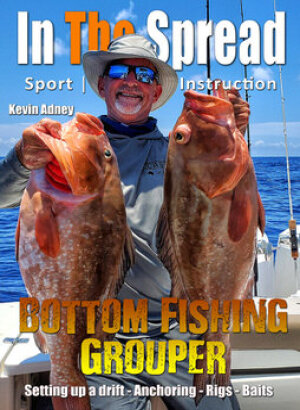
Grouper bottom fishing productivity depends on targeting natural reefs and wrecks where fish concentrate rather than random bottom. Kevin Adney's drift management approach keeps baits working productive structure zones systematically, but success requires understanding how current affects drift speed and positioning presentations where grouper ambush prey rather than sweeping past strike zones or hanging in barren areas between structure features.
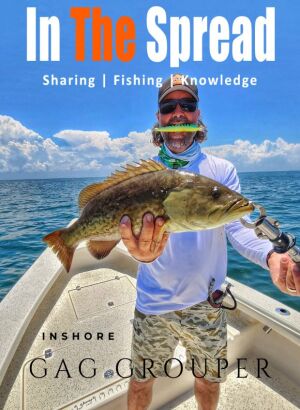
Inshore gag grouper fishing in Florida's shallow waters demands finesse with light tackle using 10 lb braid or heavier setups with diving plugs based on conditions and structure. Captain William Toney's local expertise reveals when jig heads allow delicate presentations versus when diving plugs trigger reaction strikes, plus understanding tide and current effects on fish positioning requiring anchoring strategies for effective presentations.
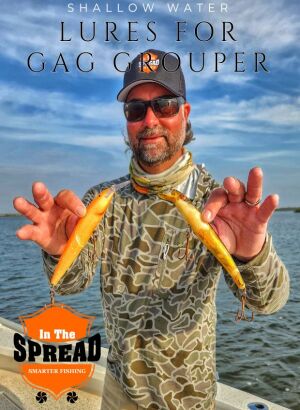
Shallow water gag grouper demand casting lure approaches different from deep fishing because clear conditions allow fish to inspect offerings closely around structure. Captain William Toney's fourth-generation Florida expertise reveals which lure profiles and colors trigger strikes, how boat approach affects spooking wary predators, and technique for extracting powerful grouper from structure before they reach safety.
How the Species Change the Way You Fish
Identification is not separate from tactics; it drives them. A shallow gag on Nature Coast rock wants a live pinfish or a fast-moving plug and a rod short enough to turn it in a hurry. A red grouper on a deep Gulf ledge wants a bait held patiently on the bottom and the leverage to lift it out of the hole it built. A black grouper on a Keys wreck demands the heaviest tackle you brought and a drag you are not afraid to lock. And a snowy at 700 feet is a different sport entirely, an electric reel and a long wait. Knowing the fish tells you which of those you are set up for.
The full technique breakdown, from bottom fishing and jigging to trolling the shallow rock, lives in the grouper hub. Use the species knowledge here to decide what you are targeting, then rig for it accordingly.
Handling and Releasing Grouper
Grouper come up from depth with their air bladders expanded, and a fish you intend to release, or one you have to release like a Nassau, a Warsaw, or a short gag, does not survive being tossed back to float on the surface. Reef fish rules in Gulf federal water require a descending device rigged and ready and a venting tool aboard, and using them is the difference between a released fish that swims back down and one that dies on top. If you are fishing deep or working through short fish to find a keeper, have that gear out and know how to use it before the first drop.
One more note, on the filet rather than the fight: ciguatera. The toxin has been documented in Florida grouper, particularly larger red grouper and yellowfin grouper taken from the Keys and South Florida reefs. It is not common, but it is real, and it is worth knowing when you are deciding whether to keep and eat a big reef fish from those waters.
A Word on Regulations by Species
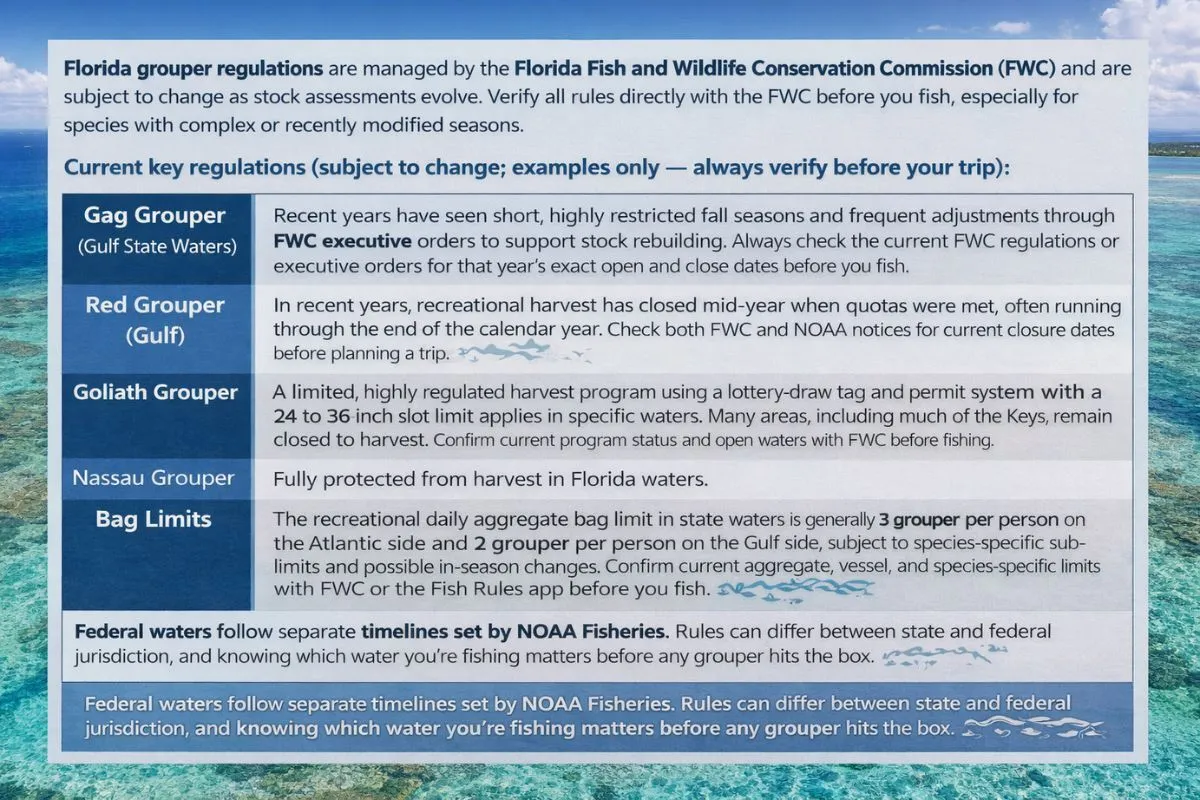
Because grouper are managed one species at a time, identification and regulation are the same conversation. Gag grouper in Gulf state water have seen short, tightly restricted fall seasons in recent years. As one example of how narrow those windows have become, the FWC set the 2026 Gulf state-waters recreational gag season by executive order for September 1 through 30, closing at 12:01 a.m. on October 1. Red grouper harvest on the Gulf has closed mid-year when quotas were met. Goliath are limited to the narrow permit harvest described above, and Nassau, Warsaw, and speckled hind cannot be kept at all. Federal water follows separate timelines set by NOAA Fisheries, and Gulf federal water closes all shallow-water grouper, gag and red among them, from February 1 through March 31 beyond the 20-fathom break.
There is biology under all of this that explains why the rules run so tight. Gag, black, scamp, and red grouper are protogynous hermaphrodites: they begin life as females, and some later turn male, which is why the biggest fish in a population are usually the males. Take the big fish and you take the breeding males, so the short seasons and slot rules exist to protect a spawning stock that does not replace itself quickly.
None of the specific dates or limits above should be taken from an article, this one included, because they change every year and turn on exactly where you fish. Before every trip, confirm the current seasons, sizes, bag limits, and gear rules for each species directly with the Florida Fish and Wildlife Conservation Commission and NOAA Fisheries. Our full breakdown of the current rules lives in the Florida grouper regulations resource, and that is the page to check before you launch.
Frequently Asked Questions About Florida Grouper Species
How many types of grouper are in Florida?
More than a dozen grouper species occur in Florida water, but a working handful accounts for nearly all the fishing: gag, black, red, scamp, yellowfin, goliath, snowy, and yellowedge, plus the protected Nassau, Warsaw, and speckled hind. The rest are smaller hinds and sea basses caught occasionally.
What is the difference between a gag and a black grouper?
A gag has a marbled body and a tail with a thin white margin, while a black grouper has blocky, organized blotches and a squared, dark-edged tail with no white trim. On a large or faded fish, the surest check is the preopercle at the cheek: angular and notched with a lobe on a gag, gently rounded on a black.
What is the best-eating grouper in Florida?
Scamp is widely considered the finest table grouper in the Gulf, followed closely by red grouper and gag. All of Florida's common grouper are excellent eating, which is a large part of why the fishery is so popular.
Which grouper live in the deepest water?
Snowy, yellowedge, and Warsaw grouper live deepest, commonly from about 300 to 800 feet and sometimes deeper, and are reachable only by deep dropping with heavy tackle and electric reels.
Which Florida grouper cannot be kept?
Nassau grouper, Warsaw grouper, and speckled hind are prohibited from harvest and must be released, and goliath grouper may only be taken under a limited permit in specific waters. Always verify a species' status before keeping it.
Do you need a descending device for grouper?
In Gulf federal water, reef fish rules require a descending device rigged and ready plus a venting tool aboard. Beyond the rule, both sharply improve survival for any grouper you release from depth.
Knowing the Fish Before You Fish It
Every good grouper trip starts with knowing what you are after. The species tells you how deep to run, what to rig, how hard to pull in the first two seconds, and whether the fish in your hands is legal to keep. Gag and black on the shallow rock and reefs, red and scamp on the mid-depth Gulf shelf, yellowfin and Nassau on the South Florida reefs, goliath around the big structure, snowy and yellowedge and Warsaw in the deep dark water. Learn those bands and their tells, and you stop guessing at the cooler and start fishing on purpose.
With the species straight, put it to work with the full technique program in our resource on how to catch grouper, and when you want to watch each of these fish identified and caught on the water, the grouper video library puts you on the boat with the captains who fish this bottom for a living.
Login
to leave a review.
User Reviews
There are no reviews yet.
Complete Dredge Pulley Setup Guide
Saltwater
12.28.2020
High Speed Wahoo Trolling Rig
Saltwater
09.08.2018
Fishing Light Tackle for Yellowfin Tuna
Saltwater
09.08.2018
0