
Most anglers miss spring muskies because they don't understand the connection between water temperature and fish location. Muskies concentrate in predictable staging areas before spawning and recovery zones afterward, but they respond to a narrow range of presentations. The difference between success and frustration comes down to reading temperature triggers, identifying subtle structure, and matching your tactics to whether fish are pre-spawn, recovering, or transitioning. This isn't about grinding through casts. It's about intercepting fish during the most concentrated, catchable period of the entire year.
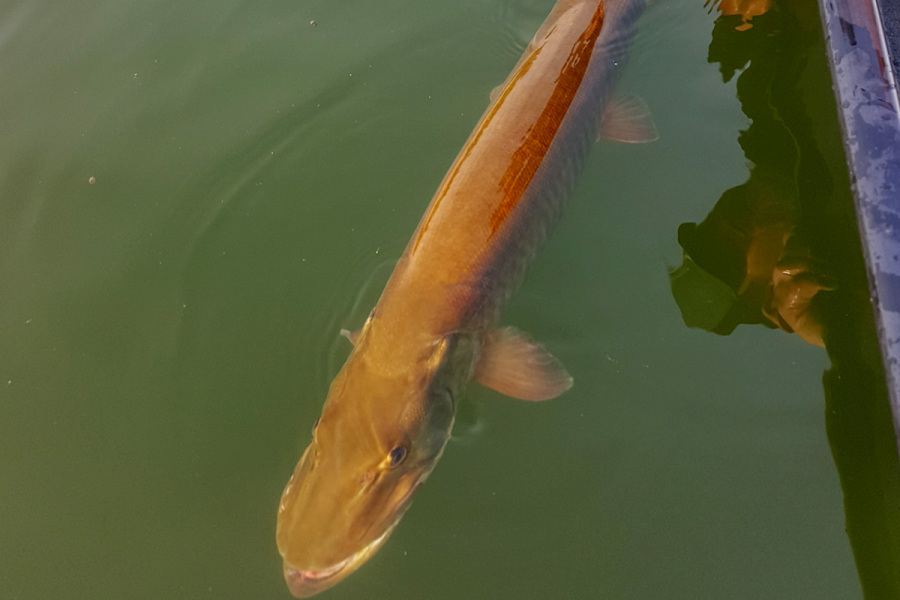
Muskie Migration Patterns and Spring Tactics
What Drives Spring Muskie Behavior and How to Catch Them
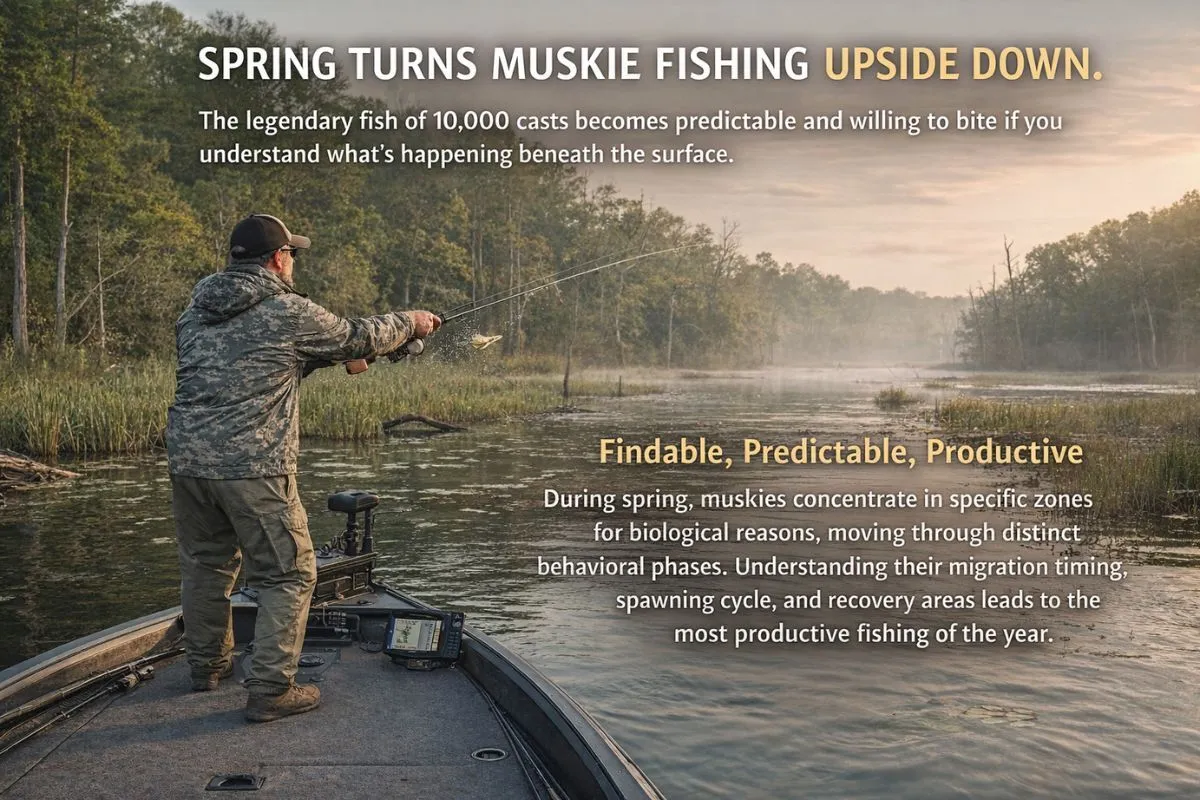
Spring turns muskie fishing upside down. The legendary fish of 10,000 casts suddenly becomes findable, predictable, and willing to bite if you understand what's happening beneath the surface.
I've watched anglers struggle through spring seasons because they're fishing summer patterns in spring water. What makes spring different isn't just that muskies are shallow. It's that they're concentrated in specific zones for biological reasons, moving through distinct behavioral phases, and responding to a narrower range of presentations than they will all summer.
Why Do Muskies Migrate in Spring?
Muskie spring migration is driven by spawning biology, not random wandering. When water temperatures hit the mid-40s, they leave deep winter haunts (main-lake basins, channel holes, deep edges) and begin moving toward shallow spawning grounds they've used for years, sometimes their entire lives.
Radio telemetry studies have tracked individual muskies moving more than 20 miles upstream to reach spawning areas, and in some river systems they may travel even farther over the course of a year between winter, spawning, and summer locations. This homing behavior creates repeatable patterns you can count on.
Once you identify where muskies spawn in your water, those areas stay productive year after year. You're not searching random structure hoping to stumble onto fish. You're intercepting a predictable migration.
Two factors control this movement: current and temperature. In river and reservoir systems, moving water draws pre-spawn muskies like a magnet, and that current is often warmer than the main lake during early spring, especially after warming trends rather than cold rains. Tributary inflows, feeder creeks, areas where rivers enter reservoirs are the highways fish travel.
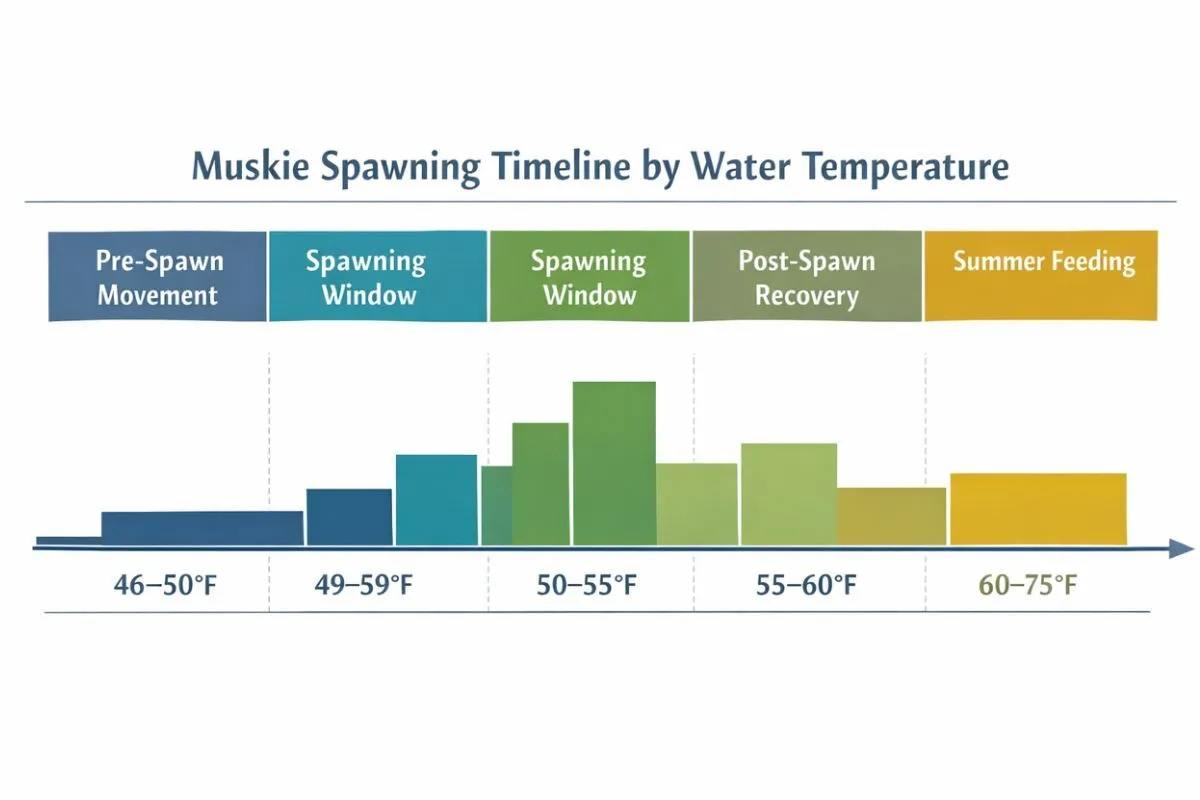
The spawning migration follows a clear sequence. Fish leave winter haunts when temperatures rise into the 46-50 degree range. They move into transitional staging areas short distances from actual spawning sites. They feed aggressively during this pre-spawn period, particularly females building egg mass. Then spawning occurs over a brief 5-10 day window when water reaches 49-59 degrees.
When Do Muskies Spawn? Understanding Regional Timing
The timing of muskie spawning varies dramatically depending on where you fish, but water temperature tells you more than any calendar date. Understanding your regional timeline determines whether you're targeting pre-spawn, actively spawning, or post-spawn fish. Always confirm local regulations, as many northern muskie fisheries are closed through spawn or have strict seasonal and handling rules.
Southern reservoir systems like Tennessee's Center Hill Lake, Great Falls, and the Collins River see spawning from late February through mid-April. Water temperatures between 49 and 59 degrees trigger spawning, with 55 being optimal. The tactical advantage: year-round open seasons mean you can target aggressive pre-spawn muskies at their maximum annual weight, concentrated in staging areas, actively feeding.
- 46-50°F: Pre-spawn movement starts, aggressive feeding in shallow staging areas
- 49-59°F: Spawning initiation range, males arrive first, 55°F optimal
- 50-55°F: Peak spawning window, brief but intense activity
- 55-60°F: Post-spawn recovery begins, fish stage near spawning areas
- 60-75°F: Active summer feeding resumes, fish disperse to deeper structure
Northern systems across Wisconsin, Minnesota, Michigan, and the Great Lakes spawn from mid-April through late May or early June. Most traditional waters maintain closed seasons during spawning, so northern anglers fish primarily post-spawn recovery periods. Ice-out creates compressed timing where fish go from winter dormancy to spawning mode within weeks.
Individual fish spawn over 5-10 days, though the overall window in any lake can stretch three weeks. During active spawning, muskies are visible in skinny water but nearly impossible to catch. Leave them alone. Focus on pre-spawn and post-spawn windows when fish are accessible and willing to feed.
What Are Pre-Spawn Staging Areas and How Do You Fish Them?
Pre-spawn muskie staging areas are transitional zones where fish concentrate before moving onto spawning flats. In southern reservoir systems where pre-spawn fishing is legal, these areas produce some of the best trophy fishing of the entire year.
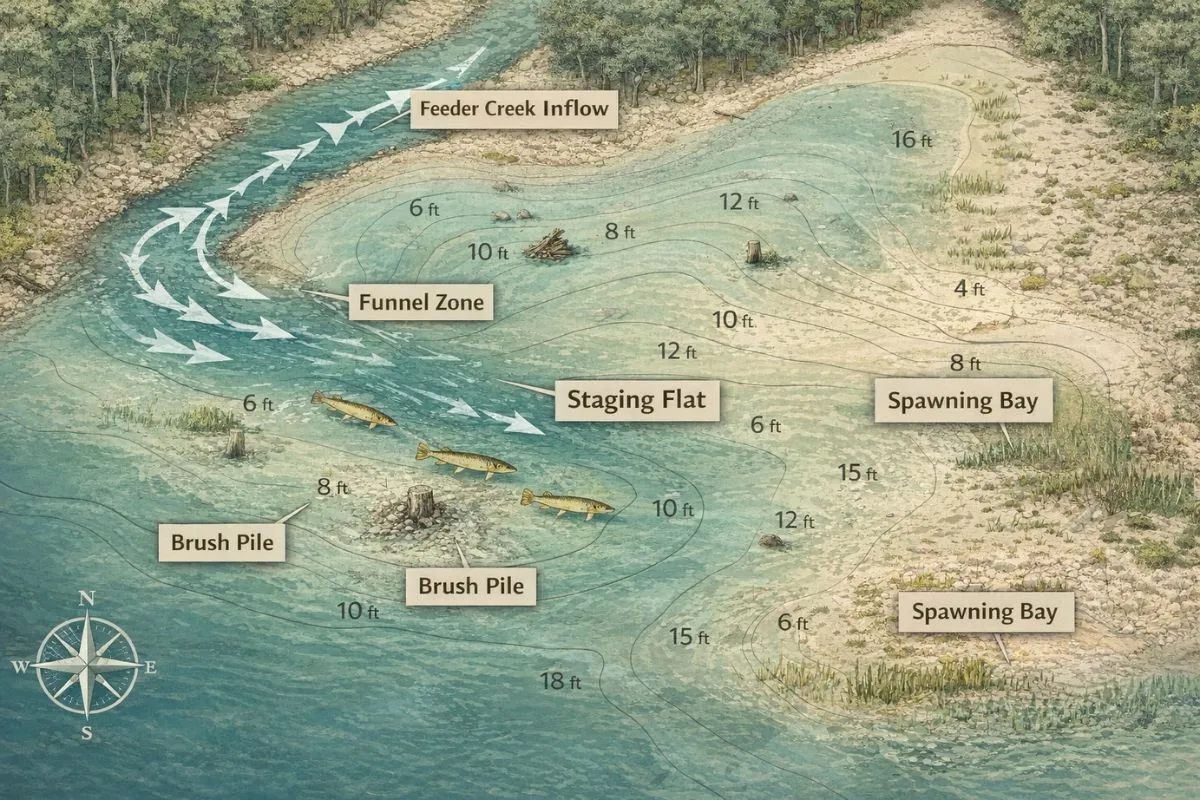
Fish funnel into specific areas that guide them toward spawning zones. In reservoirs, these funnels typically form at the back ends of major coves and cuts where feeder creeks enter. Current from tributaries concentrates here. The water is often warmer than the main lake (though cold rains can flip that advantage). Muskies hold on staging flats that may be only a few hundred yards from actual spawning bays.
The topography requires a completely different mindset than main lake structure fishing. In staging flats, a one-foot depth change concentrates fish just as effectively as a 15-foot breakline elsewhere. Minor depressions become holding zones. Slight rises function as ambush points. You need electronics to read these nuances.
- Current concentration from tributary inflows creating thermal advantages
- Subtle one-foot depth changes functioning like major breaklines
- Isolated cover on flat bottom: stumps, brush piles, rock clusters
- 6-20 foot depth range with adjacent deeper water for security
- Short distance from spawning zones but not directly in them
Tactically, staging areas demand thoroughness over efficiency. Your first pass doesn't tell you much. I've caught fish on third and fourth passes through areas that looked dead initially. Presentation speed should favor extremes: very slow retrieves give neutral fish extended time to commit, while very fast retrieves trigger reaction strikes. The moderate middle speed that allows fish to track, inspect, and refuse consistently fails.
Where Do Post-Spawn Muskies Go and How Do They Behave?
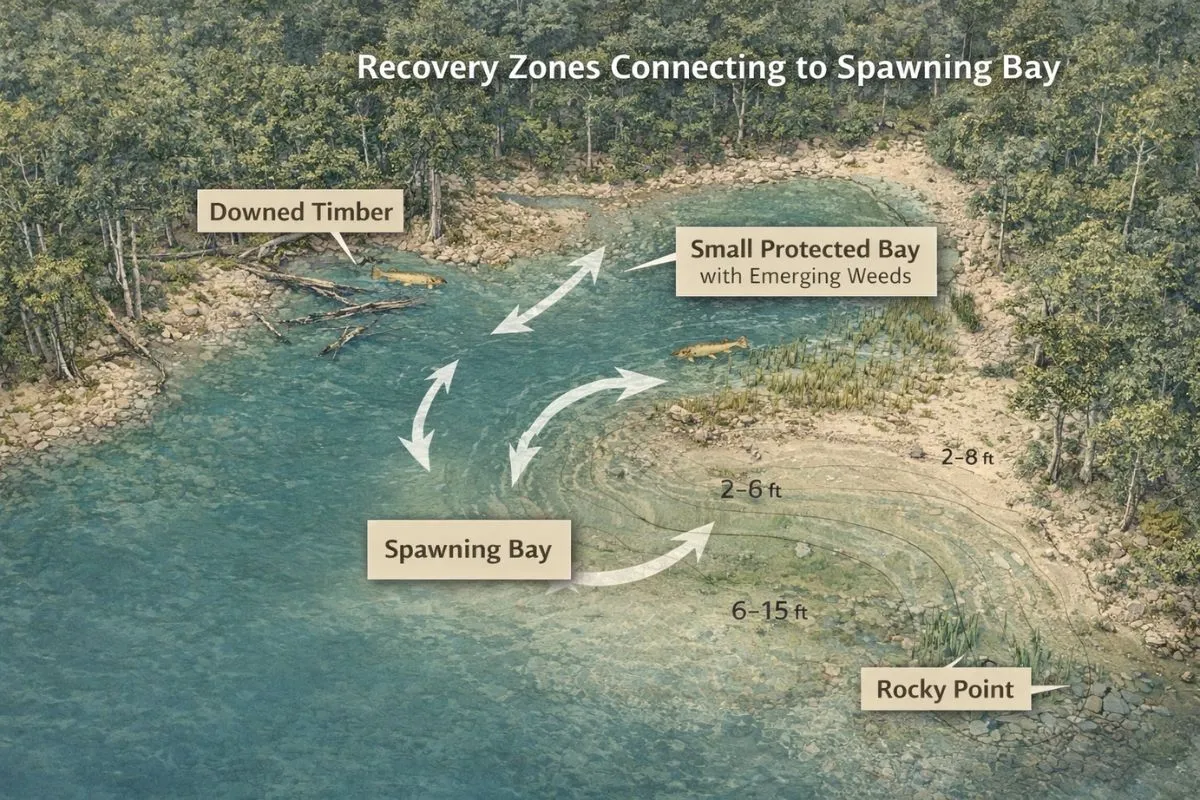
Post-spawn muskie recovery zones are easier to locate than you'd think because fish don't travel far after spawning. They're exhausted from the physically brutal spawning process. Understanding where fish stage during this recovery period is critical for northern anglers who fish primarily post-spawn seasons.
Fish move from spawning areas to nearby shallow structure with similar characteristics. If spawning occurred in a back bay with emergent vegetation, post-spawn fish stage along the shoreline leading out from that bay, sometimes dotted for miles along similar structure types.
- Shorelines extending directly from known spawning bays
- Downed timber and fallen trees in 2-8 feet of water
- Small protected bays with emerging cabbage or other weed growth
- Rocky points dropping to deeper adjacent water
- Transition zones connecting spawning flats to summer structure
- Drop-offs at bay edges ranging from 6-15 feet depth
The behavioral difference from pre-spawn is motivation. Pre-spawn fish actively feed to prepare for spawning. Post-spawn fish recuperate and feed opportunistically but aren't hunting. Where pre-spawn fish might chase aggressively, post-spawn fish want the lure delivered to their exact position with zero energy required. You drop it on their nose or you don't get bit.
How Should You Present Lures to Spring Muskies?
Spring muskie lure presentation comes down to matching your retrieve to the fish's metabolic state. The foundational principle is downsizing and slowing down compared to summer tactics.
Small soft plastics dominate because they work at crawling speeds while maintaining action. A 6-inch Bull Dawg or Medussa retrieved slowly or jigged vertically presents an easy target that exhausted fish can intercept without effort. The critical technique is pausing the lure directly in front of where you think fish are holding.
- Straight slow retrieve maintaining contact with bottom structure
- Pull-pause cadence with 3-5 second dead-stick pauses
- Vertical jigging over staging flats and subtle contour changes
- Single hard rips followed by extended pauses
Small spinners like Mepps size 4 or 5 with Colorado blades ride over emerging weed growth without snagging and maintain blade rotation at slow speeds. Work them just fast enough to keep the blade turning. The flash and vibration attract attention in shallow, often stained spring water without overwhelming sluggish fish.
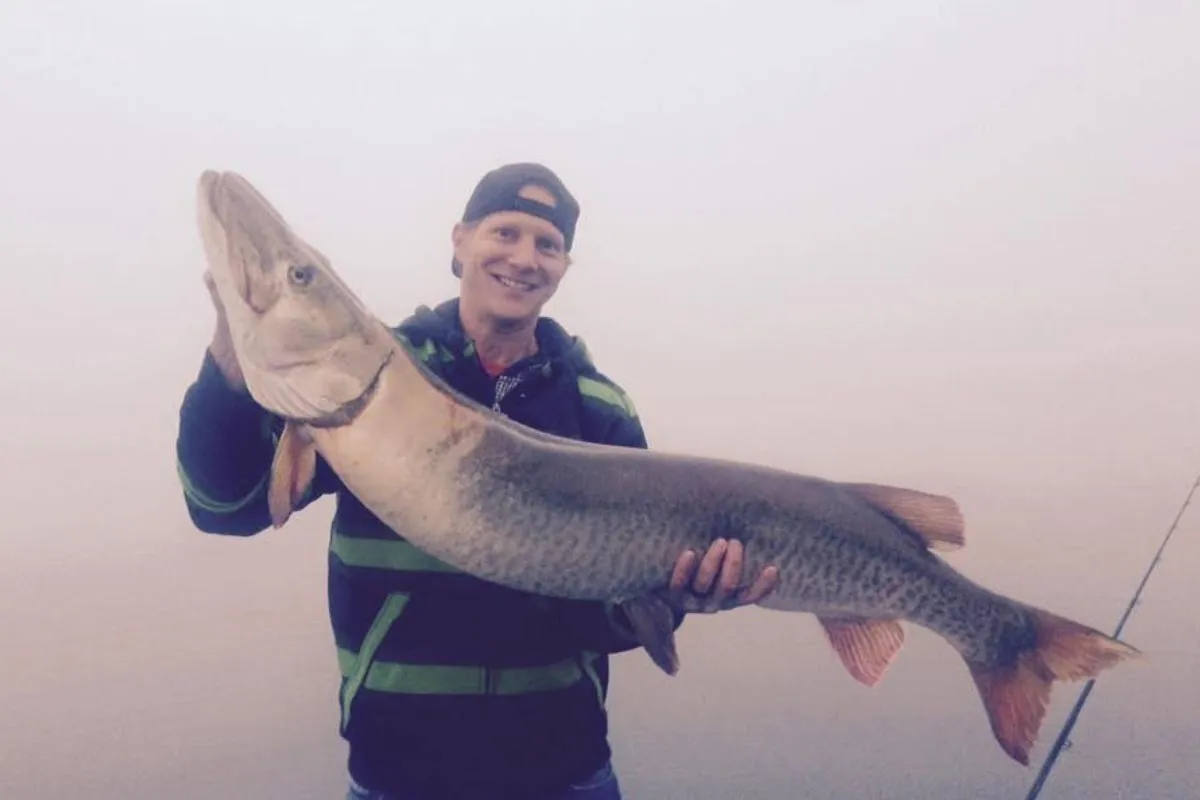
The retrieve speed guideline is straightforward: when uncertain, slow down more than feels natural. Presentations that feel painfully slow often run faster than optimal. The exception is using speed deliberately for reaction strikes, but that's a calculated change of pace, not your default retrieve.
Spring Lure Presentation FAQ
What's the best retrieve speed for spring muskies?
Painfully slow is the baseline. Work lures just fast enough to maintain action, with frequent pauses. The only exception is deliberate speed bursts to trigger reaction strikes from neutral fish.
Should I downsize lures in spring?
Yes. Spring muskies respond better to 4-6 inch presentations compared to 8-12 inch baits effective in summer. Smaller lures present easier targets for fish with suppressed metabolism.
Do muskies hit topwater in spring?
Absolutely, particularly in southern systems during pre-spawn when fish stage in extreme shallows. The key is working topwater lures at crawling speeds, not aggressive summer retrieves.
How long should I pause jerkbaits in spring?
Pause jerkbaits 3-5 seconds minimum in early spring, increasing to 10+ seconds for neutral fish. Most strikes occur during the pause, not during the jerk.
What Advanced Techniques Work for Spring Muskies?
Two techniques break conventional wisdom but consistently produce when standard approaches fail: vertical jigging with spinnerbaits and slow topwater presentations targeting trophy fish.
Vertical jigging targets the Y-axis that most spring tactics ignore. Spring muskies frequently suspend at specific depths in staging areas or transition zones. A lure passing too high or too low is invisible to these fish. Spinnerbaits offer exceptional vertical control.
- Cast spinnerbait beyond target structure or depth zone
- Allow controlled descent on slack line to suspected fish depth
- Lift rod tip creating 12-18 inch upward movement
- Drop rod allowing lure to fall on controlled slack line
- Maintain blade rotation throughout entire retrieve sequence
- Yo-yo through specific depth zones multiple times
Slow topwater seems wrong for cold water, but in southern reservoirs during pre-spawn, when muskies stage in shallows measuring as little as 9 inches deep, surface presentations become highly visible triggers. Specific lures like the H2O Creepy Ortin, Lee Lures Flaptail, and mini-Boilermaker work at unproductive-feeling speeds. Pull the lure 12-18 inches creating subtle plops, then twitch it nearly in place.
Advanced Spring Techniques FAQ
When should I use vertical jigging for spring muskies?
Vertical jigging works best when fish suspend at specific depths in staging areas, after horizontal presentations fail to trigger strikes, or when working subtle contour changes on staging flats.
Can you really catch spring muskies on topwater?
Yes, particularly during pre-spawn in southern systems when fish stage in extreme shallows. The key is working topwater lures at crawling speeds with extended pauses.
How Do You Find Spring Muskie Staging and Recovery Areas?
Spring muskie location is more predictable than any other season, but you need to read structure accurately and understand how fish position relative to spawning areas, current, and temperature.
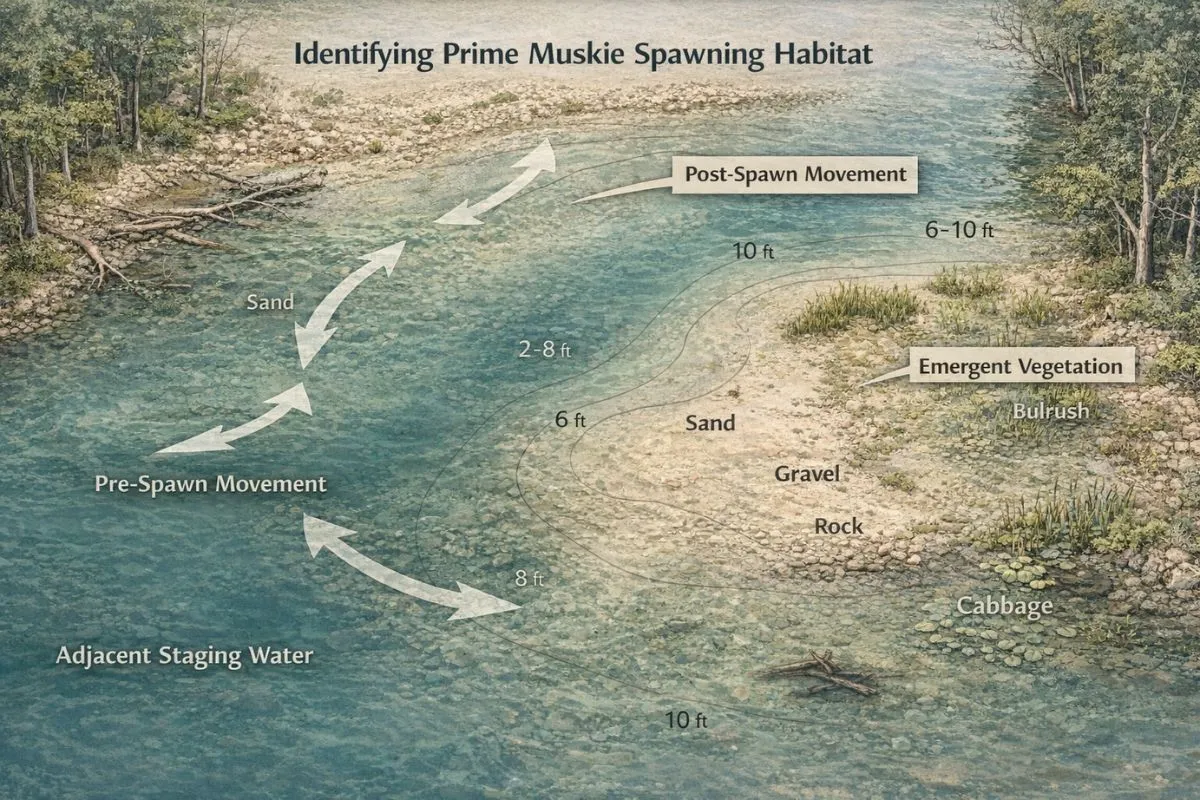
Start by identifying spawning habitat. Muskies are broadcast spawners, meaning they scatter eggs over cover rather than building nests, but their choice of spawning location is anything but random. They spawn over hard substrates like sand, gravel, or rock in shallow areas typically 1-3 feet deep, sometimes out to 6-10 feet in flooded cover.
- Hard bottom substrates: sand, gravel, or rock (not soft muck)
- Shallow depths typically 1-3 feet, occasionally to 6-10 feet in flooded cover
- Vegetation like bulrush, cabbage, or emergent plants
- Woody debris or flooded timber providing cover
- Protected bays offering shelter from wind and current
- Adjacent deeper water where fish stage before and after spawning
Pre-spawn staging areas sit short distances from spawning sites, typically in funnels formed where coves or cuts narrow. Current from tributary inflows concentrates here. A slight channel cut through the flat, a small point, isolated stumps or brush piles, any element breaking up the flat bottom concentrates fish.
Post-spawn fish occupy shorelines and cover leading out from spawning areas. Fish stage progressively deeper as they recover, often positioning where they can adjust depth based on daily temperature fluctuations.
Transition zones become critical as spring progresses. These aren't random mid-depth areas but specific structures connecting shallow spawning/recovery zones with deeper summer habitat. Points at bay mouths, drop-offs adjacent to spawning flats, saddles between shallow bays and deeper basins hold fish moving between seasonal patterns.
How Does Water Temperature Affect Spring Muskie Behavior?
Water temperature drives every decision you make in spring muskie fishing. It tells you which phase fish are in, where they're positioned, how active they'll be, and what presentations will work.
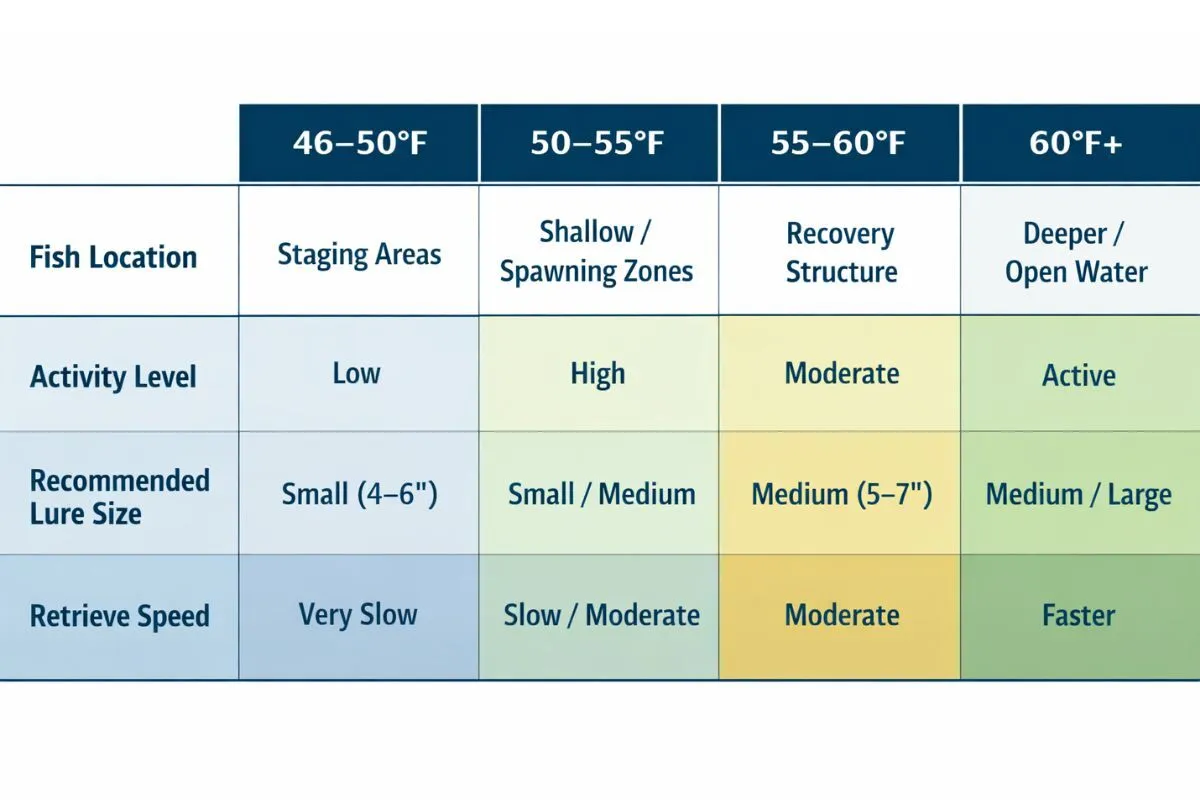
At 46-50 degrees, you're fishing pre-spawn or very early post-spawn fish. Presentations should be extremely slow, lures small. Fish are moving toward spawning areas but not fully activated. Metabolism is suppressed.
As temperatures push into the low-to-mid 50s, activity increases noticeably. This is when post-spawn feeding begins ramping up. The 50-55 degree range is often productive for post-spawn fishing. Fish have recovered enough energy to feed but haven't dispersed to summer patterns yet.
- 46-50°F: Extremely slow presentations, 4-6 inch lures, staging flat focus
- 50-55°F: Post-spawn feeding begins, moderate slow retrieves
- 55-60°F: Progressive activation, can increase speeds and sizes slightly
- 60°F and above: Summer transition begins, fish move deeper and disperse
Cold fronts shut down spring muskie fishing more dramatically than summer fronts because fish metabolism is already suppressed. When a front arrives, slow everything down further, focus on transition zones where fish can adjust depth easily, and increase patience. Recovery typically takes 24-48 hours after frontal passage.
Sun versus cloud cover changes fish positioning dramatically. Sunny afternoons with stable or warming temperatures pull fish into extreme shallows. This is when muskies sun themselves on rock bars or move into back sections of spawning bays. But when cloud cover moves in, these fish back off to staging areas or deeper edges.
What Separates Trophy Muskie Targeting from Numbers Fishing?
The difference between catching smaller muskies and targeting trophies comes down to recognizing that big fish behave differently than small fish. Trophy muskies have survived years of lure exposure. They're more selective, more energy-efficient in feeding, and less likely to chase aggressive presentations.
The tactical adjustment is counterintuitive. If you're catching smaller muskies on fast-burned rattlebaits, observe those smaller fish as data rather than the destination. To target trophies, adjust toward what experienced, larger fish respond to: slower speeds, more subtle movements, different lure categories entirely.
Putting Spring Muskie Patterns into Action
You arrive at a southern reservoir in mid-March with water temperatures reading 52 degrees. That's prime pre-spawn staging temperature. You've identified a major cove with a feeder creek entering the back end and a staging flat with subtle depth changes.
You start with fast-burned rattlebaits to cover water. After 45 minutes, you've had two follows from smaller fish when the rattlebait entered slightly deeper water along a subtle channel cut. Fish are present and positioned along that depth break, but the aggressive presentation isn't triggering commits.
You switch to a small jerkbait and slow your retrieve dramatically, working it with long pauses. Third cast produces a solid 38-inch fish. You continue working the area but notice follows without strikes. You switch completely: slow topwater with a 6-inch Ortin, working it at a crawl. This produces a 44-inch female.
You've identified fish are staging along the depth break, they're neutral enough that fast presentations fail, and trophy fish respond to slow surface presentations. By afternoon, as water temperature climbs to 54 degrees, fish have moved slightly shallower onto the actual flat. You adjust, working closer to the spawning bay with even slower presentations in water under two feet.
As the day ends, you've put together a location pattern (staging flat with subtle depth break), a presentation pattern (slow topwater for trophies, small jerkbaits for active fish), and timing information (fish move shallower during warmest afternoon hours). That's not a "bite" to apply universally. It's situational knowledge about how fish in this system responded to these conditions on this day.
Login
to leave a review.
User Reviews
There are no reviews yet.
Setting Up a Dredge Pulley for Billfish
Saltwater
12.28.2020
High Speed Wahoo Trolling Rig
Saltwater
09.08.2018
Fishing Light Tackle for Yellowfin Tuna
Saltwater
09.08.2018



0