
Red drum rank among the most accessible saltwater game fish along Atlantic and Gulf coasts. Learn proven techniques for sight fishing shallow flats, choosing effective baits and lures, reading seasonal patterns, and targeting everything from puppy drum to trophy bull reds.
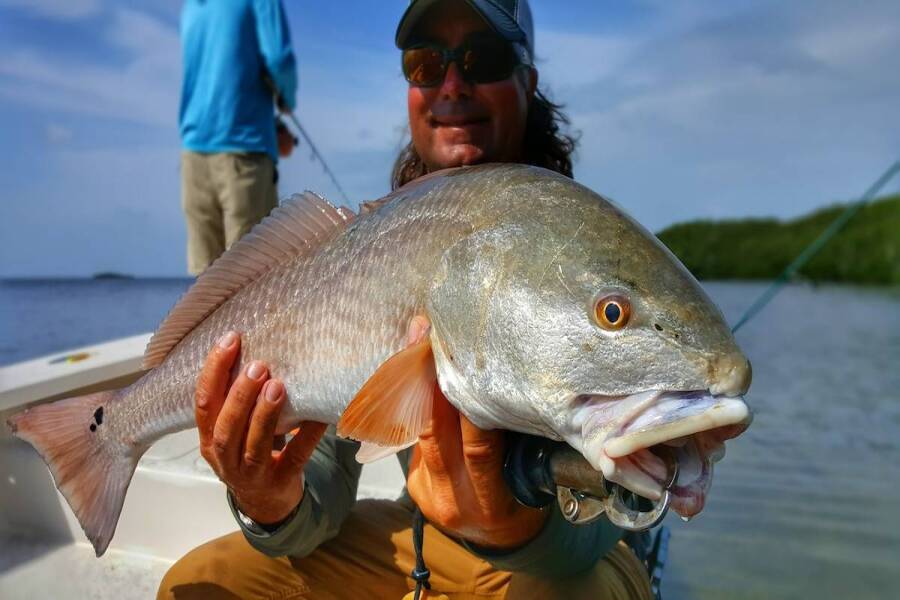
Redfish Fishing: Species, Baits, and Tactics
Most anglers learn redfish backward. They learn a bait, then a spot, then a tide, and after enough trips they build a working sense of where the fish will be without ever knowing why. That works until conditions change. Then the pattern falls apart and there is nothing underneath it to fall back on.
I have fished red drum from the Nature Coast of Florida to the Louisiana marsh, and the anglers who stay consistent across seasons and across water they have never seen before are the ones who understand the animal. They know what it eats and why. They know what its mouth is built to do. They know that a forty inch fish and a twenty inch fish are not the same animal at different sizes, they are at different stages of life with different jobs, in different places, doing different things.
What Is a Redfish?
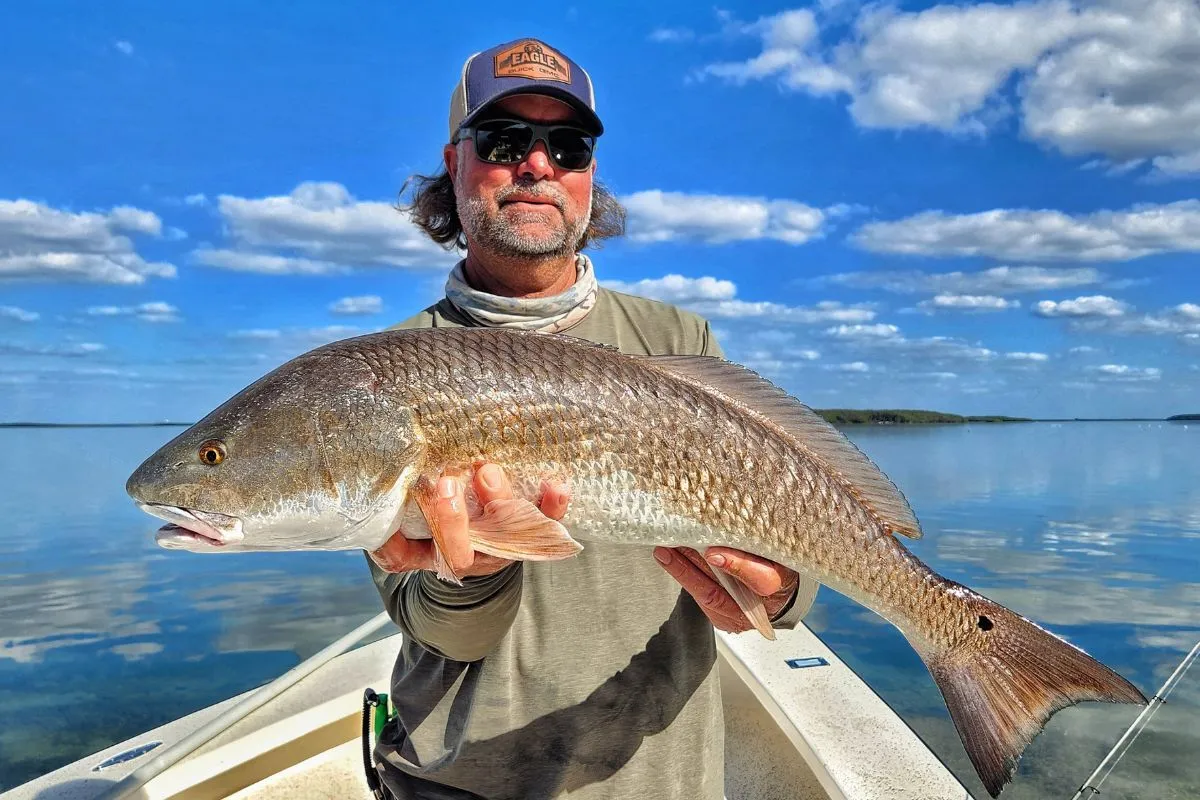
A redfish is a red drum, Sciaenops ocellatus, a member of the drum and croaker family Sciaenidae. That family relationship matters more than it sounds like it should, because it tells you a great deal about how the fish behaves.
The name changes with geography. Redfish along the Gulf Coast. Red drum in the Carolinas and in most scientific and regulatory writing. Channel bass in Virginia and parts of the mid Atlantic. Spottail bass in South Carolina. Puppy drum for the small ones in North Carolina. Same fish everywhere, and worth knowing when you are reading regulations from a state you do not normally fish, because the agency will almost always call it red drum.
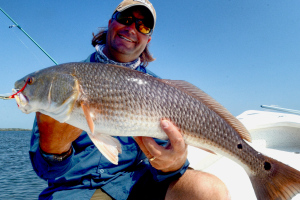
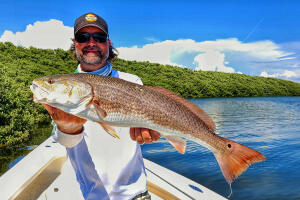
Physically it is a heavy shouldered fish with a blunt nose, a body that runs bronze to deep copper to nearly gold depending on the water it lives in, and a broad, slightly rounded tail. Fish out of dark marsh water come out much darker than fish off clean sand. That is largely environmental rather than strictly genetic, and the same fish will change over time as it moves.
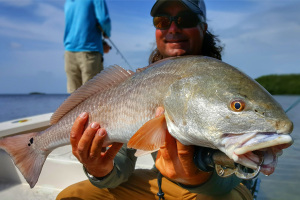
The identification point that matters most is what a redfish does not have. It lacks chin barbels entirely. A black drum has a distinct set of whiskers under its jaw, and if you are ever unsure which of the two you are holding, look under the chin first. Black drum also carry vertical bars when young and lack the tail spot. Between the barbels and the spot you can separate them at a glance, though on very small black drum the barbels are short enough that the tail spot is the more reliable tell.
Why Redfish Have a Spot on the Tail
The black spot near the base of the tail is the most recognizable feature on the fish, and it is almost certainly a decoy.
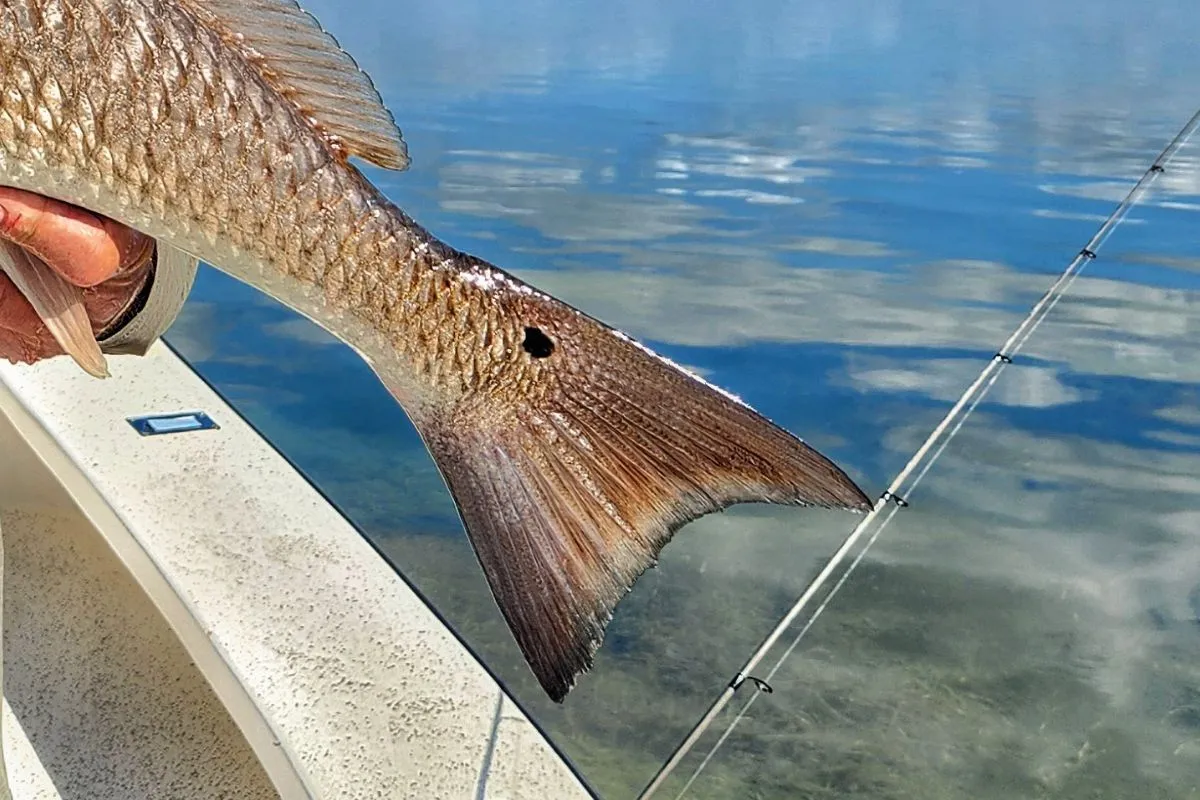
Most redfish carry one spot on one side or one on each. Plenty carry more. I have seen fish with five and six spots scattered across the tail and the rear flank, and there are documented fish well beyond that. Multiple spots are common enough that they mean nothing about the health, age, or origin of the fish. A fish with no spot at all does happen, but it is rare.
Where Redfish Live, from Massachusetts to Mexico
Red drum occupy an enormous range. The northern edge sits around Massachusetts, though occurrences that far north are rare and temperature limited rather than resident. The population runs south along the Atlantic coast through the Carolinas and Georgia, around Florida, and west across the entire Gulf of Mexico to the Mexican coast.
Within that range the fish is estuarine dependent for the first several years of life, and that dependency shapes everything about where you find it. Juveniles need protected, productive, low predation water. Salt marsh, seagrass, mangrove creeks, oyster bottom, and river mouths all supply that. Open coastline does not.
They are also euryhaline, which means they handle an extraordinary range of salinity. I have caught redfish in water that was nearly fresh, well up rivers past where you would expect anything with the word saltwater attached to it, and I have caught them in hypersaline lagoons where salinity runs above open ocean. Very few inshore species have that latitude, and it is a large part of why the fish occupies so much water.
What Redfish Eat at Each Stage of Life
Redfish diet changes completely over the life of the fish, and that is the single most useful biological fact an angler can carry.
Larval fish eat zooplankton. Small juveniles move to copepods, amphipods, and tiny crustaceans in the grass. By the time a fish reaches a few inches it is working small shrimp and crabs. From there the trajectory is steady: bigger crustaceans, then finfish added on top, then a mature adult diet dominated by crab, shrimp, and whatever baitfish is locally abundant.
Crab is usually the dominant forage. Across most of the Gulf and Southeast, blue crab and small mud crabs make up a substantial part of what an adult redfish is actually eating, though in some Atlantic systems shrimp and small fish take over seasonally. Shrimp is the other mainstay. Finfish, meaning mullet, menhaden, pinfish, and small croaker, moves up and down seasonally with availability.
- Crustacean profiles work nearly everywhere and nearly always, because they are always on the menu
- Finfish baits produce best when that forage is locally concentrated, which on the Gulf Coast usually means mullet in late summer and fall
- Cut bait works on a fish built to detect and locate food it cannot see, which is most of the time
- Bait size should track the size of the fish you are after, because a bull red is genuinely hunting different prey than a slot fish
How Redfish Grow and How Long They Live
Redfish are long lived. Fish into their forties are documented, and the upper end runs beyond that. That fact reframes what a big redfish actually is.
Growth is fast early and slows sharply. A redfish reaches the lower end of most slot limits within its first two to three years, and the upper end not long after. Then it keeps living for decades while adding relatively little length. This is why the slot works as a management tool at all: it targets the fast growing, abundant, young year classes and protects the old ones.
Males mature earlier and at smaller sizes than females. Both sexes leave the estuary as they approach maturity and join the adult population in nearshore and coastal water, generally somewhere in the three to six year range depending on region and conditions. From that point on they are largely a coastal and nearshore fish that visits inshore water rather than a resident of it, and many mature fish spend substantial time in deeper water well off the beach outside the spawning period. That is why the big fish seem to vanish from inshore systems for much of the year. They are not hiding. They are somewhere else.
How Redfish Spawn and Why Bull Reds Move to the Passes
Spawning happens in late summer through fall, and it happens at the edges: near passes, inlets, beachfronts, and the mouths of bays rather than up in the estuary.
Mature fish aggregate in those areas as water temperatures come down off the summer peak. Males drum, which is where the family name comes from and what the sound production apparatus is ultimately for. Spawning is broadcast, meaning eggs and milt are released into the water column rather than deposited on a nest. The eggs are buoyant, and the location matters enormously because tidal flow carries them from those pass and inlet areas back into the estuary where the larvae need to end up.
That is the whole reason the fish spawns where it does. It is using the tide as transportation for the next generation.
Output is enormous. A large female can spawn repeatedly across a single season and release millions of eggs over the course of it. Size structure matters here too, because the largest fish in the population skew female while males dominate the smaller adult classes. The oversized fish you catch at a pass in October is more likely than not a female, and she is carrying a disproportionate share of the reproductive work of the entire population.
How Redfish Use Grass, Oyster, Mud, and Surf
Redfish use different bottom types for different purposes, and reading which one you are looking at tells you what the fish is doing there.
Seagrass is a nursery and a pantry. It holds shrimp, small crabs, and juvenile baitfish, and it gives a redfish cover while it hunts them. Fish on grass are usually feeding actively and are usually catchable if you do not run them off first.
Oyster bottom is the richest structure in most estuaries. It concentrates crustaceans, it breaks current, and it creates the edges and drops that redfish position against. Where oyster meets a channel or a drain, you have found the best of it.
Mud and sand flats are where the tailing happens. A redfish rooting in soft bottom for crabs has to angle nose down, which is what puts the tail up. That behavior is a direct consequence of a mouth built to feed downward.
Surf and beachfront are primarily adult habitat, used seasonally, and connected to spawning movement more than to daily feeding.
Tide governs which of these is in play at any hour, and how the fish moves between them. That relationship is worked out in detail in reading tidal patterns to catch more redfish.
How Temperature and Season Change Redfish Behavior
Redfish tolerate a wider temperature range than almost anything else that shares their water, but tolerance is not preference.
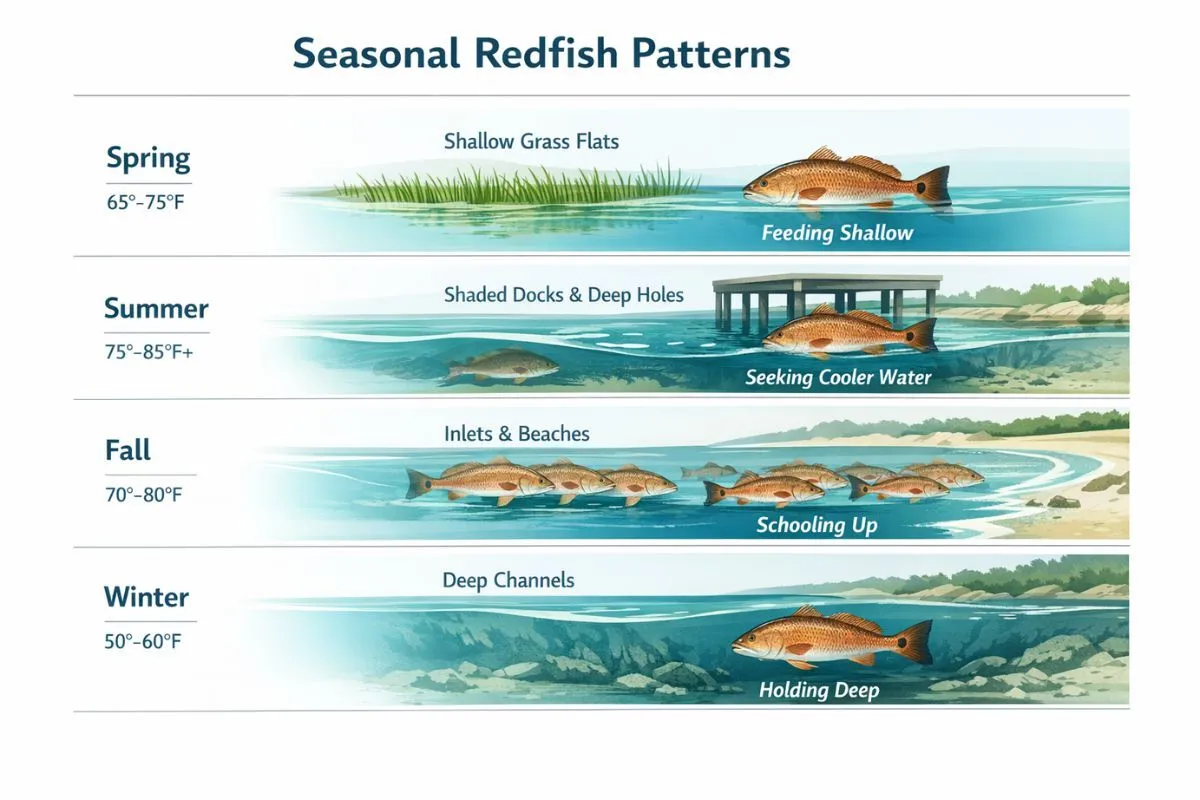
Cold stun is the real hazard at the bottom end. When water drops far and fast, particularly in shallow Gulf and Texas systems that have nowhere deep to escape to, redfish and other inshore species can be killed in significant numbers. It is a genuine driver of population fluctuation in some regions, and it is why a hard winter can affect the following season's fishing.
How Redfish Find Food
A redfish has a subterminal mouth, meaning it sits low and points down. That single anatomical fact drives most of how the animal feeds and most of what an angler needs to do about it.
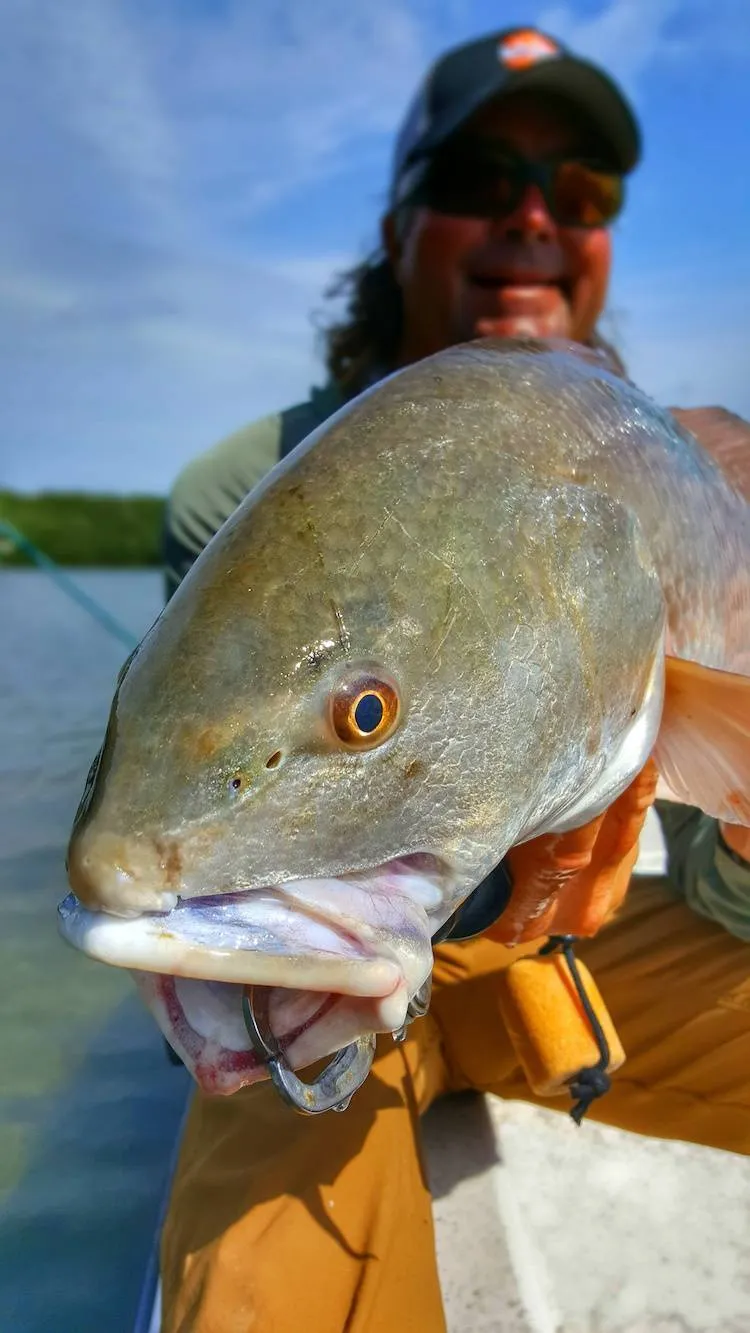
The fish is built to take food off or near the bottom. It can and does eat off the surface, and a redfish will absolutely blow up on a topwater plug, but it is doing so slightly against its design, which is why redfish miss surface baits more often than trout or snook do. A bait sitting on the bottom is a bait presented the way the fish is built to eat.
For locating that food, redfish rely on several senses working together rather than on vision alone. Vision matters in clear water. The lateral line detects vibration and water displacement, which is how a fish finds a struggling bait in muddy water or at night. Chemoreception, meaning smell and taste, is why scent trails from cut bait work as well as they do in low visibility conditions.
Rigging for Redfish
Rig selection follows directly from the anatomy above, and it is a short list because the fish is not complicated.
If the mouth points down and the fish feeds on the bottom, the rig needs to put bait on or very near the bottom and hold it there in current. That is what a fish finder rig or a simple knocker rig does. If you are working a shallow grass flat where a weight would bury and hang, a popping cork suspends the bait just above the bottom and adds a sound cue the fish will come to investigate.
Circle hooks are worth defaulting to across all of it. A redfish takes a bait and turns, which is exactly the motion a circle hook is designed for, and corner hookups release cleanly.
Redfish Fishing Courses

Redfish Stocks and How They Are Managed
Red drum are a conservation success story, and the history is worth knowing because it explains the rules you fish under.
Through the 1980s, demand for redfish rose sharply and commercial fishing began targeting the large offshore spawning aggregations. Removing the adult breeding population is about the most damaging thing that can be done to a long lived species, and stocks declined seriously. The response was substantial: federal action closing commercial harvest in federal waters, gamefish status in state after state, and the slot limit approach that most states still use.
The biology behind the slot is straightforward. Harvest pressure falls on abundant young fish in the estuary, while the older, larger, repeatedly spawning adults are protected. The reason that tradeoff works is the point made earlier about size and sex: a large share of the reproductive output of the whole population comes from a relatively small number of big females. Protect those and the fishery regenerates. Harvest them and it does not.
Recruitment is the other half of it, and it is why fishing quality swings from year to year in ways that have nothing to do with how many fish were kept. Survival of each year class depends on salinity, temperature, and estuarine conditions during the larval and juvenile stages. A strong year class produces good fishing several seasons later. A weak one leaves a hole in the size structure that shows up years down the road. Managers track what percentage of each year class survives the estuary to join the spawning stock, and they adjust bag limits and slot ranges to keep that number where it needs to be.
Common Questions About Redfish
Is a redfish the same thing as a red drum?
Yes. Redfish and red drum are the same species, Sciaenops ocellatus. Regional names include channel bass in the mid Atlantic, spottail bass in South Carolina, and puppy drum for smaller fish in North Carolina. State agencies and scientific sources almost always use red drum.
Why do redfish have a black spot on their tail?
The spot is understood to function as a decoy that draws predator strikes toward the tail and away from the head. Most fish have one spot per side, but multiple spots are common and carry no significance regarding age, health, or origin. Fish with no spot at all occur but are rare.
What do redfish eat?
Diet shifts with age. Larvae eat zooplankton, juveniles eat small crustaceans in grass and marsh, and adults eat mostly crab and shrimp along with baitfish such as mullet, menhaden, and pinfish. Crustaceans are the constant across the range and across seasons.
How long do redfish live?
Redfish are long lived, with documented fish into their forties. Growth is rapid for the first several years and then slows dramatically, so a very large redfish is an old fish rather than simply a fast growing one.
How can you tell a redfish from a black drum?
Look under the chin. Black drum have barbels there and redfish have none. Redfish also carry the black tail spot, which black drum lack, and young black drum show dark vertical bars that redfish do not have.
Where do redfish go to spawn?
Mature redfish spawn in late summer and fall near passes, inlets, and beachfronts rather than inside the estuary. Eggs are buoyant and tidal flow carries them back into estuarine nursery habitat, which is why spawning occurs at those locations.
Can redfish live in fresh water?
Redfish tolerate a very wide salinity range and are regularly caught well up coastal rivers in nearly fresh water, as well as in hypersaline lagoons saltier than the open ocean. That tolerance is one reason the species occupies so much habitat.
Turning Biology Into Better Decisions on the Water
None of this is trivia. Every piece of it changes something you do.
The anglers I have watched who consistently find redfish in unfamiliar water are not carrying a bigger list of spots. They are carrying a model of the animal. They pull into a bay they have never seen, look at the bottom, the tide, the temperature, and the bait, and they know roughly where the fish should be before they make a cast. That model is built from exactly the material above, plus enough time on the water to trust it.
Seth Horne Founder, CEO, and Chief Fishing Educator at In The Spread
Login
to leave a review.
User Reviews
There are no reviews yet.
Complete Dredge Pulley Setup Guide
Saltwater
12.28.2020
High Speed Wahoo Trolling Rig
Saltwater
09.08.2018
Fishing Light Tackle for Yellowfin Tuna
Saltwater
09.08.2018


0