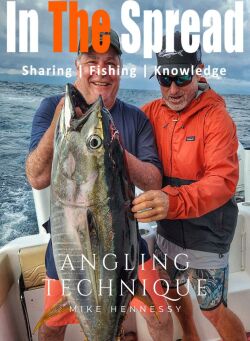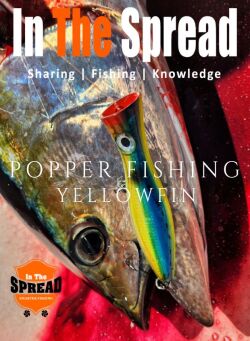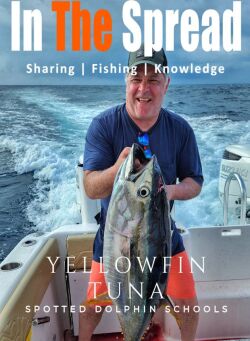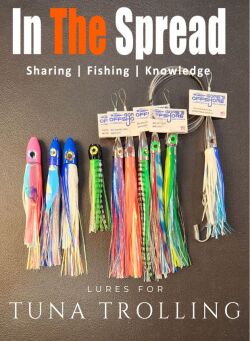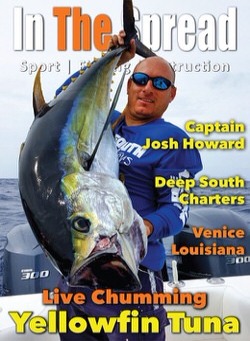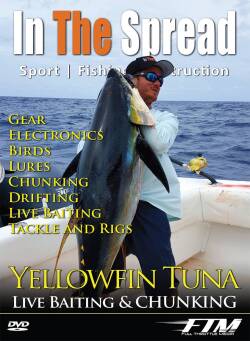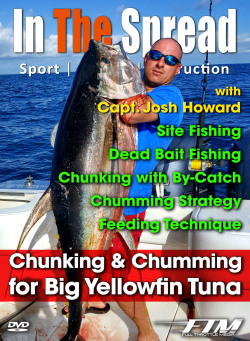
Yellowfin tuna are one of the ocean's most demanding targets, requiring the right technique, the right water, and the right presentation for every situation. In The Spread brings together elite captains from the Gulf of Mexico, Atlantic canyons, and the Pacific to teach the methods that consistently produce fish across the full range of conditions.
Yellowfin tuna are one of the ocean's most unforgiving targets. They move fast, feed selectively, and their willingness to bite can shift on you in the span of a tide change. If you're serious about catching them consistently, you need more than a handful of tips from the internet. You need a system built on real knowledge from anglers who spend their lives chasing these fish.
At In The Spread, we've built the most comprehensive yellowfin tuna fishing video collection available anywhere. Working captains from North Carolina, South Florida, the Bahamas, the Gulf of Mexico, Central America, and Hawaii share their proven methods in depth, covering every major technique and regional fishery. This page brings those lessons together in a format that gives you context before you ever press play.
Whether you're trying to crack the code on chunking along the mid-Atlantic canyons, live baiting in the Gulf of Mexico, or trolling lures in the Pacific, what follows will give you a genuine foundation for thinking through the problem and point you toward the video instruction that takes it to the next level.
What Makes Yellowfin Tuna So Difficult to Catch Consistently?
Yellowfin (Thunnus albacares) are built for speed and efficiency. They run in warm tropical and subtropical water worldwide, and they are always moving. Like other tunas, yellowfin have regional heat-conserving adaptations that allow parts of the body to operate above ambient water temperature, which contributes to their explosive speed, endurance, and the raw power of their fights. That same metabolic demand means they need to eat constantly, and smart anglers learn to intercept them during those feeding windows.
The challenge is that these fish have exceptional eyesight and highly developed lateral line sensitivity. They can pick up inconsistencies in a bait presentation from a surprising distance. They also school and unschool rapidly, making a wide-open bite disappear in minutes if conditions change or the school spooks. Getting on fish is one problem. Keeping them biting is another.
What separates consistently productive yellowfin anglers from everyone else is the ability to read conditions accurately, choose the right technique for the moment, and execute presentations that look and feel natural. That process starts well before you leave the dock.
One behavioral pattern worth understanding early: yellowfin change their habits as they grow. Juveniles frequently school with skipjack and even juvenile bigeye tuna, which can muddy the picture when you're mark-hunting on sonar. Larger, older fish tend to run deeper and are found less reliably at the surface. This means a clean sonar screen doesn't always mean no fish, and surface sign doesn't always indicate the size class you're targeting. Knowing where in the water column to focus your presentation, based on the fish you're after, is part of what separates the anglers who consistently target quality fish from those who settle for whatever shows up.
How Do You Find Yellowfin Tuna Offshore? Reading SST Breaks and Ocean Structure
The single most important skill in offshore yellowfin tuna fishing is the ability to find productive water before you start fishing. Fuel is expensive, and running 60 miles in the wrong direction is a rookie mistake.
Why Sea Surface Temperature Breaks Matter for Yellowfin
Yellowfin are found across a broad warm-water range spanning the upper 60s through upper 80s Fahrenheit. As an angling heuristic, many experienced captains focus hardest on water in the upper 60s through upper 70s, particularly where bait, structure, and current intersect. But the water temperature itself is only part of the equation. What actually concentrates yellowfin is where different water masses meet.
SST breaks often mark the boundaries between water masses, current edges, and convergence zones that concentrate bait and bring predators together. A temperature break doesn't guarantee upwelling on its own; that mechanism depends on wind, subsurface currents, and bottom topography. What it does signal reliably is a transition where conditions are changing, and where bait tends to stack. The sharper the break, the more defined the concentration. A 3-degree change over half a mile is worth investigating. A 3-degree change over five miles is less reliable.
Satellite SST imagery lets you plan your approach from the dock. Satellite map services like Hilton's Realtime Navigator layer temperature, color, and chlorophyll data so you can identify the most promising edges before you make a single run. Learning to read that data is one of the most valuable skills in offshore fishing, and it's covered in detail within our video collection.
What Offshore Structure Concentrates Yellowfin Tuna?
Water temperature gets you to the general zone. Structure gets you to the fish. Yellowfin are not random wanderers; they relate to features in the water column that concentrate bait.
Key structure types to target:
Underwater seamounts and ridges that deflect currents and create distinct feeding edges
Offshore oil platforms and rigs that function as artificial reefs with stacked baitfish
Color changes where green water meets blue, often marking a chlorophyll-rich edge
Current seams and weed lines that collect flotsam, bait, and eventually pelagics
Steep bottom contours along the continental shelf edge, especially canyon mouths
Understanding how offshore fishing structure concentrates fish is a skill that applies across every pelagic species you'll ever target. Once you learn to see the ocean's topography through current, temperature, and depth data, you'll stop guessing and start positioning.
Regional and Seasonal Yellowfin Tuna Patterns
Yellowfin tuna show up everywhere warm water exists, but the way you target them shifts significantly depending on where and when you're fishing. What works in Venice, Louisiana in August looks very different from what works along the mid-Atlantic canyons in October.
Gulf of Mexico Yellowfin: High Numbers and Live Bait Dominance
The Gulf of Mexico, and the Venice, Louisiana area in particular, produces some of the most action-packed yellowfin tuna fishing in the world. Schools of fish in the 30 to 100-pound class are common, and live bait chumming in this region has been refined to an art form. The warm, nutrient-rich water around offshore oil platforms creates stacked bait, and the fish follow. Gulf yellowfin frequently key on hardtails (blue runners), blackfin chunks, and cigar minnows depending on what is concentrated around platform structure, so carrying multiple forage options is standard practice for serious Gulf anglers.
Spring and fall produce the most consistent action, with late summer bringing the largest fish. Gulf yellowfin tend to respond aggressively to surface presentations and poppers when they're actively feeding, making lure fishing and topwater work productive alongside traditional chunking and live baiting.
Mid-Atlantic Canyon Yellowfin: Chunking Country
From Virginia to New Jersey, the deep submarine canyons of the mid-Atlantic are legendary yellowfin tuna chunking grounds. Hudson, Wilmington, Norfolk, and Baltimore. These canyon systems concentrate yellowfin along their edges and rips during fall migration. Fish in the 60 to 150-pound class are realistic targets depending on season, forage availability, and year-class strength.
Chunking with butterfish or mackerel is the dominant technique here, with light tackle finesse presentation separating productive anglers from those watching the cooler stay empty. Fall timing, often September through November, brings the best action as fish push south and stack on the canyon edges. Canyon yellowfin in this fishery often key tightly on butterfish and sardines, so matching your chunk size to the dominant forage makes a meaningful difference in bite rate.
Pacific Yellowfin: Hawaii, Kona and the Lure Trolling Game
Hawaii's Kona Coast represents a completely different style of yellowfin tuna fishing. The bottom drops fast and deep close to shore, and fish are often found working structure and current lines within a few miles of the coast. Lure trolling is central to the Kona approach, with spreader bars, skirted lures, and live bait rounding out the toolkit. Fish here can run large, with 200-plus-pound yellowfin a realistic possibility.
Seasonality in Hawaii is less dramatic than on the East Coast, with fish present most of the year. Conditions, current shifts, and bait availability drive the bite more than calendar date.
When to Use Each Technique: Matching Method to Conditions
One of the most common mistakes serious anglers make is defaulting to their favorite technique regardless of what the fish are doing. Yellowfin tuna are opportunistic but not stupid. Choosing the right method for the conditions in front of you makes an enormous difference in what ends up in the box.
When Is Chunking the Right Call for Yellowfin Tuna?
Chunking and chumming shines when fish are holding in an area but not actively feeding on the surface. You've found them on the meter, or you're on a known rip or structure where fish have been sighted, but the bite is slow. Chunking creates an attractant trail of cut bait pieces (typically butterfish, mackerel, or herring depending on region) that draws fish up in the water column and triggers competitive feeding.
Chunking works best when:
Fish are marking deep and need to be drawn up
Surface conditions are calm enough to drift effectively
You're on a known aggregation area with enough time to work it
Overcast skies or lower light have suppressed surface activity
The discipline is in presentation. Hooks buried in chunks that match the surrounding freebies, fluorocarbon leaders sized appropriately for visibility, and line management that keeps your bait in the chum slick. These are the details our instructors break down in granular, on-the-water video format.
A few terminal rig details that experienced chunkers adjust constantly:
Leader weight by bite quality: when fish are aggressive and the bite is wide open, 80 to 100-pound fluorocarbon is workable. When fish are lightly pressured or the bite slows, dropping to 40 to 60-pound leader can make a significant difference in pick-up rate.
Sinker use: in wind-against-current conditions where the slick and your bait don't align, a small split shot or rubber-core sinker above the hook holds the bait deeper in the slick and keeps it in the strike zone longer.
Circle vs. J-hook by application: circle hooks perform best on free-lined baits with light or no pressure; J-hooks give more control when you need to set the hook manually or are fishing baits with less action.
Wind and current management: if wind and current are running in opposite directions, your slick and your drifted bait will separate. Repositioning the boat frequently to keep bait in the slick is more productive than adding weight in most conditions.
Live baiting is arguably the most consistently productive technique for large yellowfin tuna, particularly when fish are finicky or have seen heavy pressure. A swimming, distressed baitfish (pogies, tinker mackerel, goggle eyes, or other regional species) triggers an instinctive response that cut bait and lures often cannot match.
Live baiting works best when:
Fish are present but refusing cut chunks or artificial lures
Current conditions allow a natural drift presentation
Large individual fish (rather than schoolies) are the target
Bait is available and can be kept lively in the well
The rigging specifics matter enormously. A hook that's too large kills the action of the bait. A leader that's too heavy spooks fish in clear water. These are exactly the kinds of details that separate a live bait that swims naturally from one that kills itself in two minutes.
When Should You Troll for Yellowfin Tuna?
Trolling for yellowfin tuna is the most efficient searching technique in the arsenal. When you don't know exactly where the fish are and you need to cover ground, trolling lets you run productive water with lures or rigged baits while you look for surface signs, bird activity, and current edges.
Trolling also excels when fish are actively feeding near the surface in a wide-open school. Getting lures into that feeding zone quickly, before the school sounds or moves, requires the speed and coverage that trolling provides.
Lure trolling is particularly productive in the Pacific, where Kona-style spreads of skirted lures and bullet heads are run at 6 to 9 knots across current lines and structure edges. On the East Coast, trolling rigged ballyhoo and cedar plugs is a standard search tactic for canyons and offshore rips. For a detailed breakdown of rigging and trolling ballyhoo as offshore bait, that article is worth reading before your next trip.
When Does Jigging for Yellowfin Produce Results?
Vertical jigging for yellowfin tuna is a specialized technique that can be deadly when fish are holding deep and refusing to come up to surface presentations. It's also a high-effort method that requires physical conditioning and the right tackle, but the hookup ratio on jigs can be excellent because fish that commit to a jig commit hard.
Jigging works best when:
Fish are showing on the meter at depth but won't respond to chunking or topwater
Current is manageable enough for the jig to work vertically
Schooling fish have sounded after being spooked on the surface
You want to target larger fish that tend to hold deeper in the water column
What Do You Do After the First Hookup? Managing the School
Getting a yellowfin tuna hooked is the beginning, not the end. What happens in the first two minutes after that first bite often determines whether you boat one fish or ten. This is an area where novice and intermediate anglers consistently leave fish in the water.
When a fish hooks up in a chunking or live bait situation, the instinct is to clear the cockpit and fight the fish. Resist that. If fish are actively feeding in the slick, the commotion of a hooked fish can hold the school near the boat. Keep other baited lines in the water, continue throwing chunks, and let the fight and the slick do the work. Experienced crews will often hook and boat two or three fish simultaneously during this window.
Specific adjustments that matter at hookup:
Keep chunking: the slick draws more fish up while the hooked fish is fought
Reduce drag on remaining rods so free-lined baits stay in the strike zone without pulling out of the slick
Watch your angles: a hooked fish running under the boat can tangle every other line; clear rods on that side quickly
Use the hooked fish: a yellowfin pulling against drag in the slick will often trigger competitive strikes from the school
The boat-handling side of this equation is equally important. Keeping the boat positioned to hold the school close, without driving over the fish or spinning up the props in the slick, is a skill our instructors cover in the video collection. It's the kind of thing that looks obvious in hindsight and costs fish until you've seen it done correctly.
If you spend enough time offshore, you'll hear experienced captains talk about fishing "on the porpoise." It's not just lore; there's biology behind it.
The association between yellowfin tuna and dolphin species is most thoroughly documented in the eastern tropical Pacific, where NOAA fisheries management has addressed it specifically in the context of dolphin-safe tuna programs. In that fishery, spotted and spinner dolphins travel with yellowfin in a relationship that reflects mutual hunting advantage: dolphins work baitfish from above while tuna attack from below and the sides. The behavior occurs in other regions too, including parts of the Gulf of Mexico, but it is less predictable outside the eastern tropical Pacific and should not be assumed to be universal.
When you do encounter dolphin schools that show the right behavioral signals, reading them accurately is a skill worth developing:
Traveling dolphins moving in a focused direction often have tuna underneath; approach from the lead angle without cutting them off
Stationary, milling dolphins may indicate fish that have already fed and are resting
Leaping, spinning behavior often signals active feeding; this is the window you want to fish
Boat shy dolphins in pressure-fished areas require a more cautious approach to avoid spooking the tuna
The approach angle, engine speed, and presentation timing when fishing dolphin schools is covered in depth by our instructors who fish the Gulf of Mexico and Pacific regularly. Getting this wrong means you blow the school and lose the opportunity entirely.
What Tackle Do You Need for Yellowfin Tuna Fishing?
Matching your tackle to your technique is not optional when it comes to yellowfin tuna. These fish run hard, dive deep, and test every component in your setup. Undersized gear leads to lost fish. Oversized gear kills your presentation.
Chunking and Live Bait Tackle for Yellowfin
For chunking and live baiting, most serious anglers run conventional setups in the 30 to 50-pound class. A medium-heavy rod with a fast tip gives you sensitivity for feeling bites on a drifted chunk while providing enough backbone to turn a big fish. Reels in the 50 to 80 class two-speed conventional cover most situations.
Line choices split between:
50-pound monofilament for stretch, forgiveness, and natural presentation
50 to 65-pound braid with a long fluorocarbon topshot for lower visibility and thinner diameter
Fluorocarbon leaders in 60 to 100-pound test are standard, with the lighter end preferred in clear water with heavy fishing pressure.
Trolling Tackle Setup for Yellowfin Tuna
Trolling setups run heavier. A typical yellowfin trolling spread runs 50 to 80-pound class conventional outfits on 5.5 to 6-foot roller-guide rods. Reels need sufficient capacity to handle a long run; 500 yards of 80-pound mono or an equivalent braid capacity is a reasonable baseline.
For light tackle trolling with smaller lures or when targeting schoolies, spinning outfits in the 30 to 50-pound class add versatility and allow for quick casts to birds or surface feeding.
Jigging Tackle for Yellowfin
Yellowfin tuna jigging requires purpose-built equipment. Speed jigging uses shorter, stiffer rods (5 to 6 feet) rated for heavy jig weights, paired with high-speed conventional reels in the 50 to 80 class or large spinning reels (10,000 to 20,000 class). Line must be braid; drag the stretch out of the equation when you're working a jig 200 feet down.
Topwater and Lure Casting Tackle
Topwater lure fishing for yellowfin is a spinning game. Most anglers run 8 to 9-foot rods rated for 40 to 100-gram lures with 10,000 to 20,000-class spinning reels carrying PE 4 to PE 6 braid. A fluorocarbon or mono shock leader of 60 to 100 pounds finishes the setup.
What You'll Learn in the Yellowfin Tuna Video Collection
The course collection covers the full spectrum of tactics and concepts serious yellowfin tuna anglers need:
Chunking and chumming techniques including presentation, hook placement, and slick management
Live bait chumming and bait rigging for maximum swimming action
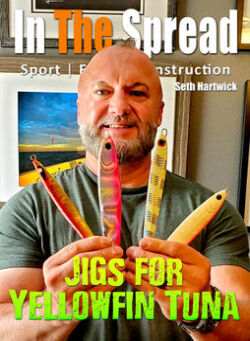
Jigging for yellowfin tuna with jig selection, retrieves, and depth targeting
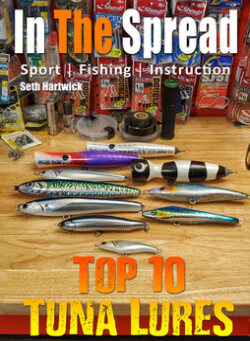
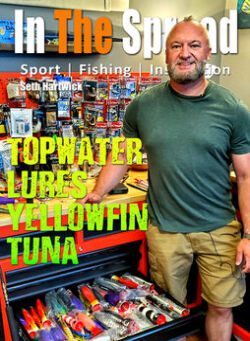
Topwater lures, poppers, and stickbaits with presentation triggers for refusal fish
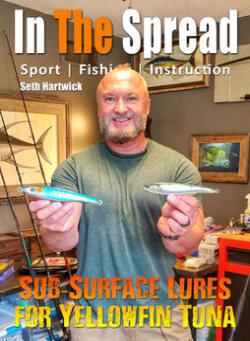
Subsurface lure strategies for fish holding just below feeding level
Trolling lures and spread configuration from skirted lures to rigged baits
Using satellite SST mapping to isolate productive temperature breaks and structure
Fishing dolphin schools, including approach angles, positioning, and presentation timing
Tackle and terminal gear selection matched to each technique
Yellowfin tuna feeding behavior patterns by time of day, depth, and condition
Boat handling and positioning when approaching active schools
Rods and reels specifically configured for each yellowfin technique
In The Spread
Learn From Captains Who Live on the Water
Access the complete yellowfin tuna video collection. Proven tactics for chunking, live baiting, jigging, trolling, and reading the ocean from elite fishing professionals.
Saltwater subscription from $22.95/month. Cancel anytime.
FAQ: How to Catch Yellowfin Tuna
What is the best technique for catching yellowfin tuna?
There is no single best technique for catching yellowfin tuna because the right method depends on conditions, fish behavior, and regional fishery. Chunking and live baiting are most effective when fish are present but not surface-feeding aggressively. Trolling covers the most water when you're searching. Jigging reaches fish holding deep that won't respond to surface presentations. Topwater lures and poppers excel when fish are in a surface frenzy. Skilled yellowfin anglers carry the ability to switch between all of these in a single day.
What water temperature is best for yellowfin tuna fishing?
Yellowfin tuna are found across a broad warm-water range, but many experienced captains focus hardest on productive water in the upper 60s through upper 70s Fahrenheit, particularly where bait concentrations and current intersect. Temperature itself is less important than the transition zones where different water masses meet. Those boundaries, where chlorophyll concentrations and bait stack up, are where you spend your time looking.
How do you find yellowfin tuna offshore?
Finding yellowfin tuna offshore starts with sea surface temperature satellite imagery to identify temperature breaks, color changes, and productive structure. On the water, look for working birds, baitfish spraying on the surface, weed lines and current seams, and dolphin schools (particularly spinners and spotted dolphins). Underwater structure such as seamounts, rigs, and canyon edges concentrates bait and creates consistent aggregation points.
What size hooks do you use for yellowfin tuna chunking?
Hook choice for chunking yellowfin tuna depends on several variables: the size of the chunk being presented, the forage species being matched, and whether you're fishing circle hooks or J-hooks. Circle hooks in the 6/0 to 9/0 range are widely used because they improve hookup rates on free-lined baits and reduce deep hooking. J-hooks in the 5/0 to 8/0 range give experienced anglers more control over hook placement. Neither is universally superior. The more important principle is that the hook must be buried cleanly in the chunk so it drifts naturally in the slick. Any hook that sticks out visibly, or that is too large for the chunk size, will generate refusals from pressured fish.
Why do yellowfin tuna school with dolphins?
Yellowfin tuna and dolphin species, particularly spotted and spinner dolphins, associate in a relationship that appears to reflect mutual hunting benefit. The pattern is best documented in the eastern tropical Pacific, where NOAA has specifically addressed it in fisheries management contexts. Both species coordinate to herd baitfish, with tuna attacking from below and the sides while dolphins work from above. The association can occur in other regions, including the Gulf of Mexico, but is less predictable outside the eastern tropical Pacific. When you encounter dolphins showing active feeding behavior offshore, checking for tuna underneath is always worth the effort.
What pound test line should you use for yellowfin tuna?
Line choice for yellowfin tuna depends on technique. For chunking and live baiting, 50-pound monofilament or 50 to 65-pound braid with a fluorocarbon topshot is standard. Trolling typically runs 50 to 80-pound class. Jigging requires braid; specifically, 65 to 80-pound PE braid gives the sensitivity and thin diameter needed for deep vertical presentations. Leaders run 60 to 100-pound fluorocarbon across most techniques, lighter in clear water with heavy fishing pressure.
Yellowfin Tuna Around the World: Where In The Spread Instructors Fish
The yellowfin tuna video collection draws from captains working the fisheries that matter most:
North Carolina is represented by instructors covering the Gulf Stream edge, where slow trolling with planers and chunking in the late summer and fall produces some of the East Coast's best action.
South Florida and the Bahamas instructors cover live bait tactics, chunking, and light tackle approaches in clear, warm water where fish can be highly selective.
Venice, Louisiana instruction covers the Gulf of Mexico approach, covering live bait chumming around oil platforms, reading bait concentrations, and managing the fast and aggressive style of action the Gulf produces.
Kona, Hawaii contributes lure trolling expertise from an area where yellowfin tuna fishing takes place in deep, clear Pacific water with different lure profiles, presentation angles, and boat-handling requirements than anywhere on the East Coast.
This regional breadth is what separates the In The Spread approach from any single-captain resource. No one fishery teaches you everything. Multiple proven systems from different environments build the adaptability you need to succeed wherever you fish.
Additional Yellowfin Tuna Resources on the In The Spread Blog
The blog contains a deep archive of yellowfin tuna articles covering specific techniques, regional approaches, and gear selection. A few worth reading alongside this course overview:
Regulations for yellowfin tuna vary significantly by region, fishery, and whether you're fishing recreationally or commercially. In the Atlantic, recreational anglers are subject to federal HMS (Highly Migratory Species) permit requirements and bag limit rules managed by NOAA Fisheries. Pacific and Gulf of Mexico rules follow different management frameworks. Both recreational and commercial rules are subject to change based on stock assessments and international management decisions.
Before any yellowfin tuna trip, verify current regulations with NOAA Fisheries (fisheries.noaa.gov) and your relevant state fish and wildlife agency. Do not rely on prior-season rules or secondhand information, particularly for bag limits, size minimums, and permit requirements, which are updated regularly.
The Knowledge Gap Is the Difference
Every angler who has watched a school of yellowfin come up and then refused every presentation they threw understands what's at stake. It's not a tackle problem. It's a knowledge problem.
The difference between anglers who boat fish consistently and those who have a great day once in a while comes down to understanding. It is knowing why yellowfin are doing what they're doing, being able to read the conditions that drive feeding behavior, and having enough technique in your kit to adapt when plan A stops working.
That's what the In The Spread yellowfin tuna video collection is designed to deliver. Not tips. Not shortcuts. A real transfer of knowledge from captains who have figured this out through thousands of hours on the water across some of the best yellowfin fisheries in the world.
The ocean doesn't give up yellowfin tuna easily. But it does reward anglers who understand it. Start building that understanding today.
Seth Horne Founder, CEO, and Chief Fishing Educator at In The Spread