
Yellowfin are fast, sharp-eyed, and maddeningly selective, and catching them offshore is a stack of small correct decisions. This foundation covers where they live, when to go, how to find them, and the chunking, jigging, casting and live-bait tactics that turn a school into a hooked-up boat.
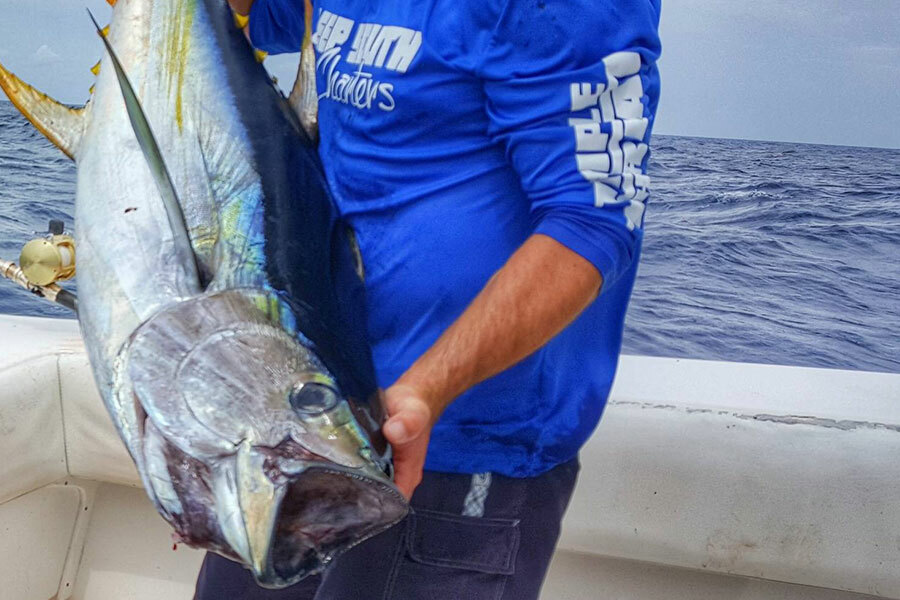
Catching Yellowfin Tuna Offshore: Baits, Lures and Gear
I have chased yellowfin tuna in a lot of oceans, from the rips south of Venice to the seamounts off Kona and the blue water off Costa Rica, and the fish teaches you the same lesson everywhere. Showing up is not enough. These are fast, sharp-eyed, selective predators that will crash bait on the surface all around the boat and still refuse everything you put in front of them. The anglers who catch them consistently are not luckier than everyone else. They understand what the fish are doing and adjust before the window closes. That is the whole game, and it is what the captains in our yellowfin tuna video courses teach in real conditions.
What are yellowfin tuna and why are they so hard to catch?
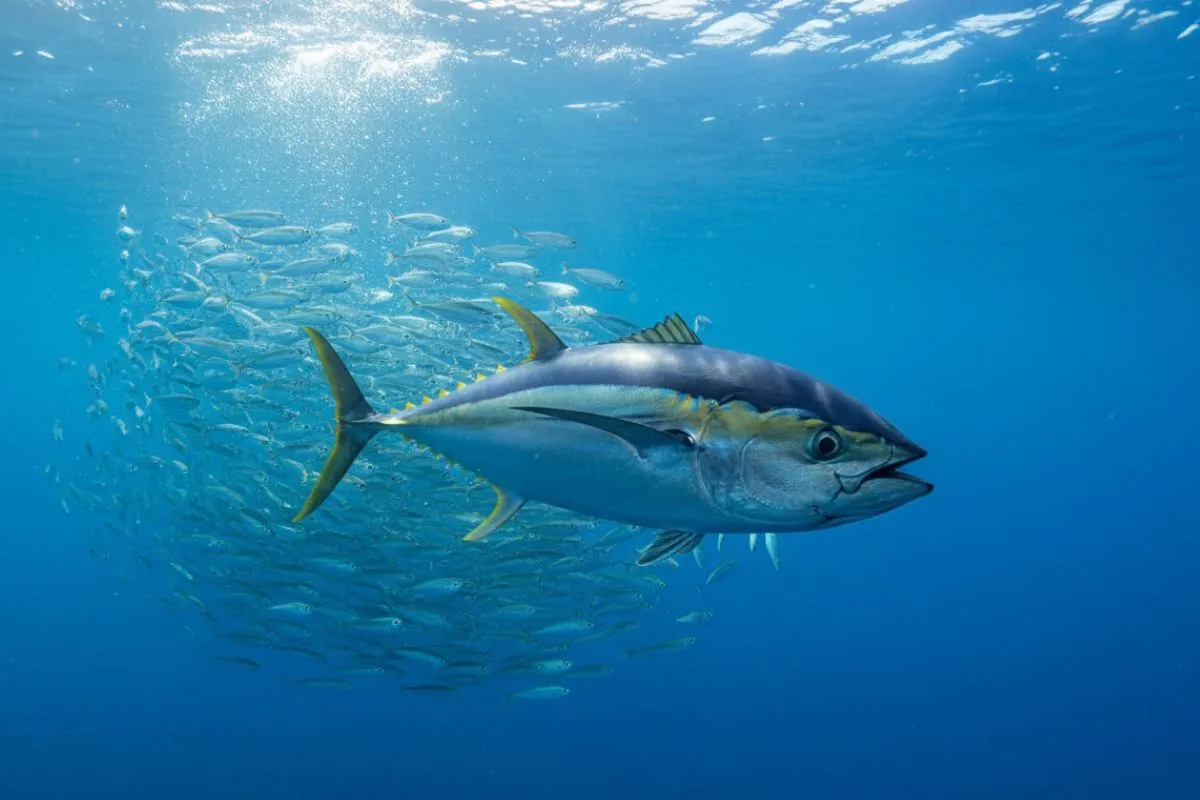
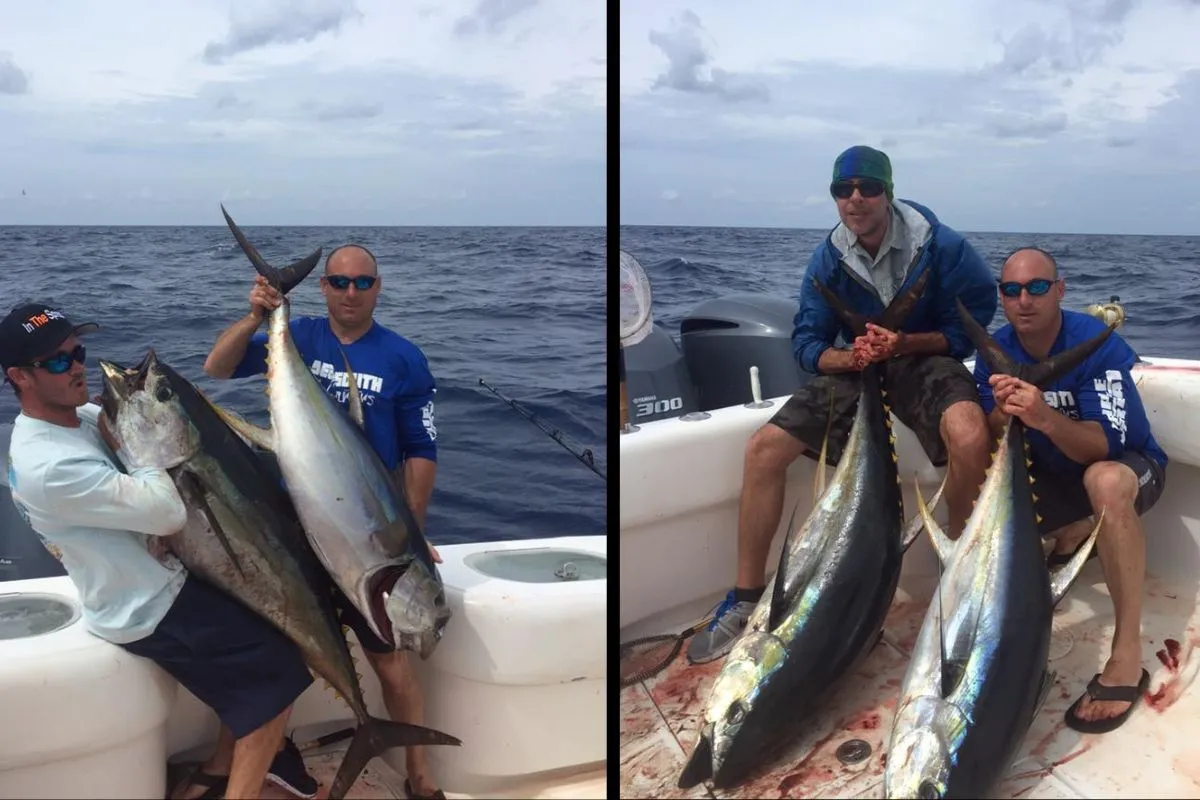
Yellowfin tuna (Thunnus albacares) are large pelagic predators built from the ground up for speed. A mature fish is a torpedo of dense muscle with a deeply forked tail, long yellow finlets, and eyes that miss almost nothing. Most recreationally caught fish run between 20 and 100 pounds, though some fisheries, the northern Gulf among them, routinely produce fish in the 100 to 200 pound class. Fish over 200 pounds show up around Pacific seamounts and Gulf rigs, and the all-tackle world record, set off Cabo San Lucas in 2024, stands at 443 pounds. They are capable of bursts approaching 50 miles per hour and cruise in the 20 to 30 mile per hour range, which tells you everything about the drag and terminal tackle you need before the fight starts.
Part of what powers that is physiology. Like other tunas, yellowfin are regionally warm blooded, using a vascular heat-exchange system to keep their core muscles warmer than the surrounding water. That is a big part of how they hold speed across temperature gradients and sustain long runs.
What makes them genuinely difficult is not speed. It is eyesight and selectivity. A yellowfin will inspect your bait at a distance, read line diameter, leader stiffness, hook shadow, and any hint of unnatural motion, and keep swimming. When they lock onto a specific size and species of baitfish, they ignore anything that does not match. Learning to read the mood of a school before you commit is the difference between a banner day and a humbling one. For more on the psychology of these fish, our breakdown of how yellowfin tuna behave and feed is the right next read.
- Typical recreational size: 20 to 100 pounds, with 100 to 200 pound fish common in some fisheries
- All-tackle world record: 443 pounds, Cabo San Lucas, 2024
- Top speed: bursts approaching 50 miles per hour
- Preferred water temperature: 68 to 86 degrees Fahrenheit, most active from 72 to 78
- IUCN status: Least Concern globally, though regional stocks vary
Where do yellowfin tuna live?
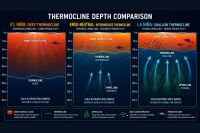
Yellowfin are found in tropical and subtropical waters worldwide, across the Atlantic, Pacific, and Indian Oceans, with the densest concentrations in the warm belt near the equator. They prefer water between 68 and 86 degrees Fahrenheit, with a sweet spot from 72 to 78. They are primarily epipelagic, spending most of their time in the mixed surface layer above the thermocline and usually within the top 300 feet, though they will dive several hundred meters and occasionally near 1,000 meters chasing squid and vertically migrating prey. Their large eyes give them an edge in low light, which is why the first and last hour of the day, and deep jigging in the middle of it, both produce.
What do yellowfin tuna eat?
Yellowfin are opportunistic feeders with a broad diet that shifts by region and season. During daylight they push schools of anchovies, sardines, mackerel, flying fish, and other small pelagics toward the surface, along with pelagic crustaceans, herding bait into tight balls and tearing through them. That cooperative feeding creates the busting you see from a distance, and it is one of the best opportunities an offshore angler gets. At night and in deeper water their diet leans toward squid and small vertically migrating fish.
The takeaway is to match what the fish are eating that day. When yellowfin are keyed on small bait, a large offering looks wrong and gets refused, and on days when they pick at tiny crustaceans a small jig worked to imitate shrimp or krill outfishes everything else. When they are on flying fish or mackerel, a longer profile draws strikes. Carry a range of live and dead options, watch the slick and the birds, and change before you decide the fish are off. Being right about the forage often matters more than being right about the technique.
How do you find yellowfin tuna offshore?
Finding yellowfin tuna is a reading exercise, and the signs stack. Birds are the loudest signal. Frigatebirds hanging high and then dropping, terns and shearwaters diving hard, and gannets folding into the water all point to bait getting pushed up, with active tuna underneath. Learn the difference between birds picking at scraps and birds working a live blitz, because only one is worth a hard run.
Marine mammals are the second signal. In the eastern Pacific especially, yellowfin associate tightly with spinner and spotted dolphin, and finding the porpoise often means finding the tuna. Different dolphin species tend to run with different sizes of fish and call for different approaches, so our look at reading porpoise and dolphin schools covers how to position without pushing the school down. That association carries a responsibility. Commercial purse seine fleets historically set nets on these dolphin schools, and sport boats should work them without harassing the animals, staying within marine mammal protection rules.
How do you read the water, current, and tide?
The best tuna fishermen are, in a real sense, oceanographers. They fish edges, and the ones that matter most are not visible from the deck. A sea surface temperature break of even one or two degrees can stack bait for miles, and a chlorophyll or color change where green nutrient-rich water meets clean blue water does the same. In the Gulf, the green water where river outflow meets clear Gulf water creates exactly these edges, and yellowfin stage along them to ambush bait.
This is where satellite and altimetry tools earn their keep. Reading temperature and chlorophyll charts before you leave the dock narrows a huge ocean to a few high-percentage edges. Sea surface height, or altimetry, matters too. Areas of lower sea surface height often mark upwelling and current edges where cooler, nutrient rich water rises and concentrates life, so those anomalies and the seams around them are worth reading alongside temperature and color. I will link the deeper satellite material as a companion resource once that cluster is in place.
When and where should you fish for yellowfin tuna?
Yellowfin are a global fish, but the peak windows are regional, and timing your trip to the season is one of the easiest edges you can give yourself. Research your specific fishery before you book, because these windows move with water temperature and bait.
- Gulf of Mexico: The deep water and rigs south of Louisiana out of Venice produce yellowfin nearly year round, with late summer through fall often strongest. Winter brings a shot at bluefin.
- Mid-Atlantic canyons: The canyons off the northeast fire up in the warmer months as the water pushes in, summer into early fall being prime for chunking and trolling.
- Bahamas: Mostly smaller, aggressive fish that reward refined tackle and light leader, more scattered than the richer belts to the south, productive through the cooler months into spring.
- Hawaii: Spring through early fall is particularly strong for ahi around the FADs and seamounts off Kona and the other islands, with opportunities across the year.
- Eastern Pacific: From Mexico and Baja down through Costa Rica and Panama, peak windows generally run May through October, and the dolphin association is strongest here.
Strong yellowfin fisheries also exist across the Indian Ocean and western Pacific, where seasonality is driven by monsoon cycles and shifting currents. Wherever you fish, the common thread is water temperature and bait. When the warm water and the forage arrive together, the tuna are there.
What are the most effective techniques for catching yellowfin tuna?
There is no single best technique. There is the technique that fits the conditions in front of you, and the willingness to switch when the fish tell you to.
Trolling
Trolling covers ground and finds active fish, which makes it the natural way to start a searching day. A spread of skirted lures, cedar plugs, and rigged ballyhoo pulled at six to nine knots locates scattered schools and picks off aggressive fish, and which trolling lures to run and where they swim in the spread is a decision worth making before you set the pattern. Stagger it across flat lines and short and long outrigger positions so the baits track at different distances and cover more water. Once you raise a fish or find a concentration, the smart move is often to stop and switch to a technique that keeps you on the school, because trolling past a stationary bait ball leaves fish on the table.
Chunking and chumming
When you are on fish, chunking and chumming is the most consistent way to convert a school into a hooked-up boat. You cut baitfish into pieces and feed them steadily off the stern to build a drifting slick, drawing fish up with scent and then presenting a hooked bait that behaves exactly like the free chunks around it. The whole thing lives or dies on cadence. Feed too much and you satisfy the fish without generating competition. Feed too little and the scent trail never establishes. A few chunks every ten to twenty seconds, adjusted to the fish, is the skill. When they are high in the column and spooky, drop to lighter fluorocarbon, because their eyesight is the same problem here that it is everywhere. Our breakdown of chunking yellowfin tuna in open water walks through leader choice, bait size, and drift positioning.
Fishing structure and trawlers in the Gulf
Gulf yellowfin fishing runs on a different logic than open-water chunking. Instead of searching bird activity, you work fixed and mobile aggregators. Oil platforms function as permanent structure that holds bait and predators, and trawl boats throwing bycatch create moving feeding events where tuna key on the discharge. You position on the up-current side, establish your own slick, and peel fish off the structure or the trawler. One word on safety, because this fishery draws a lot of less experienced anglers. Working close to trawlers and platforms puts you around moving vessels, running gear, and other boats, so communicate with the captains, keep well clear of their gear and props, and give yourself room. Captain Josh Howard's methods for chumming Venice yellowfin around structure are the template.
Jigging
Vertical jigging puts a lure at whatever depth the fish are holding, which makes it the answer when tuna are down and refusing the surface. Speed jigging with metal in the 150 to 300 gram range triggers reaction strikes on the retrieve, while slow-pitch presentations let the jig flutter with far less angler effort. Rig your jigs with assist hooks on heavy cord rather than a fixed treble, which survives long fights and reduces the leverage a big fish uses to throw the lure. Jigging is physical, so rotate through a crew or drop to slow-pitch when you need to recover without pulling your lure out of the zone.
Live baiting
When yellowfin are selective, nothing beats a lively bait swimming naturally. Goggle eyes, blue runners, and speedos rigged to swim freely, on a hook and leader sized to disappear, will draw strikes when dead bait and lures fail. Hook placement matters as much as the bait. Nose hooking suits a slow drift or a bait you want swimming ahead, shoulder hooking holds up to a faster drift, and hooking near the anal fin makes a bait swim down and away, so you choose based on drift speed and where you want the bait in the column. The whole point is unrestricted movement, so leader visibility and hook size matter more than almost anything else.
Which lures work best for yellowfin tuna?
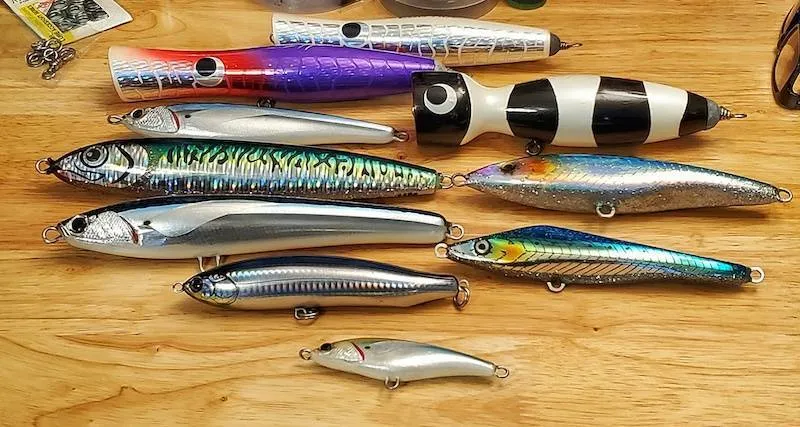
Yellowfin tuna lures fall into four categories, and carrying all four lets you match the lure to what the fish are doing in the water column rather than forcing one presentation on every situation. Topwater poppers produce explosive strikes when tuna are feeding on the surface. Sinking stickbaits reach fish holding just below the surface or refusing the popper, and they slip under the birds that snatch surface lures before the tuna can commit. Speed jigs and slow-pitch jigs handle deep and vertical presentations. Trolling lures cover water and locate schools.
How do you catch yellowfin tuna on topwater and casting lures?
There is nothing in offshore fishing quite like a big yellowfin erupting on a surface popper, and casting to breaking fish is a discipline of its own. Most serious anglers throw eight to nine foot spinning rods rated for 40 to 100 gram lures, paired with 10,000 to 20,000 class reels carrying PE 4 to PE 6 braid, which works out to roughly 40 to 60 pound class line for anglers not used to the Japanese rating, finished with a four to six foot 60 to 100 pound shock leader. Work poppers with sharp rod pops and a deliberate pause, because the pause is often when the strike lands, and cast to the edge of the boil rather than into the middle so you do not spook the school. Casting heavy poppers in a crowded cockpit around hooked fish is a real hazard, so wear eye protection and call your casts.
What tackle and hooks do you need for yellowfin tuna?
Yellowfin tackle has to balance finesse against stopping power. The finesse gets bites from spooky fish. The power turns them before they sound or spool you. Conventional setups like the Shimano Tiagra, Penn International, and Accurate BX series handle trolling and heavy chunking, while spinning reels such as the Shimano Saragosa, Penn Slammer, and Daiwa Saltiga cover casting and live bait work. Braided main line with a fluorocarbon leader is the near-universal setup, scaled to the size of fish and the clarity of the water.
How do you catch yellowfin tuna on light tackle?
Targeting yellowfin on light tackle is a skill built on balance rather than muscle. A light leader on heavy main line makes no sense, and neither does a heavy rod with an undersized reel. The whole outfit has to work as a system, with drag, rod, and line matched so the tackle does the work instead of the angler. Light tackle shines on smaller, aggressive schools and on days when heavier leader gets refused, and it rewards you with a fight heavier gear cannot match when the fish are finicky.
How do you fight and boat a yellowfin tuna?
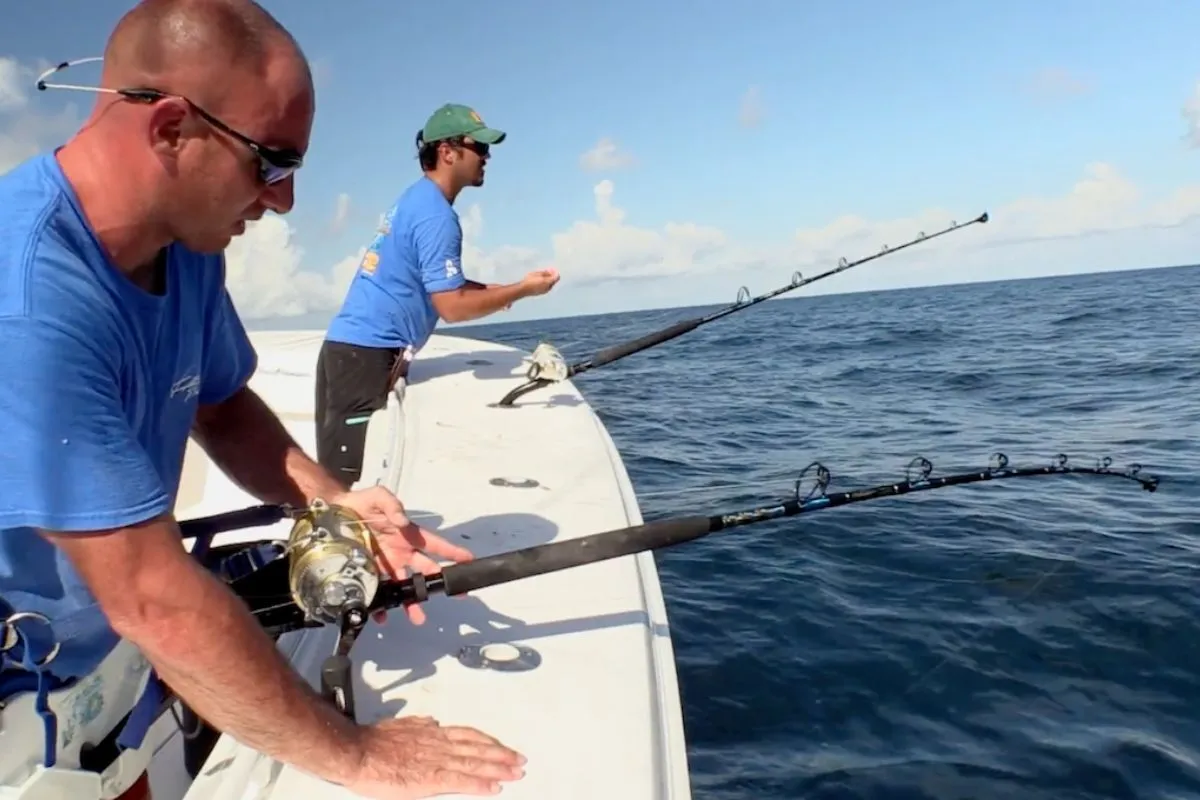
Landing a yellowfin is a fight of attrition against a fish designed to outlast you. Set your drag before the fight, not during it, because a fresh fish makes a blistering first run and a drag too heavy pops off while one too light lets the fish sound and dig. Once a big yellowfin gets its head down and starts the death spiral beneath the boat, fight it with short pumps and steady pressure, using the boat to change the angle rather than trying to muscle a fish stronger than you are.
How do you stay safe fishing offshore?
Chasing yellowfin means long runs into open water, and the fish are never worth cutting corners on safety. Check the weather window hard before you leave and give yourself a real margin, because offshore conditions build faster than the forecast suggests. Carry properly rated life jackets for everyone aboard, a registered EPIRB or personal locator beacon, a working VHF radio, flares, and a stocked first aid kit, and make sure someone ashore knows your float plan and expected return.
How do you care for a yellowfin from gaff to galley?
A yellowfin is premium table fare, but only if you handle it right, and the quality is decided in the first minutes after the gaff. The moment the fish is aboard, bleed it by cutting the arteries behind the pectoral fins and let it drain. From there it is about speed and cold. Get the fish into an ice and saltwater slurry as fast as you can, which chills a dense tuna far faster than dry ice alone, because heat and time are what turn sashimi-grade tuna into ordinary fish. Gut and gill it once it has bled and cooled, keep it packed in ice for the run in, and process it as soon as you reasonably can. Cut corners on the bleed or the chill and you will taste the difference no matter how it is cooked.
How are yellowfin tuna managed, and are they endangered?
Yellowfin tuna are a managed species, and the rules on size, bag limits, and permits change and vary by region and fishery. Do not treat anything you read here or anywhere else as current law. Before you fish, verify the regulations that apply to your waters directly with the managing authority. In United States federal waters that means NOAA Fisheries, and in state waters it means the relevant state fish and wildlife agency, such as the Florida Fish and Wildlife Conservation Commission or the Louisiana Department of Wildlife and Fisheries. Highly migratory species permits are required for many tuna fisheries, so confirm what you need before you leave the dock.
What gear do you need for yellowfin tuna? A checklist
Use this as a quick pre-trip check against the fishery and techniques you are running:
- Rods and reels: conventional two-speed setups for trolling and heavy chunking, plus 10,000 to 20,000 class spinners for casting and live bait
- Line and leader: braided main line with fluorocarbon leader scaled to fish size and water clarity, plus heavier shock leader for casting
- Hooks: non-offset circle hooks in a range of sizes matched to your baits, from 2/0 through 10/0 for big-bait fisheries
- Lures: poppers, sinking stickbaits, metal jigs, and trolling lures to cover the water column
- Terminal tackle: quality swivels, crimps, split rings, and assist hooks, checked and upgraded on retail lures
- Bait and chum: live baits where available plus fresh chunk bait, kept cold and lively
- Safety and fish care: life jackets, EPIRB or PLB, VHF, first aid, gaff, de-hooking tool, and an ice slurry ready to go
Yellowfin Tuna Fishing Video Courses
Frequently asked questions about yellowfin tuna fishing
What is the best bait for yellowfin tuna?
The best bait is the one that matches what the fish are eating that day. Live goggle eyes, blue runners, and speedos are premium when tuna are selective, while fresh chunks of bonito, mackerel, herring, and squid excel for chunking and building a slick. Freshness and matching the local forage matter more than any single bait.
What water temperature do yellowfin tuna prefer?
Yellowfin hold most consistently between 68 and 86 degrees Fahrenheit, with 72 to 78 often most productive. They tolerate cooler water chasing bait, but sustained action happens in that warmer window, which is why temperature breaks are reliable places to find them.
What is the difference between chunking and chumming?
Chumming is the broader practice of drawing fish with a scent trail, often using ground or mashed bait and oils. Chunking uses solid pieces of cut or live bait tossed steadily to create a feeding lane. Chunking tends to hold larger fish and generate the competitive feeding that triggers strikes.
When is the best time of day to catch yellowfin tuna?
The first and last hours of daylight are usually most productive, when low light favors the tuna and surface feeding peaks. Deep jigging and structure fishing produce through midday, and around structure and trawlers the bite can happen anytime the food is moving.
How big do yellowfin tuna get?
Most recreationally caught yellowfin run 20 to 100 pounds. Fish over 200 pounds are landed in the northern Gulf and around Pacific seamounts, and the all-tackle world record stands at 443 pounds. Trophy-class in most fisheries starts around 100 pounds.
Are yellowfin tuna endangered?
No. The IUCN currently lists yellowfin as Least Concern at the global species level, an improvement over its earlier Near Threatened status. Some regional stocks, notably in the Indian Ocean, remain overfished and under rebuilding plans, so responsible harvest and current regulations still matter.
How do you keep a yellowfin tuna fresh?
Bleed the fish immediately behind the pectoral fins, then chill it fast in an ice and saltwater slurry. Gut and gill it once it has bled and cooled, keep it iced for the run in, and process it as soon as you can. Speed and cold are what preserve sashimi-grade quality.
Putting it all together on the water
Catching yellowfin tuna offshore is not a single trick. It is a stack of small correct decisions made in the right order. You find the food by reading birds, mammals, structure, and water. You figure out what the fish are eating and where in the column they are holding. Then you pick the technique and presentation that fit that moment, chunking when they are up in the slick, jigging when they are down, casting when they are busting, live baiting when they are picky, and you adjust the second the fish tell you something changed. The gear has to be right, the hooks have to be quality, and the drag has to be set before the run, because these fish do not give second chances.
Login
to leave a review.
User Reviews
There are no reviews yet.
Complete Dredge Pulley Setup Guide
Saltwater
12.28.2020
High Speed Wahoo Trolling Rig
Saltwater
09.08.2018
Fishing Light Tackle for Yellowfin Tuna
Saltwater
09.08.2018
0