
Ballyhoo is the most trusted baitfish in offshore fishing for good reason. It looks right in the water, triggers predators by instinct, and works across nearly every Atlantic species worth targeting. This article covers the biology behind why ballyhoo performs so well, how to source it fresh, and how to rig it five different ways.
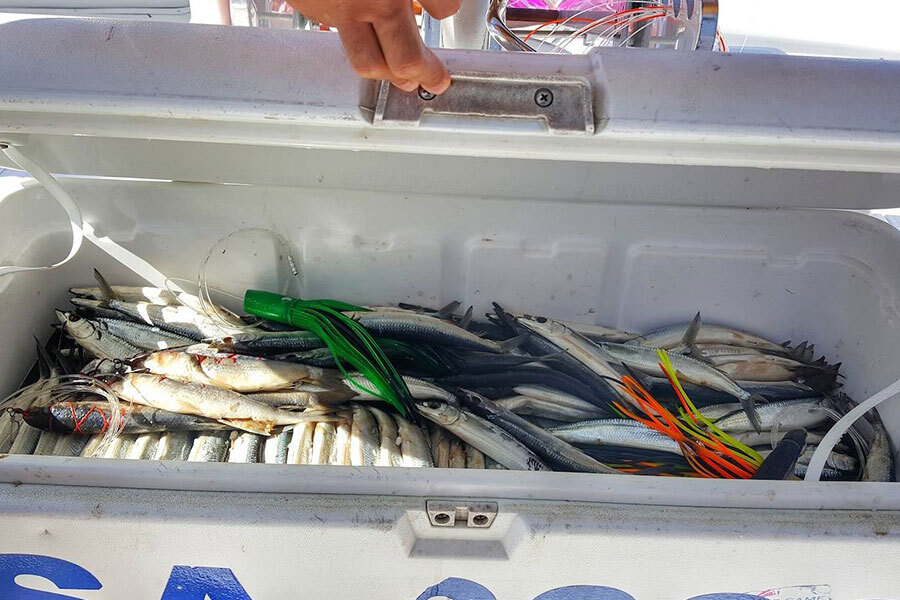
Ballyhoo Fish: Bait Rigging for Offshore Fishing
What Is a Ballyhoo Fish?
If you fish offshore in the Atlantic, you already know the ballyhoo; it is the bait. Captains stock it by the flat, mates rig it before sunrise, and the fish that matter, including blue marlin, sailfish, wahoo, yellowfin tuna, and dolphinfish, eat it with conviction. There is a reason it has been the standard offshore baitfish for generations.
Ballyhoo (Hemiramphus brasiliensis), also known as the ballyhoo halfbeak, belongs to the halfbeak family, a group named for their most recognizable feature: a lower jaw that extends far beyond the upper, forming a slender, pointed beak. They school near the surface in warm Atlantic waters, where they are preyed upon by virtually everything larger than they are. That vulnerability is exactly what makes them so effective in the spread.
Understanding what ballyhoo are, where they live, and how they feed will make you a better angler. When you know the fish, you rig the bait better, and when you rig better, you catch more.
The full operational pillar on ballyhoo as offshore bait extends this with selection, brining protocol, the eight working rig families, spread placement, and species specific trolling speeds.
What Do Ballyhoo Look Like?
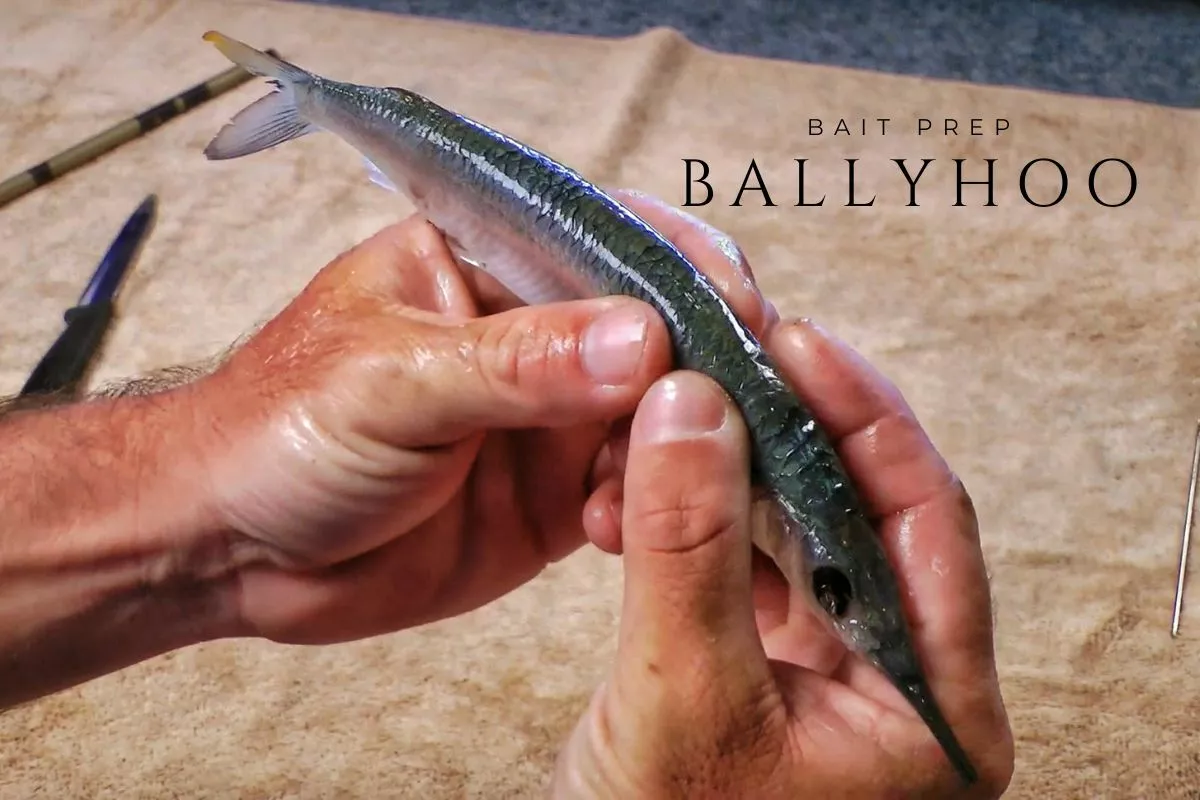
Ballyhoo are easy to identify once you have seen them. The elongated lower jaw is unmistakable, but there is a lot more to the fish that matters when you are selecting bait and deciding how to rig it.
- Body color: Silver along the flanks with a blue-green tint across the dorsal side. This reflective coloration is part of why they work so well as bait; they flash and shimmer in the water the same way a distressed baitfish would.
- Size: Most ballyhoo you will see as bait run about 10 to 16 inches in length, typically weighing between 1 and 2 pounds. You will find larger specimens, but this range covers the majority of what you will see in the bait shop and at market.
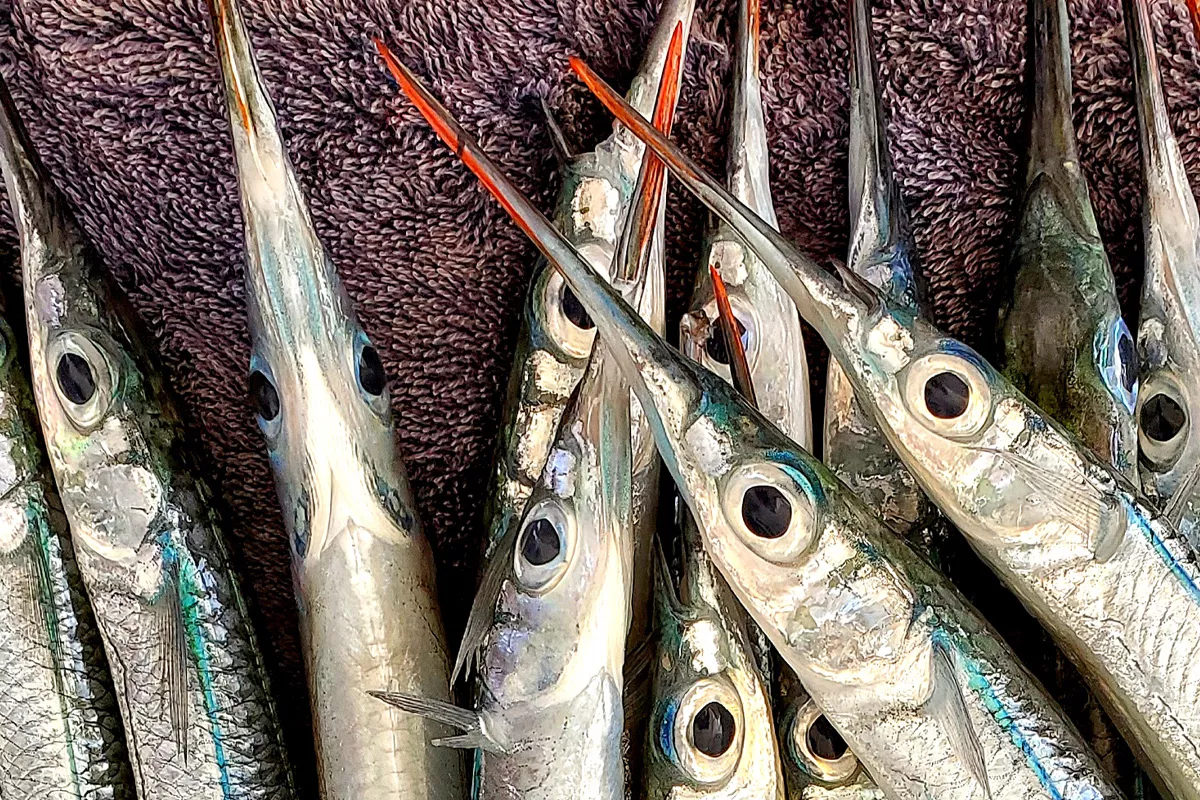
- Beak: The lower jaw extends into a long, slender beak that tapers to a fine point. This is the structural feature that defines the rigging process. How you treat that beak when rigging determines whether your bait runs true or spins out.
- Tail: The caudal fin is deeply forked and muscular, built for bursts of speed. When you are trolling a ballyhoo and you see that tail working naturally, you know the rig is dialed in.
- Speed: These fish are agile and fast, built to evade predators. That speed and body shape translate directly into the swimming action that makes a well-rigged ballyhoo irresistible to game fish.
Where Do Ballyhoo Live?
Ballyhoo are a warm-water, mostly near-surface pelagic species. They ride the surface of the open ocean, staying in the upper water column where sunlight penetrates and baitfish thrive. You will not find them on the bottom or in cold inshore water. They need warmth, and they follow it.
In the Western Atlantic, ballyhoo range from the coast of New England (including Massachusetts) south through the Gulf of Mexico, the Bahamas, the Caribbean, and all the way down to Brazil. Their distribution tracks closely with the Gulf Stream, which is why the densest concentrations show up in the Southeast United States, Florida, and throughout tropical Atlantic waters.
What Do Ballyhoo Eat?
Ballyhoo are primarily planktivores and small crustacean and seagrass feeders. Their diet consists mainly of seagrasses, copepods, amphipods, small shrimp, and other zooplankton near the surface. Occasionally they will feed on small fish and other marine material when available.
This diet puts them right at the base of the offshore food web. They are converting small plankton and crustaceans into protein that fuels marlin, sails, tuna, and wahoo. Understanding that position in the food chain helps you think about why ballyhoo concentrate where they do, and why the predators follow them.
When and Where Do You Catch Ballyhoo for Bait?
When Is the Best Time to Catch Ballyhoo?
In subtropical and tropical zones like South Florida, the Bahamas, and the Caribbean, ballyhoo are available year-round. In temperate regions farther north, their presence increases during late spring, summer, and early fall as warming Gulf Stream water pushes them inshore.
Where Do You Find Ballyhoo for Live Bait?
Ballyhoo school near the surface and respond well to chum. The most reliable spots for finding them include:
- Near reef structures, wrecks, and any bottom topography that concentrates baitfish
- Along weed lines and current edges in open water
- Around channel markers, buoys, and floating debris offshore
- In the proximity of other baitfish activity
How Do You Catch Ballyhoo for Offshore Fishing?
There are five proven methods for catching ballyhoo for live or fresh-dead bait:
- Cast netting is the most efficient method. When ballyhoo are schooling near the surface, a well-thrown cast net can bring in dozens at once. Work areas near structure or into a chum slick for best results.
- Sabiki rigs work well when ballyhoo are present but spread out. The small hooks, dressed with beads or fish skin, draw strikes when retrieved with a slow, steady motion.
- Chumming concentrates ballyhoo at the surface and within reach of your nets or rigs. Ground fish, commercial chum blocks, or even bread can pull them up.
- Ballyhoo-specific small hook rigs baited with bits of shrimp or squid will produce when you are trying to pick up fish in smaller numbers.
- Dip netting works when they are visible at the surface and within reach. It requires quick hands and the right positioning but is highly effective in calm conditions.
Most offshore captains keep a flat or two of frozen ballyhoo as insurance, then supplement with fresh-caught bait whenever possible. Fresh ballyhoo rig better, run better, and often outperform frozen bait in both action and durability.
Why Is Ballyhoo the Best Offshore Baitfish?
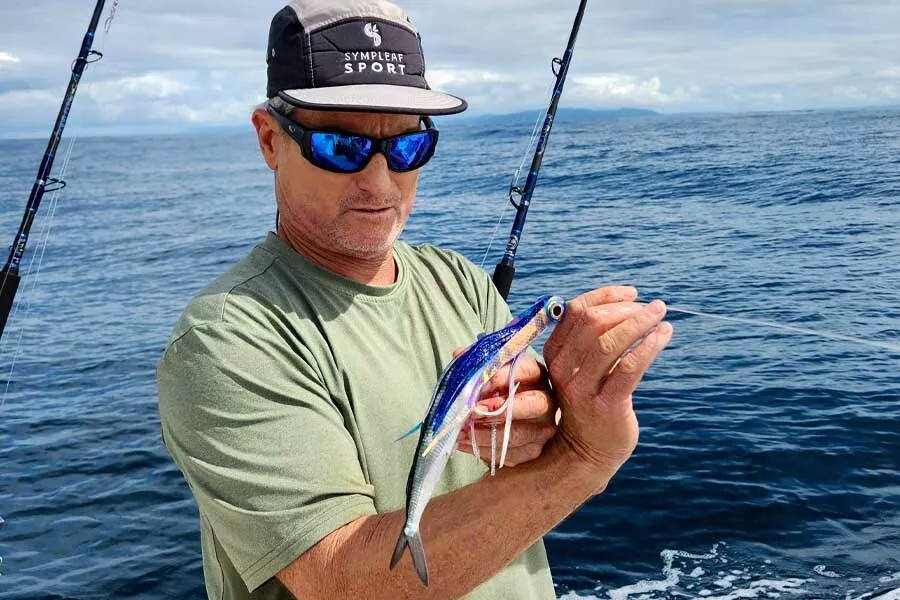
Ask any experienced offshore captain what their go-to bait is for trolling blue water in the Atlantic, and ballyhoo comes up every time. This is not tradition for tradition's sake. There are concrete reasons why ballyhoo bait has remained the standard for offshore trolling across generations of sport fishing.
- Natural appearance in the water: The slender body, silver flash, and natural movement of a properly rigged ballyhoo looks exactly like a fleeing baitfish. Game fish do not hesitate.
- Trigger response from predators: A well-rigged ballyhoo produces the side-to-side wobble that mimics an injured fish. That swimming action fires the predatory instinct in billfish, tuna, and wahoo in a way that few baits can match.
- Versatility across techniques: Ballyhoo can be rigged for flat-line trolling, as a teaser behind a dredge, on a bridge teaser, dead-bait slow trolled, or fished live near structure. No other single baitfish works effectively across that range of applications.
- Compatibility with skirts and chuggers: Skirted ballyhoo rigs are one of the most effective billfish presentations in existence. The skirt protects the bait, adds flash and color, and extends the trolling life of the bait significantly.
- Scent trail: As a natural prey species for nearly every offshore predator in the Atlantic, ballyhoo release a scent profile that game fish recognize and respond to. That chemical signature in the water is something a rubber skirt alone cannot produce.
- Broad target species range: From blue marlin and sailfish to yellowfin tuna, wahoo, dolphin, and kingfish, ballyhoo is effective across the full spectrum of offshore game fish. It is the one bait you can put confidence behind regardless of what you are targeting that day.
How Do You Rig a Ballyhoo for Offshore Fishing?
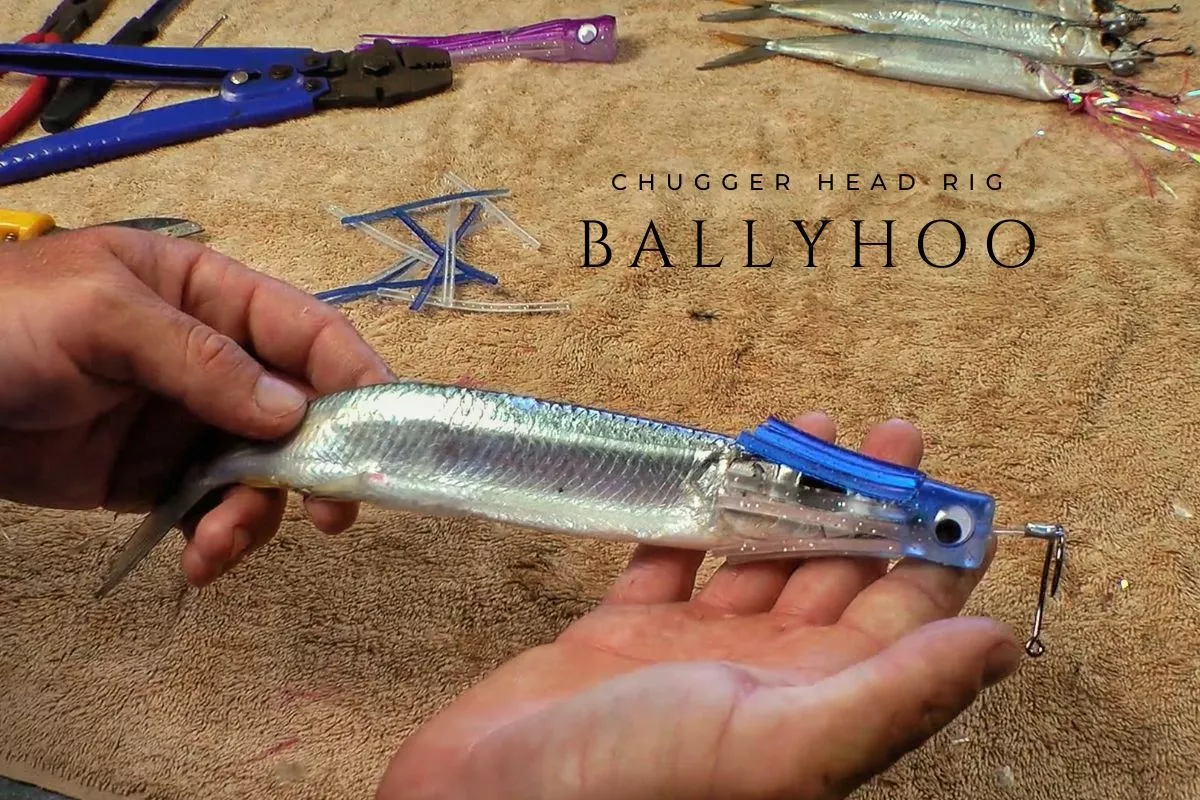
Rigging ballyhoo is one of those skills that looks simple until you watch someone who is really good at it. A poorly rigged ballyhoo spins, rolls, and kills your spread. A perfectly rigged one swims with authority and catches fish. The difference is technique, and technique is learnable.
For a complete visual breakdown of rigging ballyhoo multiple ways, watch Ballyhoo Bait Rigging 8 Ways for Offshore Fishing and Ballyhoo Rigging: Australian Garfish Methods. These courses show you exactly how each rig is assembled from start to finish by captains who do this professionally.
1. What Is a Pin Rig and When Should You Use It?
The pin rig is the most common ballyhoo setup for trolling and the one most captains learn first. It uses a long-shank hook, a bait spring, and a rigging pin. The mouth is sealed by threading the pin through the lower jaw and connecting it to the spring. The hook sits beneath the chin with the point exiting near the pectoral fins.
2. What Is a J-Hook Rig for Ballyhoo?
The J-hook rig threads a single J-shaped hook through the mouth and lower jaw, with the point exiting near the gill plate. The bait is secured to the hook shank using copper rigging wire or rigging floss, which keeps the bait streamlined and prevents it from spinning or pulling off at speed.
3. What Is a Circle Hook Rig for Ballyhoo Trolling?
The circle hook ballyhoo rig follows the same basic assembly as the J-hook but uses a circle hook in place of the J. The positioning is the same: through the mouth, exiting near the gill plate, secured with copper wire or floss.
4. What Is a Split-Bill Rig and Why Use It?
The split-bill rig is designed for slower trolling speeds and produces exceptional swimming action. The hook is inserted through the lower jaw and exits near the gill plate, as with the J-hook setup. The upper and lower jaws are then wired together, and the pectoral fins are splayed outward to increase drag and create a more pronounced swimming wobble.
5. How Do You Rig a Skirted Ballyhoo?
The skirted ballyhoo rig adds a plastic or rubber skirt over the head of the bait before the hook is secured. The rigging process underneath the skirt is typically the same as a pin rig or J-hook rig. The skirt does three things: it protects the head of the bait from damage during trolling, it adds flash and color to attract attention from greater distances, and it gives the rig a lure-like profile that triggers reaction strikes.
Skirted ballyhoo rigs are among the most effective billfish presentations ever developed. Pairing the right skirt color to water color, sea state, and target species is its own field of knowledge. Blue and white for clear bluewater, black and purple for dark or cloudy water, and bright fluorescent colors on flat, sunny days are common starting points. Green and yellow combinations often excel in mixed-light conditions and around weed lines.
FAQ: Ballyhoo Fishing and Bait Rigging
What species of fish will eat ballyhoo bait?
Blue marlin, sailfish, white marlin, spearfish, wahoo, yellowfin tuna, blackfin tuna, dolphinfish (mahi-mahi), kingfish, cobia, and even swordfish will all eat ballyhoo. It is one of the few baits that draws strikes across the full range of offshore species.
Should I use fresh or frozen ballyhoo for offshore fishing?
Fresh ballyhoo rigs better and generally performs better in the water. The skin holds up longer during trolling, the natural scent trail is stronger, and the body is more pliable for rigging. Frozen ballyhoo is a reliable backup and performs well when rigged properly, but if you can source fresh bait, use it.
How do you keep ballyhoo from spinning when trolling?
Spinning is almost always a rigging problem. The most common causes are a bent bill, a hook that is not seated flush against the body, or a bait that was not properly prepped before rigging. Straighten the bill before rigging, break the backbone with a firm but controlled bend, and make sure the hook lies flat and true along the belly. If the bait is still spinning after those corrections, the issue is usually in the mouth closure.
What size hook should I use for rigging ballyhoo?
For standard trolling ballyhoo (roughly 10 to 16 inches), a 7/0 to 9/0 hook covers most situations, with 6/0 workable on smaller baits and 10/0 on jumbo baits. Circle hook sizing follows similar logic. The specific rod and target species also influence hook selection, so match the hook to the full rig, not just the bait.
Can you catch ballyhoo with a Sabiki rig?
Yes. Sabiki rigs with small hooks, size 6 to 8, work well for catching ballyhoo when they are present but not schooling in dense enough concentrations for a cast net. Work the rig near the surface with a slow, steady retrieve.
What is the difference between ballyhoo and balao?
These names are often used interchangeably, but they technically refer to different species. Balao (Hemiramphus balao) tends to run slightly smaller than ballyhoo (Hemiramphus brasiliensis) and often has a different tail coloration, but in practice both are rigged and fished the same way, and commercial bait suppliers often sell them together.
How do you rig ballyhoo for slow trolling versus high-speed trolling?
For slow trolling (2 to 5 knots), the split-bill rig with splayed pectorals produces maximum swimming action. For higher trolling speeds, a tight J-hook or pin rig with a skirt holds together better at speed and reduces bait damage. The skirted rig also performs well at higher speeds because the skirt protects the head from water pressure.
Ready to learn every rigging variation from captains who fish for a living? Visit the Ballyhoo Bait Rigging section to watch the full course library.
Seth Horne Founder and CEO
Login
to leave a review.
User Reviews

Robert
12.12.2023
1

Benjamin
12.12.2023
1

Setting Up a Dredge Pulley for Billfish
Saltwater
12.28.2020
High Speed Wahoo Trolling Rig
Saltwater
09.08.2018
Fishing Light Tackle for Yellowfin Tuna
Saltwater
09.08.2018

0