
Sheepshead rank among the trickiest inshore fish to hook, thanks to their delicate bite and habit of holding tight to barnacle-covered structure. From choosing the right fiddler crab presentation to reading subtle line movement, success comes down to technique. This breakdown covers baits, rigs, seasonal timing, and the best locations from Texas to the Carolinas.
How to Catch Sheepshead: Baits, Rigs, and Proven Tactics
How to Catch Sheepshead: Baits, Rigs, and Tactics That Actually Work
Sheepshead are one of the most frustrating and rewarding fish you can target in saltwater. They steal bait like pickpockets, fight hard once hooked, and taste incredible on the plate. If you have spent any time fishing around docks, jetties, or bridge pilings along the Gulf Coast or Southeast Atlantic, you have probably watched one strip your hook clean without feeling a thing.
What Is a Sheepshead?
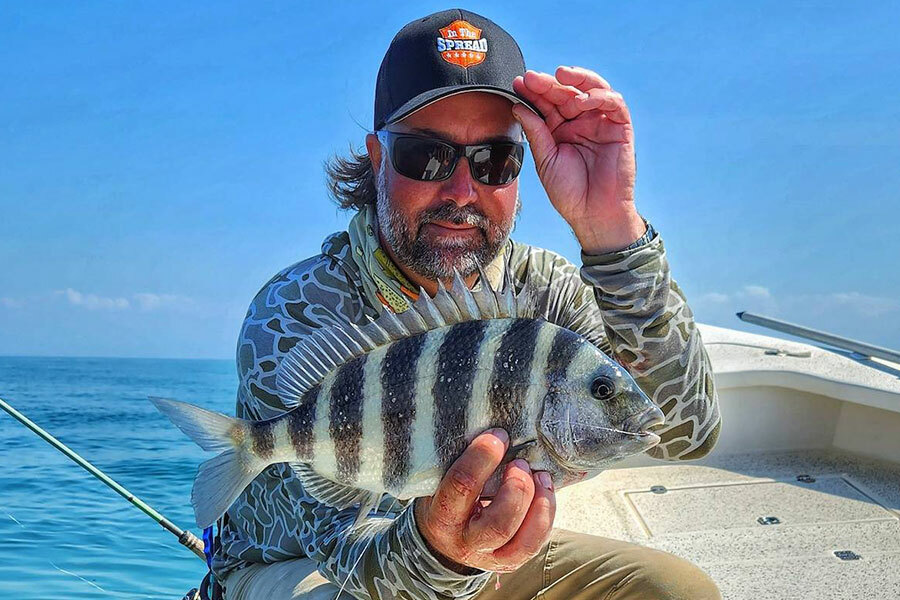
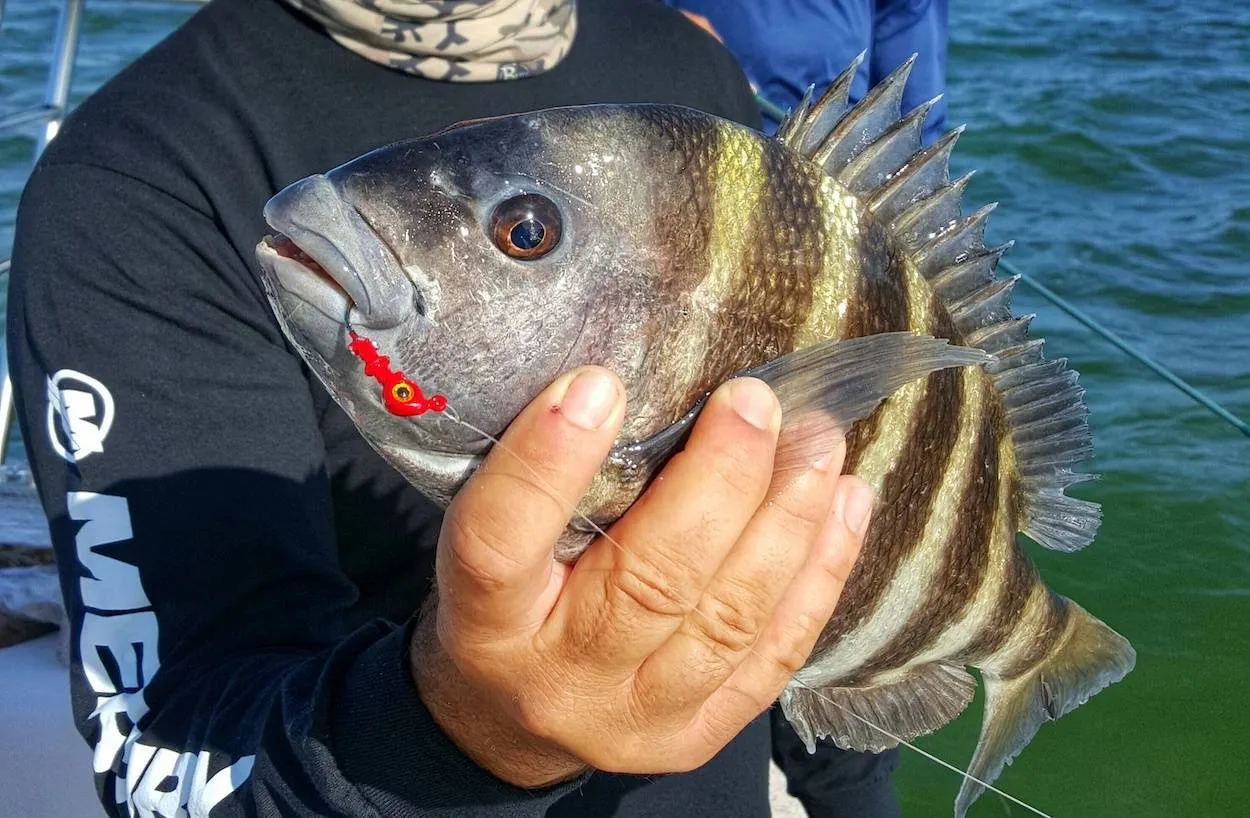
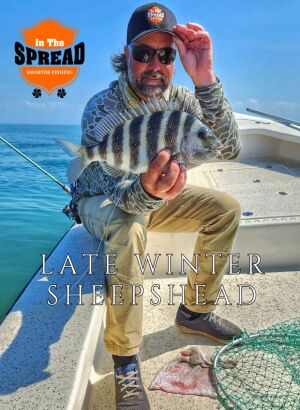
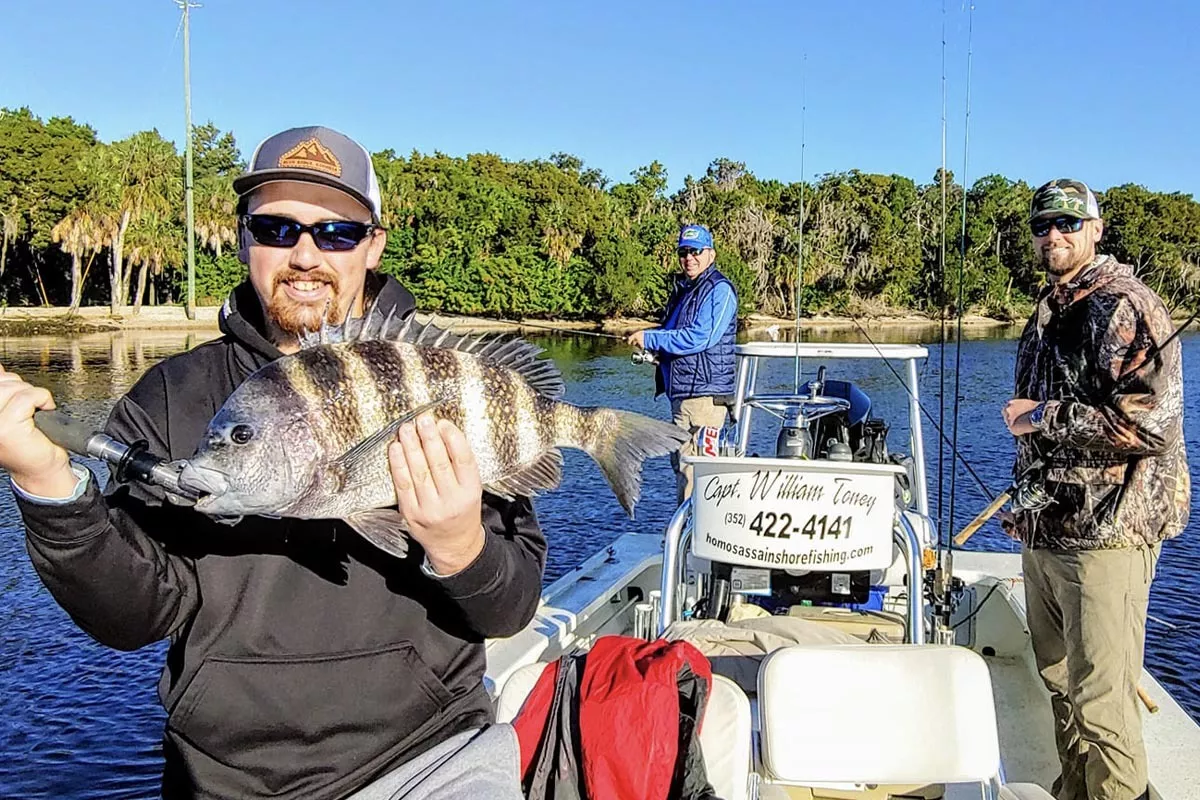
The sheepshead (Archosargus probatocephalus) is a member of the porgy family found in coastal waters from Nova Scotia down through Florida, the Gulf of Mexico, and into parts of the Caribbean. They are most commonly targeted around inshore structure in the Southeast and Gulf states. They get their name from oversized front teeth that resemble a sheep's mouth, which they use to crush crabs, oysters, barnacles, and shrimp off hard structure.
You can identify a sheepshead by the dark vertical bars running along a deep, laterally compressed silver body, usually five or six, occasionally up to seven. They have sharp dorsal spines that demand careful handling and a strong, underslung jaw built for prying shellfish from rocks and pilings. Most fish you will encounter run between 2 and 5 pounds, though trophy sheepshead over 10 pounds are caught each year during winter spawning runs, with a maximum recorded size just over 20 pounds.
Where Do Sheepshead Live?
Sheepshead are structure-dependent fish that rarely stray far from hard surfaces covered in the organisms they feed on. The most productive habitats share a few common traits: hard structure, current flow, and a food source attached to that structure. Focus your efforts on these areas:
- Dock pilings and bridge supports covered in barnacles and oysters, especially in tidal creeks and harbors
- Rock jetties and seawalls where current pushes food past stationary fish waiting to feed
- Nearshore reefs and rocky outcroppings, particularly transitional zones where rock meets sand
- Wrecks and artificial reefs that concentrate marine life and create feeding opportunities
- Inlets and passes where strong tidal flow funnels baitfish and crustaceans through narrow corridors
When Is the Best Time to Catch Sheepshead?
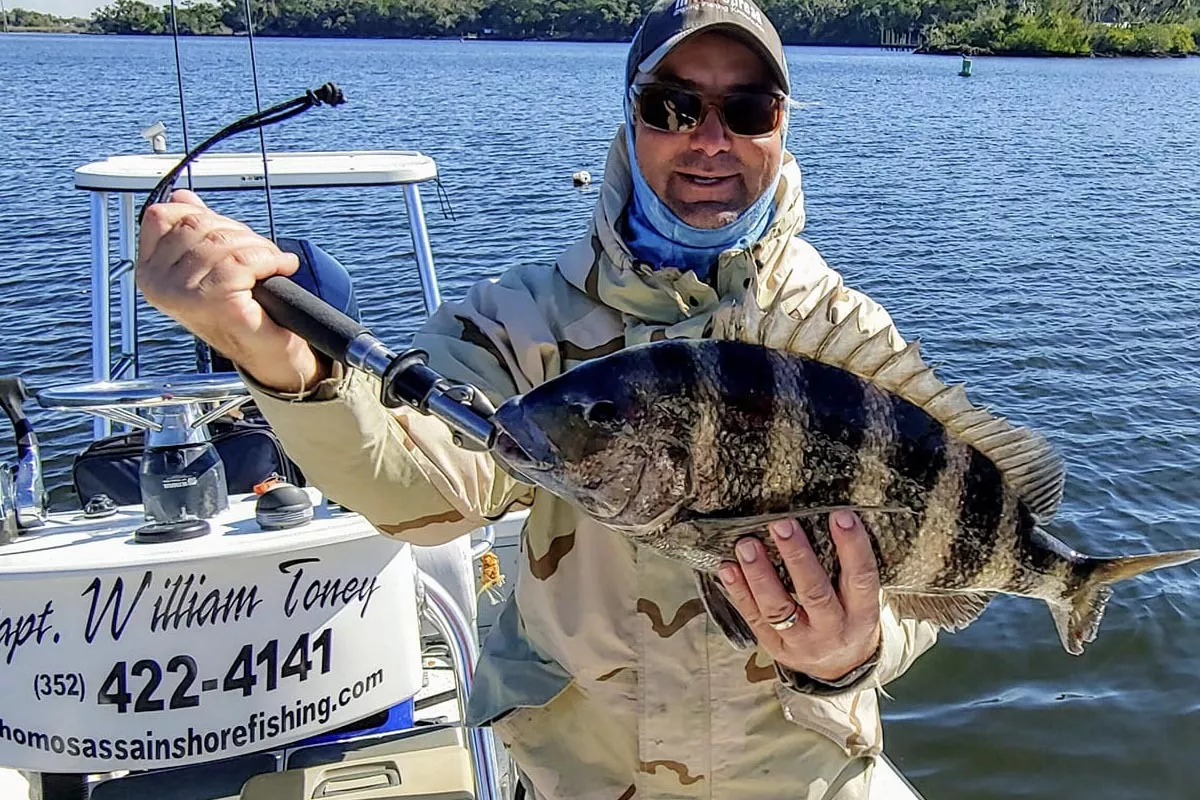
The best time to catch sheepshead is during incoming or outgoing tidal flow in daylight hours, particularly from late fall through early spring when fish gather around nearshore structure to spawn. Cooler months with water temperatures in the upper 50s to upper 60s often produce the most concentrated and aggressive feeding activity.
Sheepshead are primarily daytime feeders that rely on sight to pick crabs and shellfish off structure. Night fishing for them is seldom as productive as daytime trips. Instead, plan your trips around these conditions:
Morning and late afternoon sessions during moving tides consistently produce the best action. Sheepshead feed most aggressively when current is pushing food past their holding spots, so timing your trip around peak tidal flow makes a real difference. Overcast days and the period just before a cold front can also trigger increased feeding, as the fish sense the approaching pressure change and feed opportunistically.
Sheepshead Fishing Courses
What Is the Best Bait for Sheepshead?
Fiddler crabs are widely considered the most effective bait for sheepshead, followed closely by sand fleas and live shrimp. These three natural baits match the crustaceans sheepshead feed on daily, which is exactly why they outperform everything else.
Fiddler crabs are the top choice for a reason. They are tough enough to stay on the hook through multiple nibbles, and sheepshead rarely hesitate to eat them. Hook a fiddler through the back of the shell from bottom to top, keeping the hook point exposed. If fiddlers are not available locally, sand fleas are an excellent alternative. Pinch the shell slightly to release scent, then thread them onto your hook or jighead so they sit naturally.
Live shrimp work well, especially smaller specimens in the 2 to 3 inch range. Hook them through the tail for natural presentation and the longest life on the hook. Fresh dead shrimp can produce, though live bait almost always outperforms dead.
What Rigs Work Best for Sheepshead?
Two rigs account for the vast majority of sheepshead caught: the sheepshead jig and the bottom rig with a small circle hook. Both are designed to maximize sensitivity so you can feel those notoriously subtle bites.
The Sheepshead Jig Rig
Jig fishing is the most popular approach because it gives you direct contact with your bait and immediate feedback when a fish mouths it. Use a 1/4 to 1 ounce lead jighead with an ultra-sharp hook, spooled with 15 to 20 lb braided line for maximum sensitivity. In areas with very strong current or deeper nearshore structure, you may need to step up beyond 1 ounce to maintain bottom contact. Pair this with a 7-foot medium action rod and a 2500 to 3000 series spinning reel.
The Bottom Rig for Sheepshead
When fish are holding tight to bottom structure and will not chase a moving jig, a simple bottom rig shines. Tie a #1 octopus circle hook to 10 to 15 lb fluorocarbon leader, add just enough split shot or a small egg sinker to keep your bait on the bottom, and fish it on a 7 to 8 foot medium action rod.
The circle hook is critical here. It allows the fish to turn before the hook finds the corner of the jaw on its own. Resist the urge to set hard. Instead, reel tight and apply steady pressure. This reduces gut-hooked fish and increases your landing percentage.
How Do You Detect a Sheepshead Bite?
Detecting a sheepshead bite is the single biggest challenge in targeting this species. They delicately pick at bait with their front teeth before committing, so most bites feel like nothing more than a subtle tap or a slight increase in weight on your line.
Varying your bait depth also helps. Sheepshead do not always feed on the bottom. Depending on tide stage and time of day, they may be at mid-column along pilings or picking barnacles just below the surface. Work different depths until you find the active zone.
Where Are the Best Sheepshead Fishing Spots?
The best sheepshead fishing locations stretch from Texas to the Carolinas, with the highest concentrations around Florida, Gulf Coast barrier islands, and major harbor systems.
- Mosquito Lagoon, Florida offers miles of shallow oyster bars and mangrove shorelines near Oak Hill that hold sheepshead year-round
- Tampa Bay, Florida is a massive estuary loaded with bridges, docks, and artificial reefs that provide endless sheepshead structure
- Matanzas Inlet, Florida near St. Augustine funnels strong tidal current past rock jetties and bridge pilings, concentrating fish
- Charleston Harbor, South Carolina features historic jetties, submerged wrecks, and extensive dock systems
- Mobile Bay, Alabama is dotted with piers, pilings, and nearshore structure throughout the bay
- Chandeleur Islands, Louisiana is a remote barrier island chain with pristine habitat and trophy-class sheepshead
- Aransas Pass, Texas has rock jetties that intercept sheepshead migrating along the Gulf Coast
What Tackle Do You Need for Sheepshead?
The right sheepshead fishing tackle balances sensitivity with enough backbone to pull fish away from structure before they cut you off. A few key items make a significant difference.
A 7 to 8 foot medium action spinning rod with a fast tip is the foundation. The fast tip reveals subtle bites, while the medium backbone gives you leverage against fish pulling for the nearest piling. Pair it with a 3000 to 4000 series spinning reel with smooth drag and enough line capacity for occasional long runs.
Spool with 15 to 20 lb braided line as your main line, then tie a 2 to 3 foot section of 15 to 20 lb fluorocarbon leader. The braid provides bite detection, and the fluorocarbon provides abrasion resistance near structure plus reduced visibility in clear water. When fishing heavier structure like jetties, reef edges, or barnacle-covered bridge pilings where cutoffs are common, stepping up to 25 or even 30 lb fluorocarbon leader is worth the trade-off in stealth. Round out your tackle bag with an assortment of jigheads from 1/4 to 1 ounce, #1 and 1/0 circle hooks, split shot, small egg sinkers, and a sturdy landing net with a long handle for controlling fish around pilings and rocks.
Sheepshead Fishing FAQ
What size hook is best for sheepshead?
A #1 to 1/0 hook works best for most sheepshead fishing situations. Use a fine-wire octopus circle hook for bottom rigs and an ultra-sharp jig hook in the 1/4 to 1 ounce range for vertical jigging. Smaller hooks are more effective than larger ones because sheepshead have relatively small mouths for their body size.
Can you catch sheepshead at night?
Sheepshead are primarily daytime feeders that rely on sight to locate and pick food off structure. Night fishing for sheepshead is seldom as productive as daytime trips. Focus your efforts during daylight hours, especially during moving tides in the morning and late afternoon.
What is the bag limit for sheepshead?
Bag limits and size regulations vary by state. In Florida, the minimum size is 12 inches total length with a daily bag limit of 8 fish per person and a 50-fish vessel limit during March and April. Check your state's current saltwater fishing regulations before heading out, as these rules are updated periodically.
Do sheepshead taste good?
Sheepshead are considered one of the best eating fish in inshore saltwater. Their diet of crabs, shrimp, and shellfish gives the meat a clean, sweet, mildly briny flavor with a firm, flaky texture. They are excellent baked, grilled, fried, or blackened. For preparation ideas, check out our saltwater culinary creations.
What is the best month to catch sheepshead?
December through March is generally the peak season for catching sheepshead, as fish gather around nearshore structure during their winter spawning run. However, sheepshead can be caught year-round in most of their range, with productive fishing extending from October through April in many areas.
How big do sheepshead get?
Most sheepshead caught by recreational anglers weigh between 2 and 5 pounds. Fish over 8 pounds are considered trophies, and the current IGFA all-tackle world record stands at 21 pounds 4 ounces, caught in Louisiana. Fish in the 6 to 10 pound range are realistic targets during peak season at productive locations.
Why do sheepshead steal bait so easily?
Sheepshead use their front incisors to delicately pick and nibble at food before committing. Unlike fish that inhale bait aggressively, they take small bites and test what they are eating. This feeding style, combined with their ability to crush hard-shelled prey without fully engulfing it, makes them legendary bait stealers. Sharp hooks and constant line contact are the best countermeasures.
Should you release large sheepshead?
Consider practicing selective harvest, especially at well-known spawning aggregations. Larger sheepshead are the most productive breeders, and releasing fish over 5 or 6 pounds helps sustain the population for future seasons. Keep a few fish for the table and let the big breeders do their job.
Captain William Toney has spent over three decades fishing Florida's Nature Coast, specializing in inshore species including sheepshead, redfish, snook, and seatrout. His sheepshead fishing instructional videos on In The Spread break down the techniques covered in this article with on-the-water demonstrations and real-time instruction.
Captain William Toney In The Spread, Instructor
Login
to leave a review.
User Reviews
There are no reviews yet.
Setting Up a Dredge Pulley for Billfish
Saltwater
12.28.2020
High Speed Wahoo Trolling Rig
Saltwater
09.08.2018
Fishing Light Tackle for Yellowfin Tuna
Saltwater
09.08.2018
0